





HENDRA GUNAWAN
Known as the ‘people’s painter’, artist and activist Hendra Gunawan painted colourful, expressive works that capture the cultural practices and lives of people in Indonesia.
Personal Life
Hendra Gunawan was born in Bandung, Indonesia. He began painting in the 1930s, pursuing it more seriously after meeting the prominent Indonesian painter Affandi in 1939.
Gunawan was highly involved with politics throughout his life. Prior to the Indonesian independence of 1945, he was a guerilla fighter against Dutch colonial rule and was imprisoned in 1965 for his activism against the ruling government. Gunawan continued to paint in prison, where his style developed to include more vibrant, clashing colours. Gunawan’s incarceration led to the stigmatisation of his work, but it has gained posthumous recognition in recent years. He died in Bali in 1983.
Hendra Gunawan Artworks
Gunawan’s works are known for their innovative fusion of traditional Indonesian styles and western modernist painting . Recurring subjects span animals, figures, landscapes, and abstraction, with the majority of his figurative works depicting ordinary people of Indonesia. In his mature paintings, Gunawan often worked with energetic colours and explored the simplification of form, resulting in images that combine two- and three-dimensional renderings.
Portraits and Figures
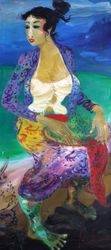
Gunawan’s figurative paintings embody a cultural moment in Indonesia’s evolving post-Independence identity. Farmers, dancers, families, and villagers are observed in ordinary settings, such as markets and beaches, and sometimes embedded within larger-scale works that evoke history paintings. Through striking compositions and contortion of forms, Gunawan’s works mythologise figures and observations with fantastical reverence.
Women often appear in groups in Gunawan’s paintings, engaged in domestic activities or in more ambiguous, provocative states. Kerokan (c. 1956) depicts a trio of women bathing and styling each others’ hair. Their bodies are rendered in wispy, smudged pastel tones, conveying sensuality and a dreamlike atmosphere.
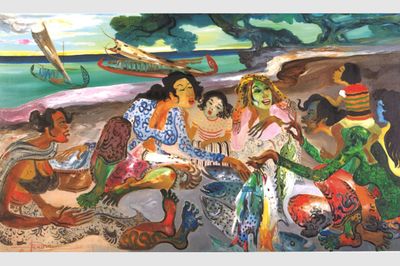
In Women and Children by the Beach, a group of four women and two children sit along the shoreline, their features exaggerated in Gunawan’s characteristic lanky limbs, defined eyebrows, pursed lips, and alluring gaze. Their bright batik attire and carefree demeanour illustrate a moment of vitality and exuberance.
Landscapes
Often rendered in lurid, unnaturalistic colours, Gunawan’s interpretations of Indonesia’s natural vistas give a fantastical edge to the landscape genre. The oil on canvas work Blessed Nature (1971) is painted with hints of fluorescent pink sands, pastel-tinged mountains, and an intense blue sea and sky. Gunawan’s fluid brushstrokes and blending of tones emphasise the sense of harmony.
In the large-scale oil painting Gembala Kerbau (1975), the artist offers a wide-angle view of a coastal village against a mountainous backdrop. Gunawan’s distinct approach to composition can be seen in the pictorial space, strategically filled with framing devices such as the curled trees on either side of the canvas, that leads the viewer to converge in the central body of water.
Collections
Hendra Gunawan’s works are held in international collections, including the Neka Art Museum in Bali and the Singapore Art Museum.
Exhibitions
Hendra Gunawan’s work has been exhibited in solo and group presentations.
Solo exhibitions include Prisoner of Hope, Ciputra Artpreneur, Jakarta (2018).
Group exhibitions include REVOLUSI!, Rijksmuseum, Amsterdam (2022); Mooi Indie to Indonesian Modern Art, ART:1 New Museum, Jakarta (2018); Indonesian Art in the Twentieth and Early Twenty-First Century, ART:1 New Museum, Jakarta (2015).
Misong Kim | Ocula | 2022

Representative Artworks
View story


Explore and Follow Artists Shaping Contemporary Art
A respected voice in contemporary art discourse.
Focusing on ambitious storytelling and insightful art-world commentary. Ocula Magazine publishes in-depth interviews, critical essays and timely analysis on the artists, exhibitions and ideas driving the global art world.
Learn more about Ocula Magazine
Showcasing the best of the art world.
Ocula partners with galleries from around the world to highlight their artists, artworks and exhibitions. Gallery membership is by application and invitation, with each member vetted by an independent panel.
Learn more about Ocula Membership
Specialises in the sale of major artworks.
Led by a team with deep ties to the world’s leading auction houses, galleries and collectors. Ocula’s advisory team offers bespoke services to high-net-worth clients from around the world who are looking to acquire the best of contemporary and modern art.
Learn more about our team and services