





HILMA AF KLINT
1862-1944, SwedenDefying expectations of what it meant to be a woman in art at the start of the 20th century, Swedish artist Hilma af Klint’s work pre-dated abstractionism. However, she kept her paintings hidden, assuming the world would not understand her spiritually influenced, theosophy inspired works.
Early Years
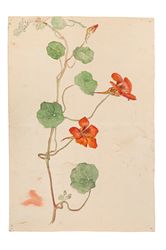
Hilma af Klint was born in 1862 in the Karlberg Palace near Stockholm that had been converted into a military academy (her father taught naval cadets). af Klint began to see visions and participated in her first séances when she was 17. She studied at the Technical School in Stockholm (where she first became friends with fellow art student Anna Cassel). Her sister Hermina died aged only 10 in 1880. Between 1882 and 1888, af Klint studied at the Royal Academy of Fine Arts in Stockholm, and her figurative paintings were shown at exhibitions across Europe. Her practice and approach to art changed dramatically in 1891, when she received messages from spiritual beings for the first time.
Hilma af Klint: Artworks
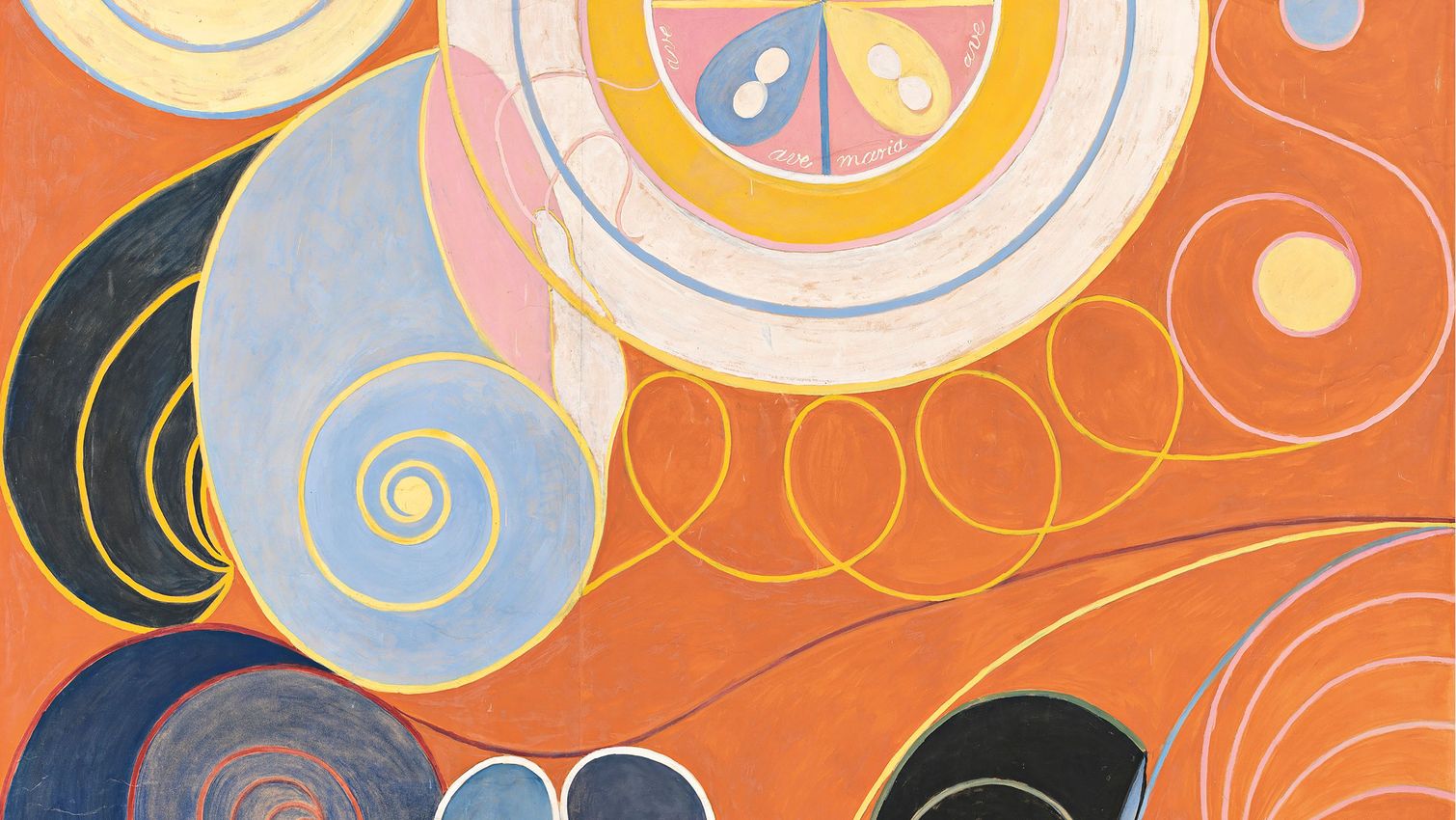
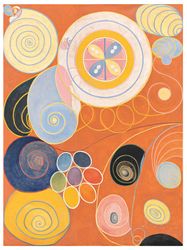
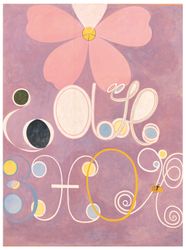
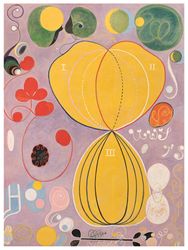
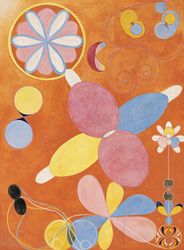
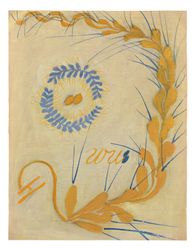
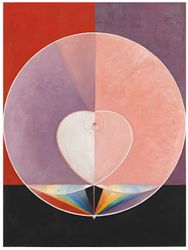
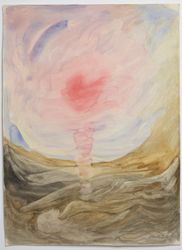
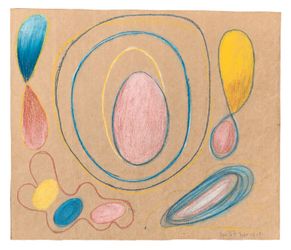
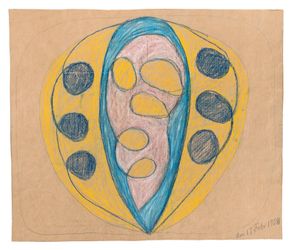
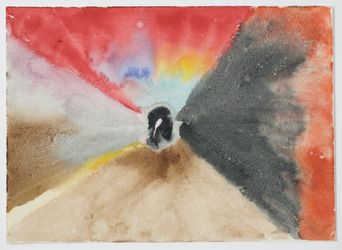
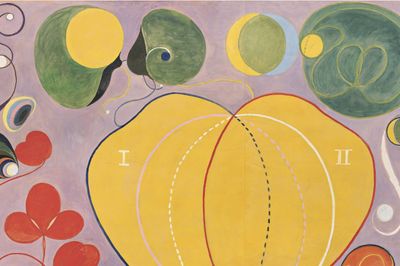
While Hilma af Klint’s figurative practice aligned with the expectations around artists at the turn of the 20th century, she is now much more widely known for her theosophy- and spiritualism-influenced pieces, which were highly avant-garde and among the world’s earliest abstract works. Her bold compositions, guided by communication with spirits—with circles, spirals, and cosmically inspired shapes—featured bright colours and geometry, anticipating many of the themes that would become associated with modern art. As her work matured, she saw herself less as an interpreter of spiritual messages, taking more control of the creative process herself.
Hilma af Klint kept these paintings hidden, although she catalogued all her work. Although she stipulated that her paintings remain unexhibited until 20 years after her death, it was actually a lot later before they were recognised. In 1986, 42 years after af Klint died, The Spiritual in Art exhibition in Los Angeles brought her work to the world’s attention, and a 2019 survey at the Guggenheim in New York City attracted further interest.
- Hilma af Klint created the Primordial Chaos (1906–1907) series following an instruction she received from the spiritual guide Amaliel during a séance. This series considers the origins of creation, based on the practice of theosophy, a late 19th-century movement that used meditation and intuition to establish knowledge of a deeper reality.
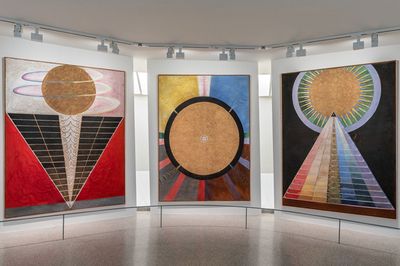
- Primordial Chaos marked the beginning of the Paintings for the Temple collection (1906–1915). She created 193 defiantly non-figurative paintings, seeing masculine and feminine energies represented by shapes and helixes. Guided by spirits, she explained: “The pictures were painted directly through me, without any preliminary drawings, and with great force. I had no idea what the paintings were supposed to depict; nevertheless I worked swiftly and surely, without changing a single brushstroke.”
Hilda af Klint: Select Posthumous Exhibitions
Select Solo Exhibitions
- Hlma af Klint, Grand Palais, Paris (2026)
- Hilma af Klint: Artist and Visionary, The National Gallery of Ireland, Dublin (2026)
- Hilma af Klint: Proper Summons, Museum of Contemporary Art Busan (2025)
- Hilma af Klint: What Stands Behind the Flowers, MoMA, New York City (2025)
- Hilma af Klint: The Beyond, The National Museum of Modern Art, Tokyo (2025)
- Hilma af Klint, Guggenheim Bilbao (2024)
- Hilma af Klint and Wassily Kandinsky: Dream of the Future, Kunstsammlung Nordrhein-Westfalen, Dusseldorf (2024)
- Forms of Life: Hilma af Klint and Piet Mondrian, Kunstmuseum Den Haag, The Hague (2023) (and Tate Modern)
- Hilma af Klint: The Ten Largest Moderna Museet, Stockholm (2022)
- Hilma af Klint: The Secret Paintings City Gallery Wellington (2021) (and Art Gallery of New South Wales, Sydney)
- Hilma af Klint—Artist, researcher, medium, Moderna Museet, Malmo (2020)
- Hilma af Klint : Paintings for the Future, Solomon R Guggenheim Museum, New York City (2019)
- Hilma af Klint: Painting the Unseen, Serpentine Galleries, London (2016)
- Hilma af Klint – A Pioneer of Abstraction, Museum of Modern Art in Stockholm (2013) (and touring)
- The Secret Paintings of Hilma af Klint, Museum voor Moderne Kunst, Arnhem (2010)
- Målningarna till Templet (The Paintings for the Temple), Liljevalchs Konsthall, Stockholm (1999)
- The Secret Pictures by Hilma af Klint, MoMA PS1, New York City (1989)
Select Group Exhibitions
- In Bloom—Art and Botany, Prins Eugens Waldemarsudde, Stockholm
- Yellow: Van Gogh and His Times, Van Gogh Museum, Amsterdam (2026)
- Northern Lights, Buffalo AKG Art Museum (2026)
- Fata Morgana, Fondazione Nicola Trussardi/ Museo Palazzo Morando, Milan (2025)
- The Atomic Age, Musée d’Art Moderne de Paris (2025)
- Women in Abstraction, Guggenheim Bilbao (2021)
- The Origins of the World. The Invention of Nature in the 19th Century, Musée d’Orsay, Paris (2020)
- Infinite Garden, From Giverny to Amazonia, Centre Pompidou Metz (2017)
- 55th Venice Biennale (2013)
- Never The Same River—Possible Futures, Probable Pasts, Camden Arts Centre, London (2010)
- Traces du Sacré (Traces of the Sacred), Haus der Kunst Munich (2008)
- Bara Färg—Färg som andlighet (Only Colour—Colour as Spirituality), Gothenburg Museum of Art (2006)
- Utopi och verklighet (Utopia and Reality), Museum of Modern Art, Stockholm (2000)
- Det andliga i konsten (The Spiritual in Art) (toured Sweden 1991)
- The Spiritual in Art—Abstract Painting 1890–1985, Los Angeles County Museum of Art (1986) (and touring)
Further Reading
- The Hilma af Klint Foundation
- Hilma af Klint official Instagram
- 2025 article from The New Yorker about Hilma af Klint’s rediscovery and complicated legacy
- The Hilma’s Ghost project
Hilma Af Klint FAQs
Was Hilda af Klint the first abstract artist?
It has often been said that Wassily Kandinsky created the first abstract painting in 1911, but five years previously in 1906, af Klint began her Primordial Chaos series, featuring geometric shapes, symbols, dynamic brushstrokes and expressive landscape-esque marks.
Who were “the Five”?
Following her sister’s death in 1880, af Klint took an interest in spirituality and received messages from spiritual beings. In 1896 she joined the Edelweiss Society spiritual group, and out of this came The Five, a group that held séances and meditations. The other members were Anna Kassel (whom af Klint had met at the Academy of Fine Arts), Sigrid Hedman, Mathilda Nilssom and Cornelia Cederberg. The Five used drawing and writing to record messages from spirits known as The High Masters. In 1907, af Klint said she had received a message that she should lead the group. This did not land well with the other four and the group dissolved in 1908.
Is there a film about Hilma af Klimt?
Yes, Lasse Hallström’s 2022 movie Hilma is a biopic starring Tora Hallström as young Hilma and Lena Olin as the older Hilma. The film follows the artist through her spiritual awakening following the loss of her sister.
Ocula




Representative Artworks
View story
View story
View story
View story
View story
View story
View story
View story
View story
View story
View story
Hilma Af Klint in Ocula Magazine










Explore and Follow Artists Shaping Contemporary Art
A respected voice in contemporary art discourse.
Focusing on ambitious storytelling and insightful art-world commentary. Ocula Magazine publishes in-depth interviews, critical essays and timely analysis on the artists, exhibitions and ideas driving the global art world.
Learn more about Ocula Magazine
Showcasing the best of the art world.
Ocula partners with galleries from around the world to highlight their artists, artworks and exhibitions. Gallery membership is by application and invitation, with each member vetted by an independent panel.
Learn more about Ocula Membership
Specialises in the sale of major artworks.
Led by a team with deep ties to the world’s leading auction houses, galleries and collectors. Ocula’s advisory team offers bespoke services to high-net-worth clients from around the world who are looking to acquire the best of contemporary and modern art.
Learn more about our team and services