


JOSEF ALBERS
1888-1976, GermanyJosef Albers (1888–1976) was a highly influential abstract painter and art teacher. His practice crossed American and European Modernism, with a focus on the properties and perception of colour.
Early Years
Josef Albers was born in March 1888 in Bottrop in the Ruhr Valley, Germany. His father was a general contractor, and trained his son in carpentry, plumbing, house-painting and other skills. Albers became a teacher, before specialising in art education (as a teacher, he was exempt from fighting in the First World War). With the support of the local teaching system, he enrolled at the Weimar Bauhaus in 1920 on the assumption that he would return to Bottrop after a year. However, he became fascinated by making assemblages from old bottles (for example, 1921’s Gitterbild) and didn’t want to go home. Besides, in 1922, Annelise Fleischmann arrived at the Bauhaus. The school’s masters admired Albers’ work and he became a professor in 1925—the same year he married Anni. The couple taught at the Bauhaus when it moved to Dessau and then to Berlin in 1932. In 1933 the faculty voted to close the school rather than comply with the Third Reich. The American architect Philip Johnson helped the couple move to the USA in 1933—Albers got a job at Black Mountain College in North Carolina.
Josef Albers: Artworks
Solid colours, abstracted forms and the juxtaposition of shades and tones characterised Josef Albers’ paintings. His geometric forms and exploration of colour conveyed seasons, emotions, times and seasons, while the shapes themselves appeared to jump out of the picture plane, or recede into it.
- Josef and Anni Albers visited Mexico and other Latin American countries several times between 1935 and the late 1960s. Each time they visited, Josef took black-and-white photographs of monuments and archaeological sites. He created photocollages from these images by arranging prints and postcards in a grid formation—one example is Monte Albán (1956).
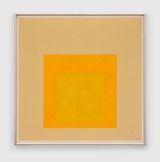
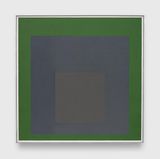
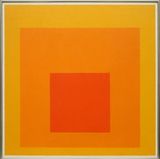
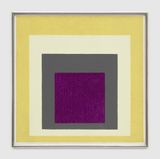
- Albers began his Homage to the Square series in 1949—he eventually made thousands of the oil paintings, each one an exercise in the optical and psychological consequences of the interrelationship of colour.
- Published in 1972, Formulation: Articulation is a two-part portfolio containing 127 screenprints, divided into folders. Albers spent two years collating and making the work, which brings together the concepts he explored during his career.
Josef Albers: Select Public Commissions
- Two Structural Constellations, Corning Glass Building, New York City (1959)
- Two Portals, Time and Life Building, New York City (1961)
- Manhattan, Pan Am Building, New York City (1963) (removed around 2000, replicated and reinstalled 2019—the building is now the MetLife)
- Loggia Wall (1965) and Growth (1967), Rochester Institute of Technology
- Gemini, Grand Avenue National Bank, Kansas City (1972)
- Wrestling, Mutual Life Centre, Sydney (1976)
Josef Albers: Select Posthumous Exhibitions
Select Solo Exhibitions
- Josef Albers: Meditations, Villa Panza, Varese (2026)
- Josef Albers: Duets, David Zwirner, Paris (2026)
- Anni and Josef Albers, National Gallery of Australia, Canberra (2024)
- Josef Albers: Pedagogical Experiments, Kawamura Memorial DIC Museum of Art, Sakura (2023)
- Josef Albers: Colours in Play, Galerie Ludorff, Dusseldörf (2022)
- Anni and Josef Albers: Art and Life, Musée d’Art Moderne de la Ville de Paris (2021) (and touring)
- Josef Albers: Interaction of Colour, Kontemporary 1, Seoul (2019)
- Josef Albers: Grey Steps, Grey Scales, Grey Ladders, David Zwirner, New York City (2016)
- Josef Albers: Paintings, Drawings, Prints, Galerie Berinson, Berlin (2012)
- Josef Albers: Colour Genius, John and Mable Ringling Museum of Art, Sarasota (2008) (and touring)
- Josef Albers: Pinturas 1957–1969, Galería Elvira González, Madrid (2004)
- Josef Albers in Black and White, Boston University Art Gallery (2000)
- Josef Albers: Homage to the Square, Galerie Denise René, Paris (1997)
- Josef Albers, Hayward Gallery, South Bank Centre, London (1994) (and touring)
- Josef Albers: Works on Paper, Art Services International, Alexandria (1991) (and touring)
- The Photographs of Josef Albers: A Selection from the Collection of the Josef Albers Foundation, American Federation of Arts, New York City (1987) (and touring)
- Josef Albers: Homage to the Square. Works from the 1950s, 1960s and 1970s, Galerie Esperanza, Montreal (1985)
- Josef Albers: Graphics and Paintings, Goethe House, New York City (1983)
- Josef Albers Showcase Exhibition, Aldrich Museum of Contemporary Art, Ridgefield (1979)
Select Group Exhibitions
- Set in Stone, David Zwirner, New York City (2026)
- I Am a Citizen of the World, Black Mountain College Museum + Arts Centre (2021)
- From the Collection: 1960–1969, MoMA, New York City (2016)
- Proof: The Rise of Printmaking in Southern California, Norton Simon Museum, Pasadena (2011)
- The Société Anonyme: Modernism for America, Hammer Museum, Los Angeles (2006) (toured for seven years)
- Prints by Painters: American Abstractions, Henry Art Gallery, University of Washington, Seattle (2001)
- From Impressionism to Abstract Impressionism, Dana Art Centre, Seoul (1996)
- Who Framed Modern Art or The Quantitative Life of Roger Rabbit, Sidney Janis Gallery, New York City (1991)
- L’Art et La Couleur, Musée des Arts-Cholet, Cholet (1986)
- Contemporary American Prints and Drawings, 1940–1980, National Gallery of Art, 2 Washington DC (1981)
- America America, Galerie Beyeler, Basel (1976)
Further Reading
- The Josef and Anni Albers Foundation
- Albers Foundation Instagram
- The 60th anniversary of Interaction of Colour from Yale News
Josef Albers FAQs
What was Josef Albers’ Colour Theory?
Josef Albers’ book Interaction of Colour was published in 1963, teaching an experimental way of teaching and studying colour. “In order to use colour effectively, it is necessary to recognise that colour deceives continually,” he said. He highlighted how colours are perceived differently by individuals, and how they exist in relation to other colours around them.
Where did Josef Albers teach?
At the Weimar Bauhaus in 1922, Josef Albers taught handicrafts. When the school moved to Dessau, he became a professor. Following his emigration to the USA, at Black Mountain College—the experimental liberal arts institution—as head of the painting programme, he taught students including Ruth Asawa, Cy Twombly and Robert Rauschenberg. In 1950, he became head of the design department at Yale, which is where he pioneered his work in colour theory.
Was Josef Albers a writer?
Yes, in addition to the celebrated Interaction of Colour book, Albers also wrote poems, pieces about design, teaching and the artists with whom he had worked—I Remember includes memories of Paul Klee and Wassily Kandinsky.
Ocula







Explore Josef Albers' Exhibitions




Josef Albers in Ocula Magazine









Explore and Follow Artists Shaping Contemporary Art
A respected voice in contemporary art discourse.
Focusing on ambitious storytelling and insightful art-world commentary. Ocula Magazine publishes in-depth interviews, critical essays and timely analysis on the artists, exhibitions and ideas driving the global art world.
Learn more about Ocula Magazine
Showcasing the best of the art world.
Ocula partners with galleries from around the world to highlight their artists, artworks and exhibitions. Gallery membership is by application and invitation, with each member vetted by an independent panel.
Learn more about Ocula Membership
Specialises in the sale of major artworks.
Led by a team with deep ties to the world’s leading auction houses, galleries and collectors. Ocula’s advisory team offers bespoke services to high-net-worth clients from around the world who are looking to acquire the best of contemporary and modern art.
Learn more about our team and services