





JÓZSEF CSATÓ
b. 1980, HungaryHungarian artist József Csató blends abstraction and figuration to paint nature-inspired visual worlds that combine plants, humanesque figures and everyday objects to create a childlike, fantastical space with a real sense of collective movement.
Early Years
József Csató was born in 1980 in Mezőkövesd, Hungary. Between 2000–2006, he studied at the University of Fine Arts in Budapest under the direction of Dóra Maurer and at the Academy of Fine Arts in Nuremberg in the class of Peter Angermann. He has undertaken residencies in Sicily and Austria.
József Csató: Artworks
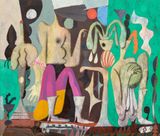
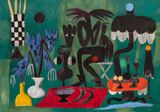
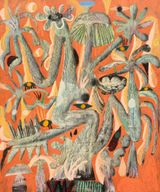
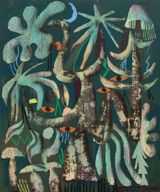
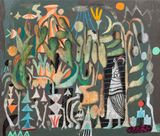
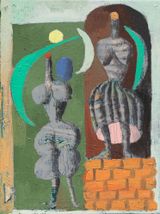
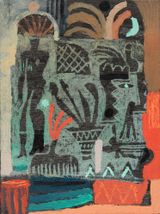
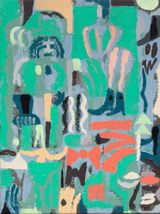
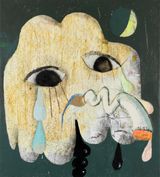
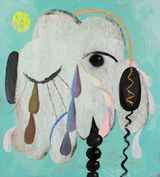
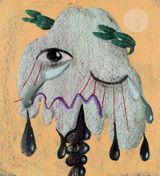
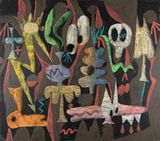
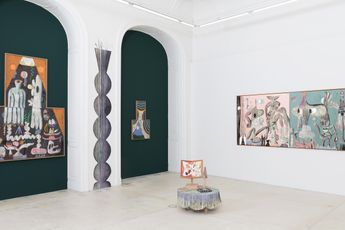
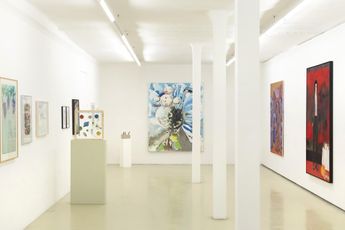
József Csató is neither completely abstract nor totally figurative. He has spoken about his early works being “highly figurative”, rich oil paintings in exotic colours, but then he found himself being pulled towards abstraction. During the 2020s he arrived at a creative practice that oscillated between abstract and figurative. His work is deeply connected to nature, both in terms of his relationship with the environment but also how humans connect with their surroundings. Csató’s colourful paintings depict organic objects, faces and bodies that playfully interact in worlds that are both bizarre and recognisable (and slightly psychedelic). Familiar artistic ideas such as still life and landscape mesh with totemic figures reminiscent of ancient civilisations.
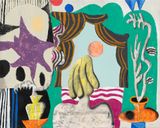
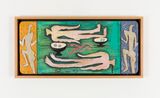
Csató reinterprets the traditional rules of painting: foregrounds merge with backgrounds in distorted perspectives. Room scenes merge into landscapes. He has also explored the idea of panel paintings, putting together smaller canvases to create a larger artwork.
- Csató’s panel painting can be seen in Attic (2022)—now acquired by the Hungarian National Gallery—a three-canvas artwork cutting into a section of a roof and revealing the objects inside, from coathangers to lamps to hybrid creatures.
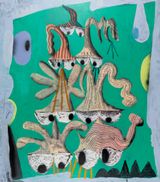
- Generations (2022) is a single large canvas where anthropomorphic big-eyed creatures pop against a green background, simultaneously staring at both the viewer and each other.
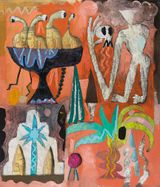
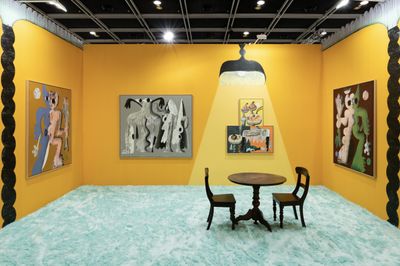
- Cosy Planning (2025) is a two-panel oil and acrylic piece from Csató’s Hong Kong exhibition Behind The Curtain, A New Landscape Again, featuring plant-animal hybrids reminiscent of mushrooms, but with the properties of a table lamp.
Select Awards
József Csató has received the Gyula Derkovits Art Scholarship three times. In 2013, he won Esterházy Art Award, a prestigious award for young artists in Hungary.
Select Exhibitions
Select Solo Exhibitions
- the most mercyful thing, Galerie Krinzinger, Vienna (2026)
- Behind The Curtain, A New Landscape Again, Double Q Gallery, Hong Kong (2025)
- Siren Hospitality, Vielmetter, Los Angeles (2025)
- Hair hours, Skin minutes, Bone seconds, Plus-One Gallery, Antwerp (2023)
- Secret Sized Garden, Haverkampf Leistenschneider, Berlin (2023)
- My Memory Foam Keeps Forgetting, Deák Erika Galéria, Budapest (2023)
- Going Home, Art Central Hong Kong, Double Q Gallery, Hong Kong (2023)
- Crossing the Invisible, Sean Horton (Presents), New York (2022)
- Balancing on the Top of the Fountain, Ravnikar Gallery Space, Ljubljana (2021)
- Kiss of the Leopard, Semiose Gallery, Paris (2021)
- Diary of Open Secrets, Galleri Urbane, Dallas (2021)
- Each and Every Kiss, Deak Erika Galeria, Budapest (2019)
- Pocket Vulcano, Virág Judit Gallery Budapest (2016)
- Women, pastry, and a snake, Nextart Gallery, Budapest (2010)
Select Group Exhibitions
- Group Exhibition, Krinzinger Schottenfeld, Vienna (2025)
- Constellations: Contemporary Positions from Hungary, Paris B, Paris (2025)
- View 2, The Hole, New York City (2024)
- Liquid Marks, Plus-One Projects, Antwerp (2024)
- Dream Paper 3, Galerie Slika, Lyon (2024)
- Think Pinker, Gavlak Gallery, Los Angeles, USA (2023)
- Place Value: New Acquisitions, Ludwig Museum, Budapest (2022)
- Paris+ par Art Basel, Galerie Krinzinger, Paris (2022)
- Six Solo Shows, Krinzinger Projekte, Vienna (2021)
- No Time Like the Present, Public Gallery, London (online) (2019)
- Floral Centrepiece, Deák Erika Gallery, Budapest (2019)
- Drekovits Now—exhibition of the Derkovits Scholarship, Kunsthalle, Budapest
Further reading
- József Csató’s Instagram
- József Csató’s official website
- Artist profile page at Galerie Krinzinger
- “Meet the Artist” interview from Double Q Gallery (2022)
- Video interview about the Constellations group exhibition in 2025
- 2020 interview from Floorr magazine
József Csató FAQs
What techniques and materials does József Csató use?
Csató has said that he doesn’t usually plan what he wants to see on the canvas, but he does make a lot of sketches—not step-by-step drafts, but an evolving guide to the shapes that eventually form part of his painting. He also paints over sections of the canvas, which results in a thick, textured surface, and has sometimes used foil, silicon, ash, glue, wax or graphite, all of which give his paintings a significant physical presence.
What are József Csató’s influences?
Csató is influenced by film and music, but also furniture design. He has also said that he has referenced his children’s drawings in his work. Rituals and customs are also among his inspirations; these could be pagan customs or our everyday behaviour. Csató also finds the rituals of the creative process fascinating (for example, stretching the canvas).
What does József Csató think about political change in Hungary?
Following the April 2026 Hungarian election victory by Péter Magyar’s Tisza party, sweeping aside decades of rule by Viktor Orbán, Csató told Ocula magazine that he was glad to see an end to the “toxic political atmosphere” of the previous administration. “We almost forgot how to be proud of our country,” he said. “We still squint our eyes a bit, getting used to the light.”
Ocula
























Explore and Follow Artists Shaping Contemporary Art
A respected voice in contemporary art discourse.
Focusing on ambitious storytelling and insightful art-world commentary. Ocula Magazine publishes in-depth interviews, critical essays and timely analysis on the artists, exhibitions and ideas driving the global art world.
Learn more about Ocula Magazine
Showcasing the best of the art world.
Ocula partners with galleries from around the world to highlight their artists, artworks and exhibitions. Gallery membership is by application and invitation, with each member vetted by an independent panel.
Learn more about Ocula Membership
Specialises in the sale of major artworks.
Led by a team with deep ties to the world’s leading auction houses, galleries and collectors. Ocula’s advisory team offers bespoke services to high-net-worth clients from around the world who are looking to acquire the best of contemporary and modern art.
Learn more about our team and services