





KAREL APPEL
1921-2006, NetherlandsQualifying Karel Appel (1921–2006) as one of the internationally best renowned Dutch artists of the 20th century may be misleading, as he left the Netherlands already in 1950 for good to realise his long career predominantly between Paris and New York. In this perspective, he may be considered as truly international, not belonging to one particular country in the first place.
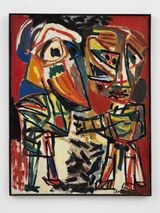
Appel was one of the founders of CoBrA. Then Michel Tapié, whom he had met in Paris through Hugo Claus, featured him in his Art Autre exhibition. Tapié, then, introduced him to Martha Jackson, who, starting with an exhibition in 1954 would become his New York gallery for almost twenty years. Also, Willem Sandberg, the then director of the Stedelijk Museum Amsterdam, was an early supporter: He sent his friend, James Johnson Sweeney, director of the Guggenheim Museum on visit in Paris, to Appel’s studio in the Rue de Santeuil. All this made Karel Appel in his early 30’s already a name in the international avant-garde of the 1950’s. His expressionist and intuitive approach to painting was fitting perfectly well within this context. However, as abstraction had almost become an orthodoxy, his painting style, not being entirely abstract, set him apart. The primordial example for the intermediate position between abstraction and figuration was of course provided by Picasso. Appel appropriated this in his own, very peculiar manner, oscillating between both, and became in turn a reference for younger artists, who opposed abstraction but wouldn’t return to figuration for that matter.
Appel once said that, while Amsterdam had been the city of his youth, Paris was the city of his development–what he had learned in Paris was crucial. So, it would seem only natural, that after a long and entirely international career, he is buried at Père-Lachaise in Paris. However, in the course of the globalisation of art, this very peculiar role of its historical capital for Appels oeuvre had fallen somewhat in oblivion, but in recent years, several important exhibitions in Paris, The Hague and Washington have contributed to rectify the record.
Courtesy Almine Rech

Recently Exhibited







Explore and Follow Artists Shaping Contemporary Art
A respected voice in contemporary art discourse.
Focusing on ambitious storytelling and insightful art-world commentary. Ocula Magazine publishes in-depth interviews, critical essays and timely analysis on the artists, exhibitions and ideas driving the global art world.
Learn more about Ocula Magazine
Showcasing the best of the art world.
Ocula partners with galleries from around the world to highlight their artists, artworks and exhibitions. Gallery membership is by application and invitation, with each member vetted by an independent panel.
Learn more about Ocula Membership
Specialises in the sale of major artworks.
Led by a team with deep ties to the world’s leading auction houses, galleries and collectors. Ocula’s advisory team offers bespoke services to high-net-worth clients from around the world who are looking to acquire the best of contemporary and modern art.
Learn more about our team and services