






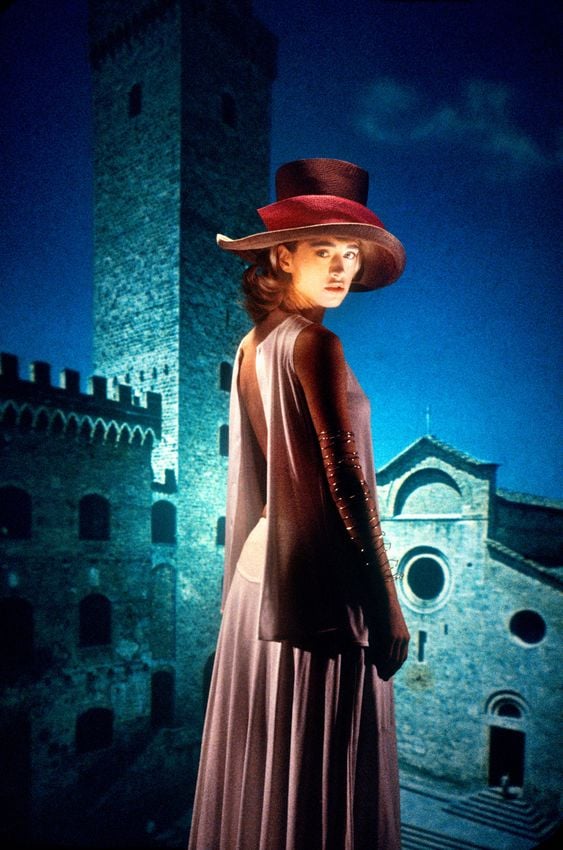
LAURIE SIMMONS
b. 1949, United StatesLaurie Simmons is an American artist, photographer, and filmmaker known for elaborately staged images that use dolls, props, interiors, and other stand-ins to probe identity, gender, domesticity, and the constructed nature of images in contemporary art and visual culture. Associated with the Pictures Generation, her works are psychologically charged, political and subversive, and her work has been shown in important institutions globally.
Early years and Background
Laurie Simmons grew up in Long Island, New York, and studied at Tyler School of Art, Temple University, receiving a BFA in 1971 before moving to New York, where she became associated with a group of artists loosely termed the Pictures Generation. Simmons has lived and worked in New York for much of her career, developing a practice that sits at the intersection of photography, film, sculpture, and, more recently, digital and AI-enabled image-making.
Laurie Simmons Artworks
In her work, Laurie Simmons stages meticulously lit tableaux using sets, miniatures, dolls, ventriloquist dummies, mannequins, and live models as stand-ins to examine how identity—particularly female identity—is scripted by mass media, domestic ideals, and photographic imagery. Across photography, film, and three-dimensional work, she constructs self-contained, psychologically charged worlds that hover between artifice and belief, prompting viewers to consider how images organise roles around home, work, desire, and performance.
Working conceptually, Simmons turns photography’s tendency to objectify—especially women—into a sustained critique of the medium itself. Drawing on childhood memories and media constructions of gender, she infuses her scenes with an eerie, dreamlike tone: her images may appear whimsical at first, but their child’s-play scenarios quickly feel unsettling as characters grapple with identity in environments where consumption, designer objects, and domestic space are exaggerated to absurd extremes.
Early staged photographs and dolls
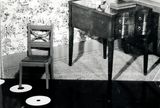
From the mid-1970s, Laurie Simmons began photographing dollhouse interiors populated by dolls and toy furniture, establishing a vocabulary in which miniature domestic spaces become proxies for real-world social scripts. These works, including early series of interiors and doll figures in precisely arranged rooms, are often cited as foundational to Simmons’ position within the Pictures Generation and to debates about the politics of representation in contemporary photography.
Underwater figures and ‘Underneath’ bodies
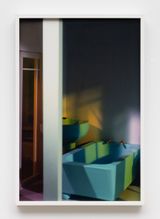
In the 1980s and 1990s, Simmons developed series such as ‘Water Ballet’ and ‘Family Collision’ (c. 1980s—1990s), in which human bodies and figurines appear submerged in atmospheric underwater scenes, followed by the ‘Underneath’ (late 1990s) photographs featuring mannequins whose clothing opens onto idealised domestic interiors in place of flesh. These bodies of work, surveyed together in Underwater & Underneath (30 November—17 January) at Andrew Reed Gallery in Miami, track Simmons’ evolution from dreamlike spaces of apparent liberation towards a sharper examination of how domestic fantasies are projected onto and through the body.
Big Camera/Little Camera and later series
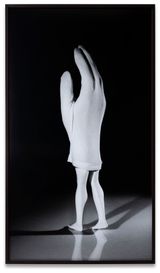
Laurie Simmons’ survey Big Camera/Little Camera (2018—2019) at the Modern Art Museum of Fort Worth and the Museum of Contemporary Art Chicago brought together four decades of work, from dollhouse photographs to large-scale images of ‘walking’ objects, ventriloquist dummies, and portrait-based series that extend her interest in performance and masquerade. The exhibition highlighted the continuity between Simmons’ analogue table-top sets and later series incorporating life-sized figures, costumes, and cinematic lighting, underscoring her sustained focus on how photography mediates experience.
Autofiction, AI, and new image worlds
In Laurie Simmons: Autofiction (2023—2024), presented by YoungArts in Miami, Simmons showed new work that engaged explicitly with artificial intelligence and evolving tools of image production, extending her long-running interest in staged reality into contemporary debates about AI-generated pictures. The exhibition, part of Miami Art Week, connected her practice to a younger generation of artists and audiences while positioning her experiments with digital processes as a continuation—rather than a break—from her investigations into how images are authored, manipulated, and consumed.
Installed in the glass-walled YoungArts Jewel Box on Biscayne Boulevard, Autofiction brought together photographic and moving-image works that build on Simmons’ use of surrogates and constructed sets while responding to the possibilities and anxieties of AI-driven image-making. Immersing viewers in layered, often humorous yet unsettling scenes, the exhibition underscored Simmons’ role as a key voice in discussions about how contemporary artists use technology to interrogate authorship, authenticity, and the persistence of the photographic image.
Laurie Simmon’s film work
Laurie Simmons’ film work extends the staged, surrogate-driven worlds of her photographs into time-based narratives that examine performance, gender, and the mechanics of looking. Her first major film, The Music of Regret (2006) , is a three-act mini-musical starring Meryl Streep, Adam Guettel, puppets, ventriloquist dummies, and Simmons’ signature ‘walking objects’, and premiered at The Museum of Modern Art in New York before screening at institutions including the Metropolitan Museum of Art, the Whitney Museum of American Art, Tate Modern, Centre Pompidou, and Cinema Rise in Tokyo.
Simmons’ narrative feature My Art (2016) —in which she plays a middle-aged artist restaging scenes from classic films—had its international premiere at the Venice Film Festival and North American premiere at the Tribeca Film Festival, reinforcing her standing in both the art and cinema worlds. Across these acclaimed projects, which have since been revisited via platforms such as the Criterion Channel and museum retrospectives, Simmons uses film to animate the characters and sets from her photographs, deepening her exploration of regret, fantasy, ageing, and women’s roles within visual culture.
Institutional context and collections
Laurie Simmons has had solo exhibitions at MoMA PS1 in New York, the Walker Art Center in Minneapolis, the Baltimore Museum of Art, San Jose Museum of Art, the Gothenburg Museum of Art, the Neues Museum in Nuremberg, the Jewish Museum in New York, and the Contemporary Art Museum St. Louis, among others. Her work is held in major museum collections, including the Metropolitan Museum of Art, the Museum of Modern Art, the Whitney Museum of American Art, the Solomon R. Guggenheim Museum, the Los Angeles County Museum of Art, the San Francisco Museum of Modern Art, and Centre Pompidou in Paris.
Laurie Simmons Exhibitions
Laurie Simmons has been the subject of both solo exhibitions and group exhibitions at important institutions and galleries worldwide.
- Underwater & Underneath (2025—2026), Andrew Reed Gallery, Miami
- Laurie Simmons & Peter Wheelwright: The Kaleidoscope (...Bigger) House (2024—2025), public installation, Miami Design District, Miami, organised with Almine Rech and ICA Miami
- Laurie Simmons: Big Camera/Little Camera (2018—2019), Modern Art Museum of Fort Worth, Fort Worth; Museum of Contemporary Art Chicago, Chicago
- Laurie Simmons: How We See (2015), The Jewish Museum, New York
- The Fabulous World of Laurie Simmons (2014), Neues Museum, Nuremberg.
Simmons has also presented solo exhibitions at MoMA PS1, Long Island City, New York; Walker Art Center, Minneapolis; Baltimore Museum of Art, Baltimore; San Jose Museum of Art, San Jose; Gothenburg Museum of Art, Gothenburg; and Contemporary Art Museum St. Louis, St. Louis.
Laurie Simmons FAQs
Who is Laurie Simmons?
Laurie Simmons is an American contemporary artist, photographer, and filmmaker born in Long Island in 1949, whose staged photographs and films use dolls, mannequins, props, and constructed sets to explore identity, gender, domestic life, and the role of images in contemporary culture. You can follow Laurie Simmons on Ocula to learn more about her work, find out about art for sale, contact her gallery, and keep up to date with upcoming exhibitions.
Where can I see work by Laurie Simmons?
Laurie Simmons’ work is held in major museum collections, including the Metropolitan Museum of Art, the Museum of Modern Art, the Whitney Museum of American Art, the Solomon R. Guggenheim Museum, the Los Angeles County Museum of Art, and Centre Pompidou. You can follow Laurie Simmons on Ocula to receive alerts on upcoming exhibitions by the artist.
Where does Laurie Simmons live?
Laurie Simmons lives and works in New York, where she has been based for much of her career as part of a community of artists associated with the Pictures Generation and contemporary photography.
What are some of Laurie Simmons’ most important series?
Some of Laurie Simmons’ key bodies of work include her early dollhouse photographs from the 1970s, the underwater-themed Water Ballet and Family Collision (c. 1980s—1990s), the Underneath (late 1990s) mannequins with interiors, as well as later series featuring ventriloquist dummies, ‘walking’ objects, and portrait-based works that extend her exploration of performance and identity. These series have been extensively exhibited in institutions such as MoMA PS1, the Jewish Museum, the Walker Art Center, and in the survey Big Camera/Little Camera (2018—2019).
What is Laurie Simmons’ relationship to Jimmy DeSana‘s work?
Since 1990, Laurie Simmons has served as executor of the estate of her close friend and fellow photographer Jimmy DeSana, who died at the age of 40 from an AIDS-related illness. Simmons acknowledges DeSana as very influential upon her practice. In her role as executor of the estate, Simmons has overseen the preservation, organisation, and exhibition of DeSana’s archive, working with curators and institutions to support major projects such as museum surveys and publications that have helped secure his legacy within contemporary art and queer photographic history.
How does Laurie Simmons use AI and new technologies in her art?
Laurie Simmons has incorporated AI and digital tools into series such as Autofiction (2023—2024), using them to generate and manipulate imagery that still relies on her long-established methods of staging and world-building. Rather than abandoning photography, Simmons treats AI and other technologies as new means to question how images are authored, circulated, and trusted, continuing her investigation into the constructed nature of visual culture.
How is Laurie Simmons’ name pronounced?
Laurie Simmons’ name is pronounced ‘LOR-ee SIM-enz’, with emphasis on the first syllable of ‘Laurie’ and the first syllable of ‘Simmons’.
Where can I buy Laurie Simmons’ work?
Laurie Simmons is represented by leading contemporary art galleries, including Salon 94 and Almine Rech, and has longstanding ties to galleries such as Sperone Westwater and others that have shown her work internationally. Laurie Simmons is represented by leading contemporary art galleries; you can explore Ocula to find out which Ocula galleries represent the artist and enquire directly about buying art by Laurie Simmons, and follow them and their gallery to keep up to date; you can also get in touch with Ocula’s art advisory team to find out more about buying or selling work by Laurie Simmons.
Ocula | 2025






Explore Laurie Simmons' Exhibitions





Explore and Follow Artists Shaping Contemporary Art
A respected voice in contemporary art discourse.
Focusing on ambitious storytelling and insightful art-world commentary. Ocula Magazine publishes in-depth interviews, critical essays and timely analysis on the artists, exhibitions and ideas driving the global art world.
Learn more about Ocula Magazine
Showcasing the best of the art world.
Ocula partners with galleries from around the world to highlight their artists, artworks and exhibitions. Gallery membership is by application and invitation, with each member vetted by an independent panel.
Learn more about Ocula Membership
Specialises in the sale of major artworks.
Led by a team with deep ties to the world’s leading auction houses, galleries and collectors. Ocula’s advisory team offers bespoke services to high-net-worth clients from around the world who are looking to acquire the best of contemporary and modern art.
Learn more about our team and services