





TAVARES STRACHAN
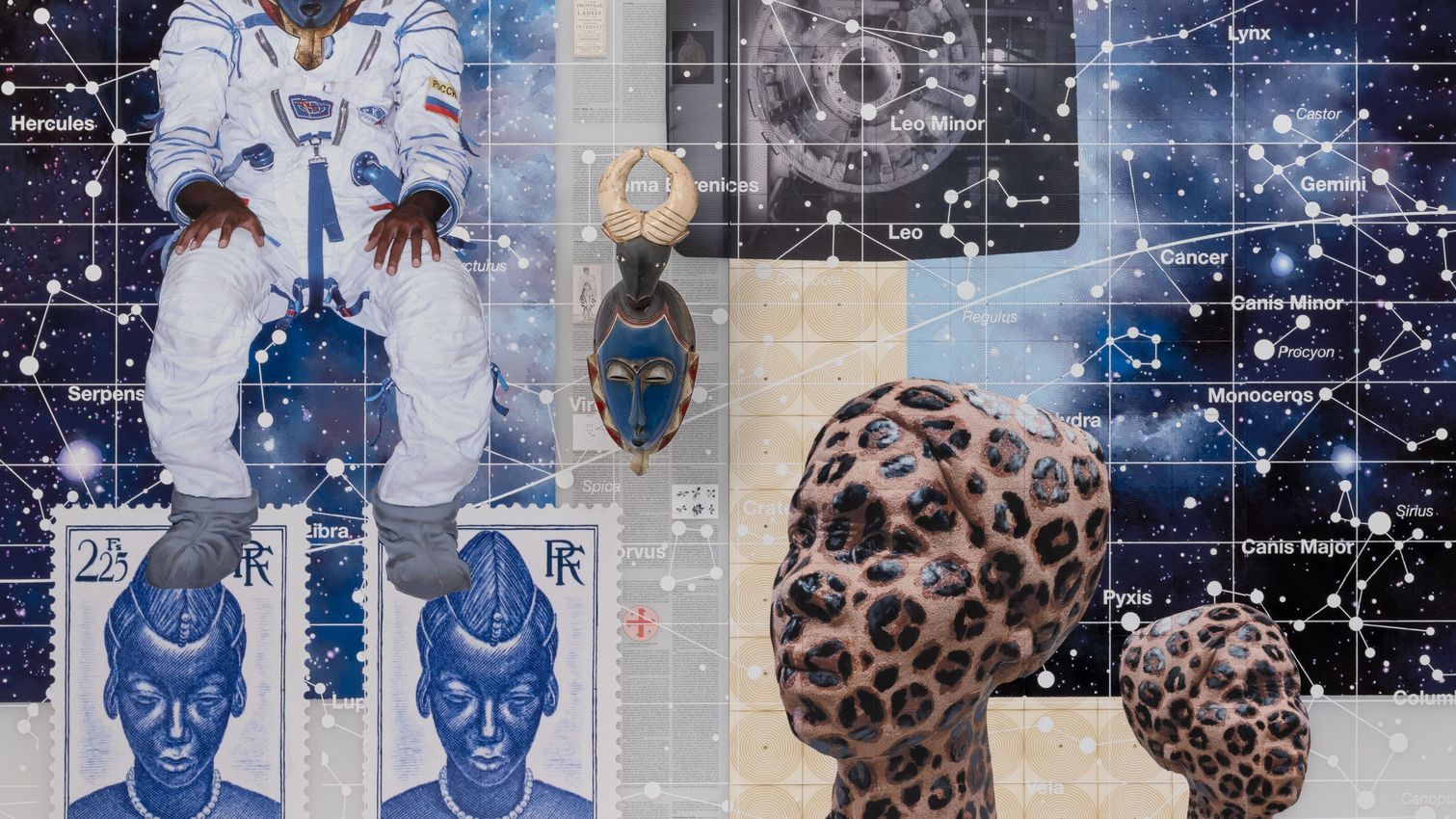
b. 1979, BahamasTavares Strachan is a Bahamian conceptual artist celebrated for his ambitious, research-driven practice, which weaves together art, science, and politics to offer distinct perspectives on the cultural dynamics of scientific knowledge. Working across sculpture, neon, ceramics, music, text, installation, and large-scale collaborative projects, he creates work that moves between the Arctic, outer space, and the deep sea to consider the impact of storytelling querying how knowledge is produced and who is made visible in the historical record. Born in 1979 in Nassau, The Bahamas, Strachan lives and works between New York City and Nassau.
Strachan has received numerous awards and residencies, including a John D. and Catherine T. MacArthur Foundation fellowship (2022) and an Artist in Residence position at the Getty Research Institute (2019–20). In 2025, the Los Angeles County Museum of Art (LACMA) and the Columbus Museum of Art co-organised Tavares Strachan: The Day Tomorrow Began, which opened at LACMA as the artist’s first museum survey exhibition in the United States and will be on view at the Columbus Museum of Art from 16 May 2026 to 3 January 2027.
Early life and Education
Tavares Henderson Strachan was born in 1979 in Nassau and has described how growing up in the Bain Town neighbourhood shaped his view of the world. He studied painting and liberal arts at the College of The Bahamas and later at Brown University before focusing on sculpture and glass.
Strachan completed a BFA in Glass at the Rhode Island School of Design in 2003 and an MFA in Sculpture at Yale University in 2006, marking a shift from traditional painting to conceptually driven, materially experimental work. He now divides his time between studios in New York and Nassau, where he has established long-term community, educational, and research initiatives.
Practice, Themes, and Key Projects
Strachan’s artistic practice activates the intersections of art, science, and politics, offering a uniquely synthesised view on how scientific knowledge and historical narratives are constructed. Aeronautics, astronomy, deep-sea exploration, medicine, and extreme climatology serve as arenas for monumental allegories that address cultural displacement, human aspiration, and mortal limitation. Themes of invisibility, endurance, and loss are central, as he re-inscribes overlooked figures—particularly Black scientists, explorers, and cultural leaders—into public consciousness.
His practice spans neon text works, glass and bronze sculptures, large-scale installations, and collaborative projects that operate at the scale of expeditions and aerospace programmes. Signature works include The Distance Between What We Have and What We Want (2006), for which he transported a 2.5-ton block of Arctic ice to his childhood school in Nassau in a solar-powered freezer, invoking climate fragility, cultural displacement, and the overlooked legacy of Arctic explorer Matthew Henson.
Initiated in 2004, the multi-year project Orthostatic Tolerance documented Strachan’s cosmonaut training at the Yuri Gagarin Cosmonaut Training Center in Star City, Russia, and related space-travel experiments in Nassau conducted under his Bahamas Air and Sea Exploration Center (BASEC). Works such as Invisible Diver (2010)—a hand-blown glass circulatory system submerged in mineral oil and visible only from certain angles—link scientific experiment with poetics of disappearance, making bodies and histories appear and vanish in the same gesture.
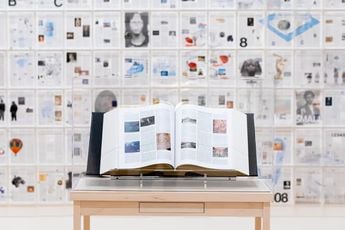
Strachan’s long-term project Encyclopedia of Invisibility (2018) takes the form of a more-than-2,000-page encyclopaedia dedicated to people, places, and ideas rendered invisible in mainstream histories. In his 2023 TED Talk on the work, he discusses this project as a framework for restoring lost narratives and as a conceptual engine for many of his sculptures and installations. He argues that “lost stories” — people, places and events omitted from dominant histories — shape who is seen as important, and that we have a responsibility to excavate and amplify them at a scale that matches their significance.
In 2011 he realised Seen/Unseen, a large survey of over 50 works installed in an undisclosed New York warehouse and closed to the public, turning the exhibition itself into a meditation on presence, absence, and access. His satellite project ENOCH (2018), created with LACMA’s Art + Technology Lab, launched a 3U CubeSat into orbit to honour Robert Henry Lawrence Jr., the first African American selected for a national space programme, keeping the commemorative sculpture in sun-synchronous orbit until 2021.
Recent work such as The First Supper (Galaxy Black) (2021–23), unveiled at London‘s Royal Academy of Arts in 2024, reimagines Leonardo’s Last Supper with Black historical and cultural figures in cast bronze, overlayed with black patina and gold leaf, to propose an alternative canon of saints, prophets, and visionaries.
Research Platforms and Community Initiatives
Strachan has established the Bahamas Aerospace and Sea Exploration Center (B.A.S.E.C.) in Nassau, a combined art studio and scientific research platform that uses aerospace and marine exploration as a framework for education, community building, and world-making. B.A.S.E.C. and its related programmes engage scientists, engineers, artists, and young people, turning the artist’s practice into a hybrid research station that blurs distinctions between experiment, pedagogy, and artwork.
He is also the founder of OKU, a not-for-profit community project in Nassau that includes an artist residency, exhibition spaces, scholarship scheme, and after-school creative programmes. These initiatives reflect his commitment to building local infrastructures for art and science while connecting The Bahamas to global conversations about technology, climate, and Black futures.
Major Exhibitions and Recent Projects
Strachan has presented solo and collaborative projects at institutions including the Venice Biennale, Prospect New Orleans, the Lyon Biennale, the Baltimore Museum of Art, the Carnegie International, the Southbank Centre’s Hayward Gallery, SFMOMA, ICA Philadelphia, and the Getty Research Institute, among others. He is represented internationally by Marian Goodman Gallery and Perrotin.
Major solo exhibitions include:
- 2026-2027– Tavares Strachan: The Day Tomorrow Began, Columbus Museum of Art, Columbus, USA.
- 2025–2026 – Tavares Strachan: The Day Tomorrow Began, Los Angeles County Museum of Art, Los Angeles, USA.
- 2024 – Tavares Strachan: There Is Light Somewhere, Hayward Gallery, Southbank Centre, London, UK.
- 2024 – Magnificent Darkness, Marian Goodman Gallery, Los Angeles, USA.
- 2013 – Polar Eclipse, Bahamas Pavilion, 55th Venice Biennale, Venice, Italy.
- 2011 – Seen/Unseen, undisclosed exhibition space, New York, USA.
- 2011 – Orthostatic Tolerance: It Might Not Be Such a Bad Idea if I Never Went Home Again, MIT List Visual Arts Center, Cambridge, USA.
- 2010 – Orthostatic Tolerance: Launching into an Infinite Distance, Grand Arts, Kansas City, USA.
Tavares Strachan’s survey exhibition The Day Tomorrow Began, initially on view at LACMA and on view at the Columbus Museum of Art at The Pizzuti from 16 May 2026 to 3 January 2027, brings together nearly a decade of the artist’s work across sculpture, painting, neon text, music, and immersive environments. Anchored by Strachan’s expansive project The Encyclopedia of Invisibility (2018), a 2,000-page reference work devoted to marginalised people, places, and ideas, the exhibition situates his large-scale Flip Monuments, ceramic works exploring the iconography of Black haircare, and self-playing instruments within a speculative archive that collapses boundaries between art, science, history, and everyday life. In Columbus, this inquiry extends into the museum’s architecture itself, where the twenty-foot Flip Monument (Christophe x Napoleon) (2025) and the participatory installation Bar Room (2022/2025)—a functioning rum bar and café that will remain on permanent view—underscore Strachan’s commitment to reimagining public monuments and cultural institutions as active, living sites of visibility and belonging.
Awards and Honours
Strachan received a MacArthur Fellowship in 2022, recognising his expansion of what contemporary art can be and his efforts to foreground overlooked contributors across science, politics, and culture. He was awarded the LACMA Art + Technology Lab Artist Grant in 2014, supporting the development of ENOCH.
Other distinctions include the Frontier Art Prize (2018), the inaugural Artist-in-Residence position at the Allen Institute (2018), an Artist-in-Residence Scholar appointment at the Getty Research Institute (2019–20), a Tiffany Foundation Grant (2008), the Grand Arts Residency Fellowship (2007), and the Alice B. Kimball Fellowship (2006), among others. These honours underscore the breadth of his influence at the intersection of art, science, and social history.
Tavares Strachan FAQs
Who is Tavares Strachan?
Tavares Strachan is a Bahamian conceptual artist whose interdisciplinary practice bridges art, science, and history to interrogate invisibility, displacement, and overlooked Black and diasporic narratives. Born in Nassau in 1979, he lives and works between New York City and The Bahamas.
What kind of art does Tavares Strachan make?
Tavares Strachan creates conceptually led artworks across sculpture, neon, ceramics, installation, music, performance, and large-scale collaborative projects, often grounded in scientific research and archival study. His work frequently borrows the visual language of encyclopaedias, monuments, laboratories, and space hardware to question how knowledge is produced and who is made visible.
Where is Tavares Strachan from, and where does he work?
Tavares Strachan is from Nassau, The Bahamas, and maintains studios in both Nassau and New York City. His projects often draw on the communities and resources of his birthplace through platforms such as B.A.S.E.C. and OKU.
What are the key themes in Tavares Strachan work?
Key themes in Tavares Strachan’s art include include visibility and invisibility, endurance, exploration, displacement, and the recovery of marginalised histories—especially those of Black scientists, explorers, and cultural figures. He frequently stages his research through narratives of Arctic expeditions, deep-sea and space travel, and speculative cosmologies.
What was Tavares Strachan’s exhibition “The Day Tomorrow Began” at LACMA in 2025-2026 about?
Tavares Strachan: The Day Tomorrow Began is the artist’s first museum exhibition in Los Angeles, bringing together over 20 new works in immersive, multisensory environments that highlight stories excluded from dominant histories of the Black diaspora. The exhibition combines neon, ceramics, bronze, painting, sound, text, and performance to imagine how communities might remember the past differently and envision alternative futures.
Has Tavares Strachan received major awards?
Yes. Strachan received the MacArthur Fellowship in 2022 and the LACMA Art + Technology Lab Artist Grant in 2014, alongside several other major residencies and prizes. These awards recognise both the experimental reach and social impact of his research-driven practice.
How does science feature in Tavares Strachan’s art?
Science functions as both subject and medium in Tavares Strachan’s work, encompassing fields such as astronomy, climatology, physiology, and aerospace engineering. He undertakes activities like cosmonaut training, satellite launches, and deep-sea and climate research to generate artworks that critique systems of knowledge and power while proposing new ways of seeing the world.
What is Tavares Strachan’s ‘Bar Room’?
Tavares Strachan’s Bar Room (2026–ongoing) is a large-scale installation by the artist at the Columbus Museum of Art, developed for the exhibition The Day Tomorrow Began (16 May 2026–3 January 2027). A fully operational rum bar and café, the work was conceived as both a social hub and a conceptual artwork. It reflects Tavares Strachan’s interest in invisible histories, migration, and community, using hospitality and conversation as central elements of his artistic language. Tavares Strachan’s Bar Room is on permanent installation at the Columbus Museum of Art, serving as an ongoing site for social interaction, reflection, and programming.
Ocula | 2026


Explore Tavares Strachan's Exhibitions










Explore and Follow Artists Shaping Contemporary Art
A respected voice in contemporary art discourse.
Focusing on ambitious storytelling and insightful art-world commentary. Ocula Magazine publishes in-depth interviews, critical essays and timely analysis on the artists, exhibitions and ideas driving the global art world.
Learn more about Ocula Magazine
Showcasing the best of the art world.
Ocula partners with galleries from around the world to highlight their artists, artworks and exhibitions. Gallery membership is by application and invitation, with each member vetted by an independent panel.
Learn more about Ocula Membership
Specialises in the sale of major artworks.
Led by a team with deep ties to the world’s leading auction houses, galleries and collectors. Ocula’s advisory team offers bespoke services to high-net-worth clients from around the world who are looking to acquire the best of contemporary and modern art.
Learn more about our team and services