Press Release

From May 18 to September 8, 2024, UCCA Center for Contemporary Art presents Liang Hao: Pacing the Void, featuring the artist’s most representative wooden sculpture series, as well as a new series of plaster sculptures conceived for the occasion of this exhibition. Liang Hao: Pacing the Void is the artist’s first institutional solo show and a retrospective of her works and practice over the past decades.

UCCA Center for Contemporary Art presents Liang Hao: Pacing the Void, the artist’s first institutional solo show. The exhibition features over 50 sculptures, including two wooden series, and a new plaster series commissioned by UCCA. A culmination of her decades-long career in sculpture, this exhibition traces the chronological progression of her sustained efforts in exploring the relationship between non-representational form, materiality, and space, and pays tribute to her practice that has forged alone unencumbered by the limitations of national borders, gender, and a linear view of history. Liang Hao: Pacing the Void is curated by UCCA Curator Neil Zhang.

While studying at the Sculpture Department at the Central Academy of Fine Arts (1980 – 1985), Liang Hao was simultaneously influenced by her training in Chinese socialist realism and the rise of an artistic new wave. Faced with the encounters and stimulation by a plethora of discourses, Liang Hao yearned to expand her horizon. After graduation, she enrolled at the Cranbrook Academy of Art in the United States to continue her studies. Immersed in the forefront of the contemporary art scene, Liang Hao became inspired visually, conceptually, and culturally. From then on, she strived to abandon her previous artistic language and embark on a series of explorations and experiments, while reflecting on her own traditions, the legacy of modernism, and the influence of artists active in the 1990s such as Eva Hesse and Richard Serra, all of which inspired epiphanies and formal transformations.

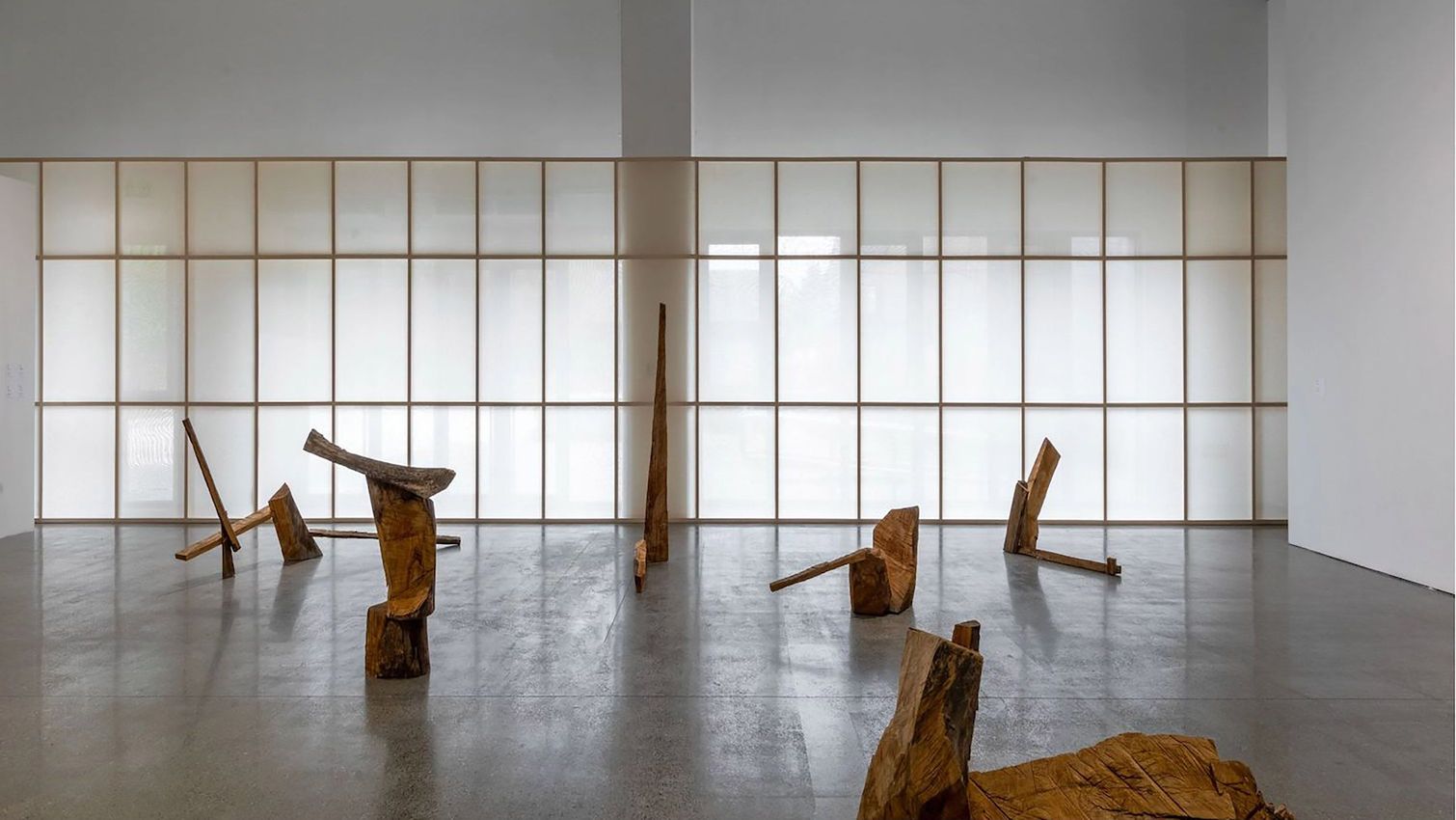
From the 1990s onwards, Liang Hao became drawn to the power, vitality, and organic texture intrinsic to wood as a material. She began to focus on creating wooden sculptures in abstract shapes, often using an industrial chainsaw to cut the material directly into pieces that she would then place standing or lying around in space. The subtle changes in form, the construction of the space, and the relationship between the works are all essential to Liang Hao’s practice.

In 2007, upon returning to Beijing after almost 20 years of living in the United States, Liang Hao continued to follow this path in pursuit of a purer sculptural form, attempting to strip away all forms and images and focus single-mindedly on fully abstract and non-representational expressions that are true to the heart.

This exhibition is divided into two sections based on the materials of wood and plaster, reflecting the chronological progression of the artist’s career. The West Gallery presents two series of wooden sculptures, including Untitled (Segmentation) (2015 – 2018), featuring works made from wood cut directly by an industrial chainsaw, and Untitled (Splicing), which began around 2018 and builds on the cut form by incorporating joinery and recombination techniques. Underlying the variety of method, Liang Hao’s interventions with wood have all transpired through a dialogue with its form. This process also allows her to enter into a state of intuitive surrender to nature, where she may probe deeper into her inquiries into energy, space, and the language of sculpture itself.

The buoyancy of the new series of plaster sculptures Untitled (Amalgam) (2023 – 2024) in the New Gallery stands in contrast with the primal and contemplative ambience of the wooden series in the West Gallery. Since 2023, Liang Hao has been revisiting plaster, the most basic sculptural material. Because it is predominantly used for molds and inherently fragile, few artists would deliberately employ plaster as the final material for their works. However, by casting plaster molds on the surface of wooden logs before splicing and shaping it into form, Liang Hao manages to transfer a part of the wooden form and texture onto a new material that, at the same time, transcends the imagery of trees and becomes liberated from their original structural and material forms, attaining a new state of freedom and metaphysical poetics. For Liang Hao, ‘Every cut or move to shape the material is an attempt to advance, challenge, or even disrupt familiar forms, which requires a great deal of courage.’ In this sense, the experimentation of the latest series of works is not only about transformation at the material level, but also for the artist to reflect on and anticipate the unfolding of her own career in art.

The title of the exhibition Pacing the Void refers to the process of the sculptor’s body constantly, physically moving through space as she works, while alluding to the artist’s way of life as she traverses across different cultures and countries over the years without belonging to any one locale. For Liang Hao, artworks are incidental of the artist’s practice—the state of life reflects the state of art-making. As she once remarked, ‘How minute and transient I am in this vast and eternal universe, and yet I can make myself part of it by becoming one with nature. The journey keeps on. My work will lead me to a future that I cannot foresee.’

Liang Hao (b. 1960, Beijing) received her Bachelor’s degree in Sculpture from the Central Academy of Fine Arts (1985) and a Master’s degree in Sculpture from Cranbrook Academy of Art (1989). Her works were included in exhibitions such as Central Academy of Fine Arts Professors Exhibition (CAFA Art Museum, Beijing, China, 2013); Inside Out 2012 (Inside-Out Art Museum, Beijing, China, 2013); Touched by Women’s Hands (Smithsonian Institution – Flushing Town Hall, New York, USA, 2008); and Global Roots: Artists from China Working in New York (Stewart Center Gallery, Purdue University, IN, USA, 1998)

Read More
About the Artist

Liang Hao 梁浩 (b. 1988, Guangdong Province) currently lives and works in Shanghai. He graduated from the Painting Department of the Academy of Arts and Design at Tsinghua University, Beijing, in 2012. His practice focuses on painting while extending to other media. He is interested in the dynamics between the hand, gaze and mind, reconsidering the technicality of the hand and the affects that flow through it by constructing illusions of technical production and making references to images in art history or texts.

View Artist Profile

Also Exhibiting at UCCA

About the Gallery

UCCA Center for Contemporary Art is China’s leading contemporary art institution. Committed to the belief that art can deepen lives and transcend boundaries, UCCA presents a wide range of exhibitions, public programs, and research initiatives to a public of more than one million visitors each year. UCCA Beijing sits at the heart of the 798 Art District, occupying 10,000 square meters of factory chambers built in 1957 and regenerated in 2019 by OMA. UCCA Dune, designed by Open Architecture, lies beneath the sand in the seaside enclave of Aranya in Beidaihe.

View Gallery Profile
Address
798 Art District
No 4 Jiuxianqiao Lu
Chaoyang District
Beijing
China
Opening Hours
Tuesday – Sunday
10am – 7pm

Closed Monday
(1)
Beijing 798 Art District, No 4 Jiuxianqiao Lu
UCCA
798 Art District, No 4 Jiuxianqiao Lu, Chaoyang District, Beijing, China
+86 10 5780 0200
http://www.ucca.org.cn/en

Opening hours
Tuesday – Sunday
10am – 7pm

Closed Monday
The art world in focus