The art world in focus
Subscribe to our newsletter for news and insights on artists, galleries and exhibitions.

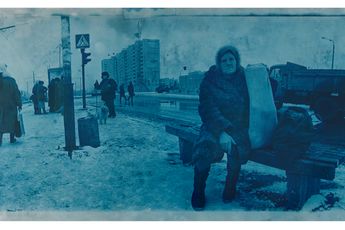
Boris Mikhailov, At Dusk, 1993. Courtesy The Lithuanian National Museum of Art.
A photograph by one of Eastern Europe’s most influential photographers, Boris Mikhailov, has been stolen from the Radvila Palace Museum of Art, part of The Lithuanian National Museum of Art, where it was on display as part of the exhibition Ukrainian Dreamers: Kharkiv School of Photography.
According to museum officials and local police, the theft of the work, which is part of the imagemaker’s 1993 series At Dusk, took place shortly before 1.30pm on 28 June. The incident was captured on CCTV and footage has been handed over to police, who have opened an investigation.
In a statement to Ocula, Arūnas Gelūnas, the director general of the Lithuanian National Museum of Art, said it appears that the theft was “not a spontaneous act”. He continued: “We believe the perpetrator likely knew in advance that Boris Mikhailov is the most prominent artist featured in the exhibition and that his works are among its most valuable.
“At this stage, we can only speculate about the motive. The photograph may have been stolen for a private collection or with the intention of selling it on the black market.”
According to the museum, staff noticed shortly after the incident that the work was missing from a second-floor exhibition space, but the person suspected of carrying out the theft had already left the museum.
Local police, who valued the work at €7,000, are investigating the event as a Basic Theft, which, under Lithuanian law, is punishable by a maximum of three years in prison.
The stolen image is one of 111 small, hand-tinted panoramic photographs taken in Mikhailov’s hometown of Kharkiv in the north-east of Ukraine, following the dissolution of the Soviet Union in the early 1990s. Bleak and unforgiving, they show long queues for food, piles of rubble and abandoned buildings.
The works were on display in the Ravila Palace Museum of Art in Mikhailov’s preferred format, with the prints hung low on the gallery wall, mirroring the low angle from which they were taken. This approach is intended to compel the viewer to stoop towards the images, bringing them unusually close to the subjects photographed.
Gelūnas stressed that the last recorded theft at the museum was more than 20 years ago, when another small-scale artwork was stolen and never recovered.
“This incident is a reminder that museums must continuously strengthen security measures, including the protection and mounting of smaller exhibits,” he said. “While it is not feasible to install individual alarm systems for every object, it is clear that reinforcing the physical security of vulnerable works is an important step.”
Mikhailov began his career as a photographer in the 1960s; by the 1980s, had garnered considerable acclaim for his particular brand of social realism, which occupies a hybrid position between documentary and conceptual work. Touching on subjects including Ukraine under Soviet rule, living conditions in post-communist Eastern Europe, and the fallen ideals of the Soviet Union, he became known for both his style and subversive approach.
Now represented by Marian Goodman, he has won some of the biggest prizes in photography: the Hasselblad Foundation International Award in Photography, the Deutsche Börse Photography Foundation Prize and the prize for best photography book at the Rencontres Internationales de la Photographie in Arles, France.

A respected voice in contemporary art discourse.
Focusing on ambitious storytelling and insightful art-world commentary. Ocula Magazine publishes in-depth interviews, critical essays and timely analysis on the artists, exhibitions and ideas driving the global art world.
Learn more about Ocula Magazine
Showcasing the best of the art world.
Ocula partners with galleries from around the world to highlight their artists, artworks and exhibitions. Gallery membership is by application and invitation, with each member vetted by an independent panel.
Learn more about Ocula Membership
Specialises in the sale of major artworks.
Led by a team with deep ties to the world’s leading auction houses, galleries and collectors. Ocula’s advisory team offers bespoke services to high-net-worth clients from around the world who are looking to acquire the best of contemporary and modern art.
Learn more about our team and services