The art world in focus
Subscribe to our newsletter for news and insights on artists, galleries and exhibitions.


Frank Stella. Courtesy Marianne Boesky Gallery.
Frank Stella, the American artist whose abstract paintings, prints, and sculptures were presented with the modest promise ‘what you see is what you see’, died on Saturday at 87.
Marianne Boesky Gallery, who represented Stella from 2014, said his ‘extraordinary, perpetually evolving oeuvre investigated the formal and narrative possibilities of geometry and colour and the boundaries between painting and objecthood.’
Born in Malden, Massachusetts, in 1936, Stella painted houses before using the same tools—enamel house paint and house painting brushes—to make his name in the art world.
His ‘Black Paintings’, begun in 1958 when the artist was just 22, are tightly spaced stripes of black paint on raw canvas. Breaking with the abstract expressionism popular at the time, the paintings featured in the exhibition Sixteen Americans (1959) at the Museum of Modern Art (MoMA) alongside works by Robert Rauschenberg and Jasper Johns.
Stella believed the goal of art was ‘to create space’, which New York Times critic Deborah Solomon paraphrased as ‘roominess—the ideal of amplitude’ harking back to Renaissance painting.
It’s an objective that even public intellectual Susan Sontag thought esoteric.
‘Frank Stella’s work is thought to be very interesting because it is a solution to central problems,’ she wrote in her diary in 1966. ‘Without a knowledge of recent art history + its “problems”, who would be interested in Frank Stella?’
There was nothing too abstract about abstract art for Stella, though, who forewent figuration even as it returned to fashion.
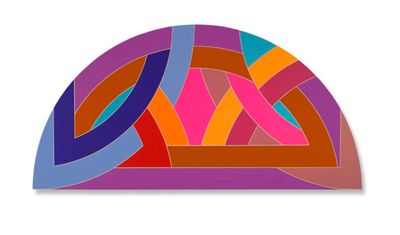
Stella’s curvy and colourful ‘Protractor’ series (1967–1971), for instance, combined his interests in the hues of Henri Matisse and the half-moon shape of the tool pulled out of pencils cases during maths class.
His ‘Moby Dick’ series (1986—1997) included 226 works—paintings, sculptures, and lithographs—inspired by the 135 chapters of Herman Melville’s novel. The swirling works were sparked by a wave-like form that emerged in his painting and a proximity to the tale’s setting; Stella owned a beach house not far from Nantucket.
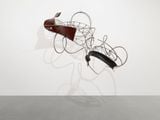
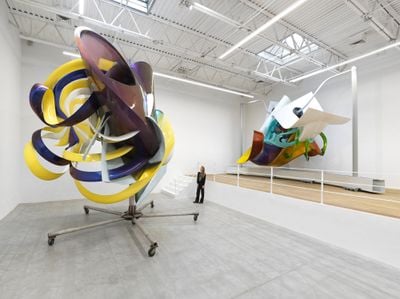
Stella remained remarkably productive and innovative late in life. His recent sculptures, designed on computers, engineered from fibreglass using shipbuilding technology, and painted in colourful high gloss, are now on show at two New York City galleries: Yares Art and Jeffrey Deitch.
Some of these are mounted on five-wheeled stems akin to the base of office chairs, fitting for someone who worked tirelessly but was always changing direction. —[O]


A respected voice in contemporary art discourse.
Focusing on ambitious storytelling and insightful art-world commentary. Ocula Magazine publishes in-depth interviews, critical essays and timely analysis on the artists, exhibitions and ideas driving the global art world.
Learn more about Ocula Magazine
Showcasing the best of the art world.
Ocula partners with galleries from around the world to highlight their artists, artworks and exhibitions. Gallery membership is by application and invitation, with each member vetted by an independent panel.
Learn more about Ocula Membership
Specialises in the sale of major artworks.
Led by a team with deep ties to the world’s leading auction houses, galleries and collectors. Ocula’s advisory team offers bespoke services to high-net-worth clients from around the world who are looking to acquire the best of contemporary and modern art.
Learn more about our team and services