The art world in focus
Subscribe to our newsletter for news and insights on artists, galleries and exhibitions.

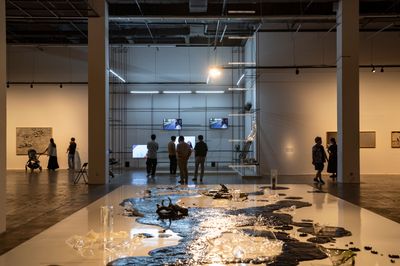
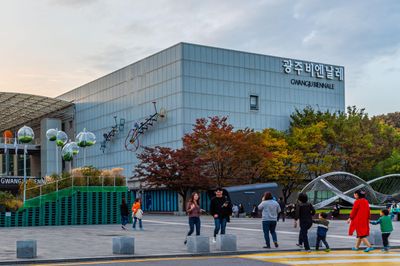
The biennale’s 16th edition is due to open later this week. Its 15th edition (above), took place in 2024, and was titled Pansori, a soundscape of the 21st century. Courtesy Gw
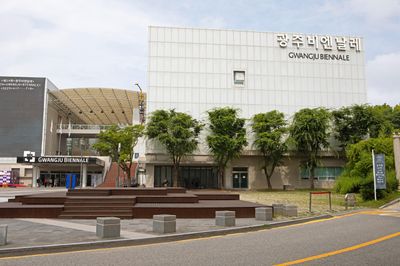
The Gwangju Biennale has today issued a statement of apology to all participating artists, institutions, audiences and stakeholders for the “concern, confusion and disappointment” caused by recent controversy surrounding the participation of Taiwan in its 16th edition, which is due to open later this week.
The apology, shared via Instagram, again attributed the international row to administrative procedures and contractual frameworks, which it said led the name “Taiwan Pavilion” to be omitted from promotional materials.
The statement asserted that the Biennale Foundation has “consistently upheld the principle that it does not intervene in or censor the planning, content, or expression of exhibitions” and remains “committed to safeguarding artistic autonomy and freedom of expression”.
The Gwangju city government recently issued its own public apology for the “insufficient communication” surrounding the Taiwan Pavilion. Published on 31 August, the statement also offered diplomatic reassurance to China by reaffirming the city’s respect for the “One China” principle, in line with South Korean government policy.
“We wish to clarify that the name used for the Taiwan pavilion at this Gwangju Biennale represents an expression left to the participating artists within the realm of art; it does not imply that Jeonnam-Gwangju Integrated Special City or the Gwangju Biennale recognises Taiwan as a sovereign state,” the statement said.
Though Taiwan has its own constitution and democratically elected leaders, it is not recognised as a sovereign nation by the United Nations, and its participation in international organisations and events has long been opposed by China, which considers the island to be a breakaway province that will eventually be under Beijing’s control.
The city’s apology followed objections from China’s ambassador to South Korea on 27 August, and the suspension of the installation of the Chinese pavilion. Chinese curators and installation staff reportedly left their pavilion’s venue, the Ha Jung-woong Museum of Art in Gwangju, on Friday with the display unfinished.
Gwangju’s attempt to contain the diplomatic fallout has prompted renewed criticism within the city’s cultural community. Rather than taking either side in the cross-strait dispute, some have questioned why its predictable political consequences were not anticipated.
Gwangju-based independent curator Kim So-jin, head of visual-arts collective 1995Hz, wrote on Instagram: “What is needed… is not an explanation that changes according to circumstances, but a clear position on how artistic autonomy and participants’ expression will be protected.”
Kim argued that cross-strait tensions were not an unexpected variable. If the biennale chose to host both the China and Taiwan pavilions, it should have been prepared to bear the consequences, she wrote.
Actor and Gwangju cultural figure Jang Do-guk also expressed anger in an Instagram post, calling on Biennale Foundation chair and city mayor Min Hyung-bae, and senior cultural adviser Hwang Pung-nyeon, to reflect and apologise.
He described the city’s apology as appearing “more desperate to offer an explanation to the Chinese government than to address the very people who deserve the apology”.
The 16th Gwangju Biennale opens on 5 September and continues until 15 November. Its pavilion programme is organised separately from the main exhibition and comprises presentations by countries and cultural institutions at venues across the city.


A respected voice in contemporary art discourse.
Focusing on ambitious storytelling and insightful art-world commentary. Ocula Magazine publishes in-depth interviews, critical essays and timely analysis on the artists, exhibitions and ideas driving the global art world.
Learn more about Ocula Magazine
Showcasing the best of the art world.
Ocula partners with galleries from around the world to highlight their artists, artworks and exhibitions. Gallery membership is by application and invitation, with each member vetted by an independent panel.
Learn more about Ocula Membership
Specialises in the sale of major artworks.
Led by a team with deep ties to the world’s leading auction houses, galleries and collectors. Ocula’s advisory team offers bespoke services to high-net-worth clients from around the world who are looking to acquire the best of contemporary and modern art.
Learn more about our team and services