





DIS – Collective
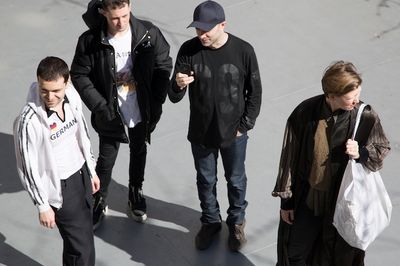
Image: DIS, curatorial team of the 9th Berlin Biennale for Contemporary Art. Photo: Julia Burlingham.
DIS is a New York-based collective responsible for curating the 9th Berlin Biennale for Contemporary Art, The Present in Drag, showing from 4 June to 18 September 2016.
The collective—Lauren Boyle, Solomon Chase, Marco Roso and David Toro—came together in 2010 around their common interests in fashion, lifestyle and marketing. Ever since, they have been involved in numerous creative and cultural projects, but are best known for publishing the online DIS Magazine, and gathering a core group of collaborators around the magazine’s online ecology.
Hortensia Völckers and Alexander Farenholtz, the executive board members of the Kulturstiftung des Bundes (German Federal Cultural Foundation), responsible for funding the Berlin Biennale, have called the DIS curatorial debut ‘a friendly takeover’ of an art institution by a group of people who are not rooted in contemporary art but instead are ‘experts in not wishing to claim expertise.’ With their fingers pointing to new trends, DIS stands at the intersection of pop culture, where everything collides and melts into the air that the wider population eventually breathes.
Although the curators of this edition of the Berlin Biennale have decided to thematically focus on the ‘present’, it is a different present from that with which contemporary art of the last two decades has been preoccupied. On one hand, their notion of contemporaneity comes after the internet and is described as ‘post-contemporary’. On the other, their present, as evident in the title of the Biennale, comes in drag—it is performed not exclusively by human agents, but perhaps also through a civilisational reliance on algorithmic intelligence that is equally capable of executing a sense of the present.
With a busy schedule, the curatorial team made themselves available for a few questions about their plans and hopes for the 9th Berlin Biennale.
MS: A few years ago, at a Lower East Side restaurant in New York, I had a conversation with artist Babak Radboy, co-founder of Shanzhai Biennial and creative director of Bidoun magazine, where we discussed his intriguing idea about modern and contemporary art. He believed that people like to see financial operations, political maneuvering and anthropological reasoning behind the persistence of the idea of art from the late 19th century onwards. However, what he thought really propels art and its global force forward is its ‘conscious and unconscious embodiment of the ideals set forth by communism’.
Even today, in light of the total subsumption of art by capital, the art world is one of the only remaining places where concepts of equality, collectivity and future are discussed or even exercised. Fast forward to the surprising endorsement of Bernie Sanders in DIS Magazine‘s editorial ahead of New York State’s Democratic Party primary, which for me signified the most ambitious aspect of the political image of the DIS collective. I strongly believe in the positive impact of baffling contradictions to the movement of history and the unfolding of the future. How do you personally and professionally reconcile the contradictions between the luxury- loving, money-fuelled world of art and the emancipatory spirit of socialism, which guarantees art its social and historical relevance?
DIS: I think this is one reason some people are upset at the Biennale: it’s not about objects, or about luxury, or about the ‘inside’ world of art. It’s focused on understanding our complicated relationships with the world we’re in—our internal conflicts as consumers, as political beings, as ‘leftists’, as people who want to do good within the world, as people who feel powerless, as people who are complicit, as people who are just people, as individuals within a system, and as individuals who generate content for this system.
“Many people see DIS as another way that the art world ‘eats’ other cultural industries. Ironically, that’s just a magazine. We are not incredibly invested in the nomenclature of who is an artist versus who is not an artist. However, it is a reflection of the creative industries today that many of our participants do not identify with a single market or field of production.
Artist Christopher Kulendran Thomas’ work has been particularly controversial, and is especially important. Kulendran Thomas looks at how the emergence of a new contemporary art market in Sri Lanka (accompanying the economic liberalisation that followed a genocide) functioned as part of a process of ‘soft’ (or economic) ethnic cleansing, whereby the spoils of prosperity, such as contemporary art, became a sort of retrospective justification for the violence on which that prosperity was founded.
Kulendran Thomas works through the idea that emancipatory communalism for a stateless nation might not be achieved today by force or resistance, or even through any mass-collective moral choice, but possibly through making something that people want. In a way, it’s a subversion of the Silicon Valley ‘disruptive’ mentality, used to chart an alternative scenario for displaced people, evolving a new economic model out of the existing economic system without friction.
At the outset, we thought of DIS as a space in which ideas and value systems are not overtly analysed or critiqued, but represented in their most heightened configuration. We’re political without the usual critical melancholy. We don’t have a standard oppositional critique and most of the artists we’re working with don’t either. If anything, critique should occur as a compulsory reaction in the body of the public, rather than as a field of specialised labour.
MS: Does this mean you are intentionally evoking rage in your audiences?
DIS: This is a show about the present, and the present is extremely troubling. In this show you don’t get an opt out card. It’s aggressive and almost violent in its rendering of the present, and the audience is fully implicated. There is no escape and there is no release valve for tensions. If you point fingers, you have to point them at yourself. So, people may leave feeling angry or uncomfortable, which is a valid response, and it’s better than them feeling gratified, as if they’d just recycled, or donated to a cause.
MS: The road to the art establishment’s embrace of the new aesthetics proposed by your collective has been long and rough. We all know about the quarter century obsession of the art world with Marxist and poststructuralist critiques of everything from art’s commodity form to its institutional structures. At the same time, the very same institutions and curators have lately come to embrace and assimilate not only the digital and the post internet but the DIS style blend of art, commerce, technology and design.
We have witnessed the ascension of artists like Ryan Trecartin, Jon Rafman and Katja Novitskova in the museum world. I am thinking of The Expo1 exhibition at PS.1 and The New Museum’s Triennial last year with which your exhibition in Berlin shares a lot of artists. Since you were appointed as the curators of this exhibition two years ago, one can assume that there has been plenty of time for your collective to reflect back, both on what you have accomplished and what others in the name of embracing future forms have done. What have been these lessons? Can we claim that given the significance of this triumph, we can expect the Berlin Biennale to be the mother of all post-Internet exhibitions?
DIS:

It’s funny because our office (and home in Berlin) at KW Institute for Contemporary Art has really bad wifi. The rest of the team is on desktops with somewhat better Ethernet connections, but we use our laptops and the Internet is incredibly slow; we were calling it the No-Internet Biennale. Definitely it is not a nostalgic show. There are so many ways and lenses through which to look at the 9th Berlin Biennale, post-Internet is just one of them—and maybe not the most interesting. In a sense it’s a background condition, but not a closed circuit. Nobody’s work is simply about the Internet—but the effects of technology and our compulsive connectivity are deeply felt.
We were really inspired by Ursula Franklin, a German/Canadian physicist and historian who’s in her 90s now and was interviewed for the Berlin Biennale 9 catalogue. Her ‘Real World of Techonology’ lectures from the 1980s release us from our relationship to technology as a sum of artifacts and gadgets, instead positing technology as the division of labor, and the structures that shape and control us. To her the most influential technologies are ‘social innovations’ that are increasingly about structuring discipline and compliance and diminishing reciprocity—this has been woven into the fabric of politics, banks, schools, government, transportation and distribution of energy. Following this logic we can see how the Internet (as the latest structuring technology) is re-shaping all of these societal elements. At the core of the Biennale is a consideration of these immense structures of technology and communication, and our position within them as individuals.
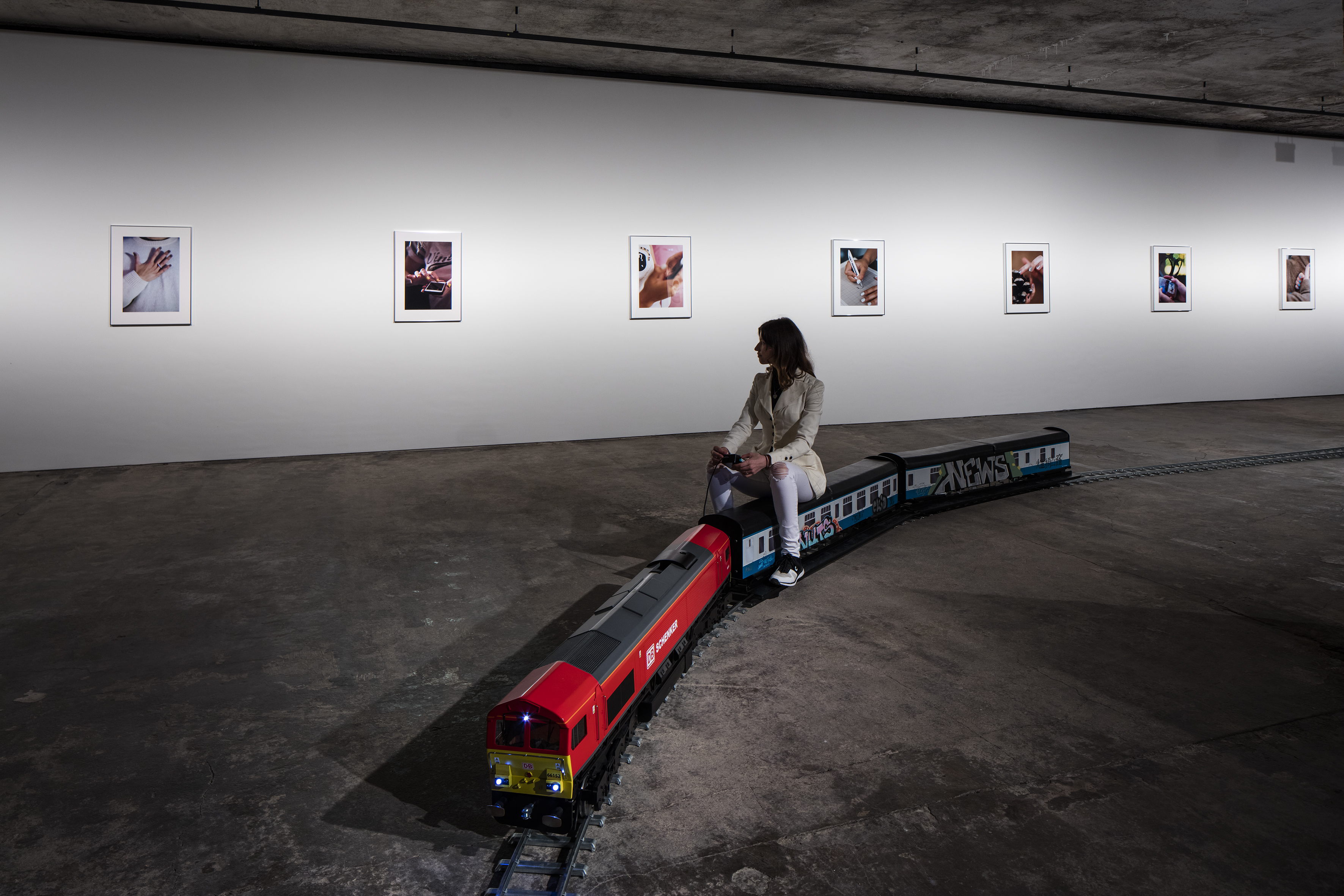
MS: Would it be correct to say that the question of content in the age of the Internet is one of the main concerns of the Berlin Biennale? I can see that there are many different sides to this debate within what we already know about the exhibition: First, there is the number of designers and architects who have been invited to participate. The shift from exhibiting only artists highlights how form and formal solutions can be rebranded today as content;. Second, there is ‘DISCREET, An Intelligence Agency for the People’: a Biennale related consortium, which addresses the issue of the privacy of content in the hyper-surveillanced environments of networked computing; Third, the fact that the Biennale’s online journal is called Fear of Content.
How do you resolve the tension that exists between the definition of content coming from design and commerce which considers all sorts of previously unavailable digitised information as content, and the realm of art in which content is more elusive, ephemeral and often only available to those who have the ability to produce it as a result of their encounter with the cultural product. Do you think that the current conditions of artistic production in the age of networked and algorithmic planetary computing and accelerated capitalism makes the distinction impossible or irrelevant? Can this blurring of the distinction be productive for political progress?
DIS: Many people see DIS as another way that the art world ‘eats’ other cultural industries. Ironically, that’s just a magazine. We are not incredibly invested in the nomenclature of who is an artist versus who is not an artist. However, it is a reflection of the creative industries today that many of our participants do not identify with a single market or field of production.
We don’t take for granted that contemporary art will exist any more than fashion, music or any other cogs exist in the culture industry. Still we are beholden to its formats and conventions, even if we ‘disrupt’ them—and that ‘disruption’ is precisely what beholds us to similarities within the ‘culture industry’ more generally. After all, it’s a cliché of the ‘creative class’ that everyone can be an artist, that it doesn’t matter, since we’re all content farms anyway. At the same time, people are very tied to their categories: we are dealing with a professionalised ‘art world’ after all. This is a paradox.
‘DISCREET, an Intelligence Agency for the People,’ is a platform by Armen Avanessian and Alexander Martos. It assumes the complexity of our society and the media-sociological revolution of the Internet/digital—we humans are no longer the only big players. Therefore our point of departure, the present, has lost its primacy. Algorithms, memes, hyperstitions etc. are instead ruling from the future. And the future can be predicted with incredible accuracy but is uncontrollable.
DISCREET is one example for how to use the field of art without producing objects. So, yes if memes really are more important/relevant today than contemporary art, then BB9 is also an investigation of what ‘gaining traction’ in the present condition might actually look like. The big mistake people make is to see this as a disillusioned or cynical or fatalist perspective.
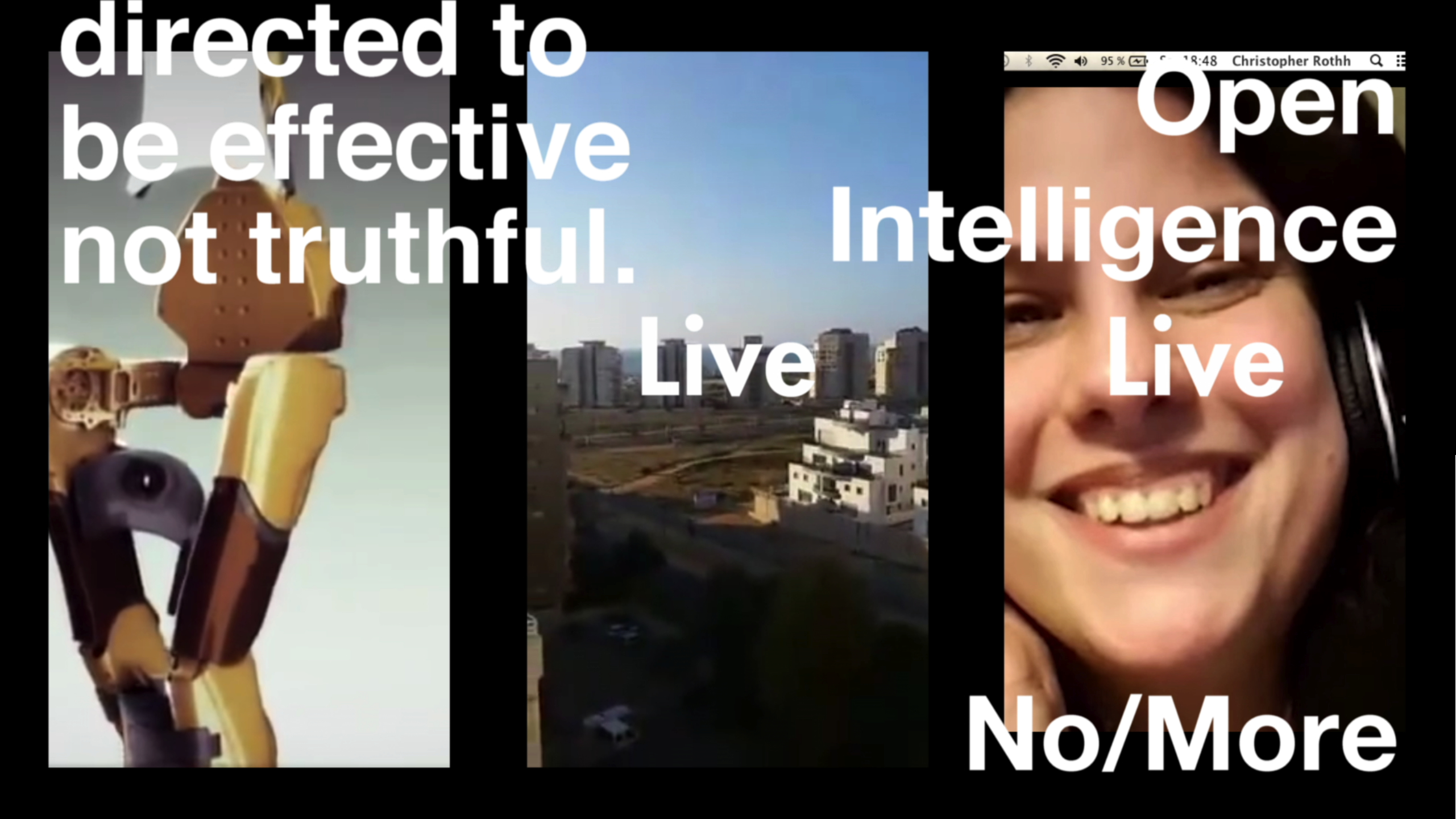
MS: How do you rate Berlin especially in comparison to New York? What about its night life? Would you move here if you have the chance?
DIS: Berlin has low stress, low consumption, and guilt-free partying for 48 hours. The space of night-life, gay clubs, physical proximity in dark spaces with music has been one generating factor for us (and of course so many others) in terms of our community and grounds for creativity. This is celebrated here—but more—so the club seems to be a space of freedom and anonymity in Berlin.
But, again we lived and worked at the KW on Augustrasse. It’s pretty monastic to live and work within an art institution. Berlin (the city itself) is almost self-conscious, to gentrification, to histories, in a way that New York is not. When a high rise goes up in New York, nobody notices or cares. Here in Berlin it is deeply felt. We could see ourselves here, but not now. Now we are planning our somewhat complicated return to New York.
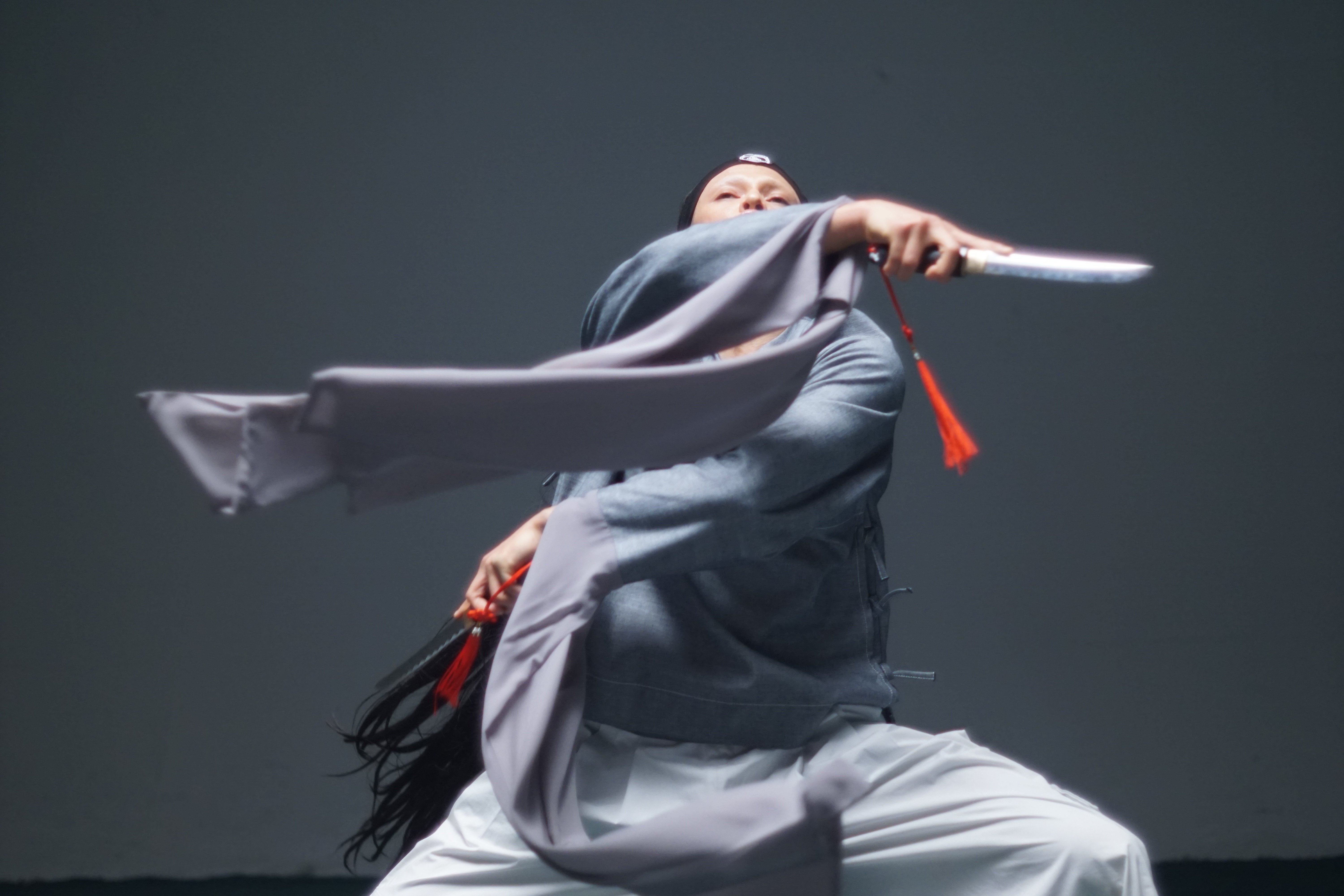
MS: Lastly, I want to invite you to ask a question of your own, and then to respond to it any way you like.
DIS: What comes to mind when you hear ‘paradessence’?
The rise of hyper-individualism in the face of the utter powerlessness of the individual. The shift to a personalised, wireless world of networked individualism, with each person switching between ties and networks against the backdrop of complex global concerns, impossible to process on an human scale. The feeling when you open your inbox, and you see a message or notification from your boss, your Tinder date, followed by an imploring call to arms about greenhouse gases, the Zika virus, and voting in the next election.
The way words and expressions are co-opted and re-branded by corporations and interest groups, like Patagonia’s ‘Don’t buy this jacket’ campaign which uses anti-consumerism to sell jackets. Feeling healthy by drinking a green juice while wasting vegetable pulp that emits methane. Soylent, the mysterious substance on the cover of the catalog, which promises the food of the future, while claiming to replace food altogether, but is not approved as food in Germany. —[O]
Main image: Image: DIS, curatorial team of the 9th Berlin Biennale for Contemporary Art. Photo: Julia Burlingham.


A respected voice in contemporary art discourse.
Focusing on ambitious storytelling and insightful art-world commentary. Ocula Magazine publishes in-depth interviews, critical essays and timely analysis on the artists, exhibitions and ideas driving the global art world.
Learn more about Ocula Magazine
Showcasing the best of the art world.
Ocula partners with galleries from around the world to highlight their artists, artworks and exhibitions. Gallery membership is by application and invitation, with each member vetted by an independent panel.
Learn more about Ocula Membership
Specialises in the sale of major artworks.
Led by a team with deep ties to the world’s leading auction houses, galleries and collectors. Ocula’s advisory team offers bespoke services to high-net-worth clients from around the world who are looking to acquire the best of contemporary and modern art.
Learn more about our team and services