The art world in focus
Subscribe to our newsletter for news and insights on artists, galleries and exhibitions.

Hany Armanious with Flat Earth (2017) at Henry Moore Institute, Leeds. Courtesy Henry Moore Foundation. Photo: Min Young Lim.
Stone Soup. The title conjures a lump in the throat; a hard esophageal obstruction that threatens to inhibit the ingestion of air, or meaning. Maybe it’s an oversized olive pip that slyly dodged extraction. You can almost feel it.
The evocative nature of the written word and its relationship to the material world is something that is playfully observed by Hany Armanious in his first U.K. museum solo show, Stone Soup, at the Henry Moore Institute.
Over the course of his career, the British sculptor Henry Moore worked with at least 41 different varieties of stone, from marble to sedimentary and metamorphic rock. Photographs from the 1960s and 70s document the artist wearing goggles and a short-sleeved button-down shirt, diligently carving away at large slabs of rock like an archaeologist in search of fossils.
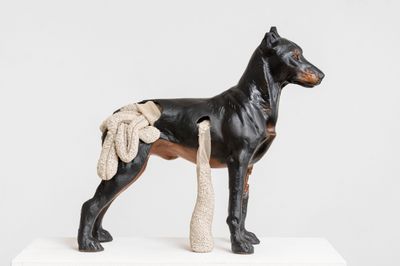
Armanious is an archaeologist of a different kind, one who excavates the detritus of the modern world to then replicate in pigmented polyurethane resin.

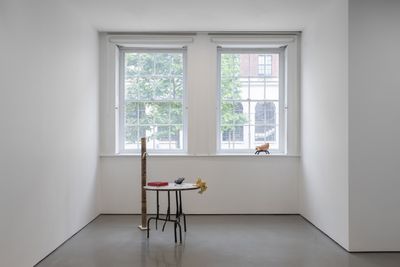
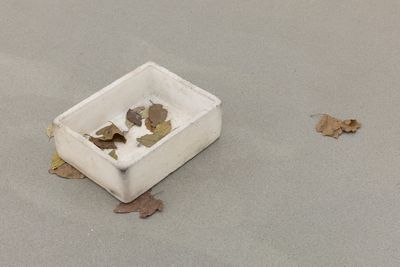
Stone Soup is a hotchpotch of 23 cast objects and assemblages dispersed throughout the gallery spaces—on the floor, walls, windowsills, tables, and plinths. Among them are used house paint trays, a table tennis bat, rubber bands, dead leaves, a grimy block of polystyrene, and a rolled-up projector screen.
Empathy Chart (2009) comprises a large sheet of white chipboard studded with coloured pinheads, its top edge broken irregularly on a downwards angle, as though a graph showing empathy on the decline. Resting almost apologetically on a low window ledge in the adjoining space is Mumble (2023), a fist-sized cluster of pastels wrapped in a tangled web of white cord.

A mass-produced painter’s canvas—Flat Earth (2017)—is hung backwards, exposing the wooden frame, staples, and its rear cavity filled with a cement-like substance. Elsewhere in the room, huddled around a corner, is a ritualistic congregation of 20 half-burned pillar candles, cryptically titled Frequently Asked Questions (2015).
The sculptures emit an aura of almost perverse obsession: what does it mean to cast largely mundane objects to exacting precision, down to the last grubby fingerprint, trace of rust, or scuff mark? It’s a gesture of trickery without resolve.

‘A lot of quite conventional processes and materials are brought together to create this thing which is a legitimate and fairly conventional sculpture,’ Armanious tells Ocula Magazine. ‘At face value, it may seem like an Arte Povera gesture.’
The titular parable offers another clue: in the European folk tale, a hungry boy with only a pot of water and a stone tricks villagers into giving him various ingredients to make a soup, at the promise of sharing the cooked result.

‘I think it’s quite a rich story, and it could be analogous to art making,’ Armanious says. ‘Particularly the work that I make where there’s a pretence that there’s a lack of worth.’
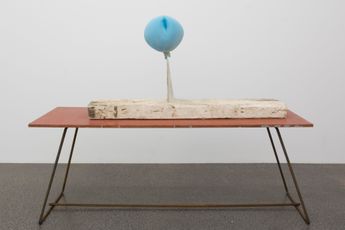
I look towards what appears to be a large polystyrene ball, trapped beneath the legs of a steel-frame table. On the table’s warped, rough-cut, particle-board top are pools of golden sand, swept with finger marks. Armanious has called it Happiness (2010).
Some of his titles might be read as tongue-in-cheek: droll slapstickery bubbling with existential angst. I suggest this to the artist, but he replies: ‘There’s no cynicism; it’s all pretty earnest.’
‘Often the title is a big part of realising the work ... I don’t really know what I’m making until I find the words to name it. The title is integral. It actually helps me to understand it.’
Armanious has a knack for coupling language with object; this quietly confident dichotomy is a curious characteristic of his work. To name something is to assert a level of authority over it, and to shape its interpretation. I point to a rock on the floor. ‘The world,’ Armanious immediately responds, the title of this sedimentary mass. ‘I think it’s pretty clear, once you put the two together, that there’s an aggregation of certain things that do create a world.’

‘And the nature of the materials, because they’re kind of decrepit and a bit fucked up, I don’t think makes them any less beautiful. In fact, I find them sort of redemptive gestures.’
‘Something like that plinth, where you notice the dripping paint and the badly joined corners,’ he says, pointing to a conspicuously unremarkable white platform titled Birth of Venus (2010). Its surface is grubby, with a single square of duct tape indicating the spot where Venus might have originated.
‘All of those things are suddenly brought into focus and made beautiful again.’ —[O]
A respected voice in contemporary art discourse.
Focusing on ambitious storytelling and insightful art-world commentary. Ocula Magazine publishes in-depth interviews, critical essays and timely analysis on the artists, exhibitions and ideas driving the global art world.
Learn more about Ocula Magazine
Showcasing the best of the art world.
Ocula partners with galleries from around the world to highlight their artists, artworks and exhibitions. Gallery membership is by application and invitation, with each member vetted by an independent panel.
Learn more about Ocula Membership
Specialises in the sale of major artworks.
Led by a team with deep ties to the world’s leading auction houses, galleries and collectors. Ocula’s advisory team offers bespoke services to high-net-worth clients from around the world who are looking to acquire the best of contemporary and modern art.
Learn more about our team and services