





Collector Profile: Jordan Schnitzer
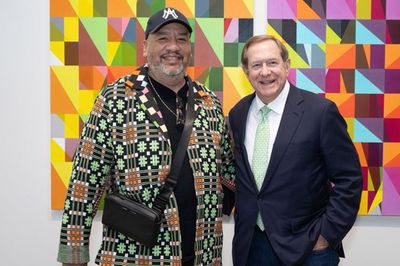
Jordan Schnitzer with Jeffrey Gibson at his exhibition Jeffrey Gibson: They Teach Love, From the Collections of Jordan D. Schnitzer and His Family Foundation, Kennesaw State University (27 August–7 December 2024). Courtesy Jordan Schnitzer Family Foundation.

Through his collection and eponymously named family foundation, the American collector Jordan Schnitzer has amassed over 22,000 artworks, including 40 by the artist Jeffrey Gibson.
Over the phone, Schnitzer explains how he came across Gibson’s boldly coloured textiles and sculptures at the 2019 Whitney Biennial. Struck by the work, which draws upon a wide range of references, including Choctaw, Cherokee, and queer histories, he contacted Gibson’s then-dealer, Kavi Gupta, and bought most of everything he had. When pressed about what drew him to Gibson’s work, Schnitzer replies, ‘You just know, and you get it done.’ That encounter began a long-term commitment to the artist, with Schnitzer adding more works to his collections over the next five years.
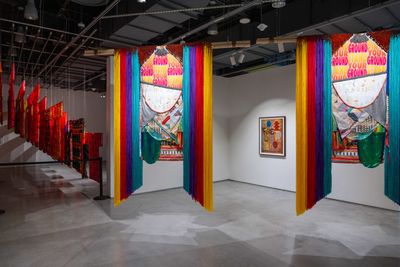
Among the works shown at the Whitney and subsequently purchased by Schnitzer was Stand Your Ground (2019): two boldly coloured, ceiling-hung banners emblazoned with the titular expression. The banners reference U.S. legislation, also known as the ‘Shoot First’ law, allowing citizens to use deadly force when they feel threatened.
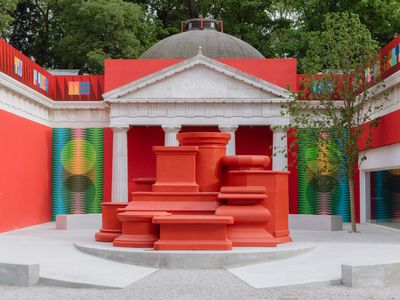
Stand Your Ground is included in a major travelling exhibition, Jeffrey Gibson: They Teach Love, at Bernard A. Zuckerman Museum of Art, Kennesaw State University. Comprising pieces from Schnitzer’s personal and foundation collections, the show is an opportunity for an American audience to experience the breadth of Gibson’s work. Gibson represented the U.S. at the Venice Biennale this year, a first for an Indigenous artist.
In person, Schnitzer is polite and absolutely to the point, and his commitment to American artists—whose work he follows avidly, amasses in-depth and exhibits widely—appears to be characterised by a relentless drive.
He begins our discussion by covering the numbers quickly: the Jordan D. Schnitzer Family Foundation Collection includes approximately 22,000 paintings, prints, and sculptures by 1,500 artists. He has supported 180 exhibitions at 120 museums over the past 27 years. Asked why he thinks collecting is important, Schnitzer responds, ‘Art and artists are important; they are chroniclers of our times.’ As the interview nears its end, Schnitzer’s businesslike manner softens, and the passionate collector surfaces.
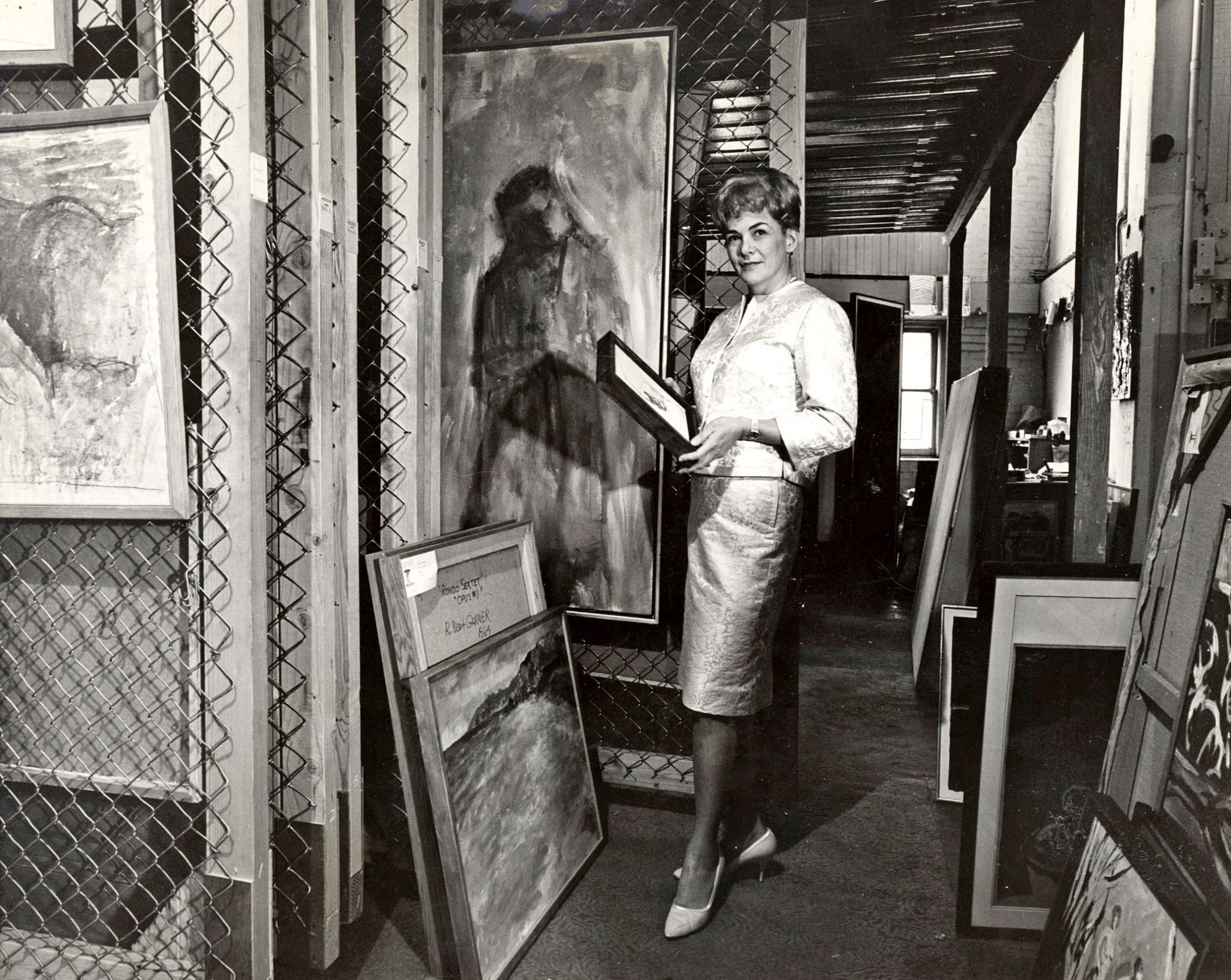
Schnitzer grew up in Portland, Oregon, the son of Fountain Gallery founder Arlene Schnitzer and real-estate investment magnate Harold Schnitzer. Today, he runs the family business as president of Schnitzer Properties (formerly Harsch Investment Properties) and oversees the family’s philanthropic pursuits. His support of the arts also extends to the funding of Portland’s Converge 45 biennial and the annual IFPDA Jordan Schnitzer Award for Printmaking Excellence.
Now in his early 70s, Schnitzer was just 14 when he acquired his first piece of art—a 1965 painting titled Sanctuary by the late Portland artist Louis Bunce, which still hangs in his home. His interest in art can be traced to his mother, who opened Portland’s first commercial gallery in 1961 and ran the space for 25 years. As a result, Schnitzer spent time around local artists such as Bunce, whom his mother’s gallery represented. His family collection today reflects these roots, holding work by leading artists from Seattle, Portland, and San Francisco.
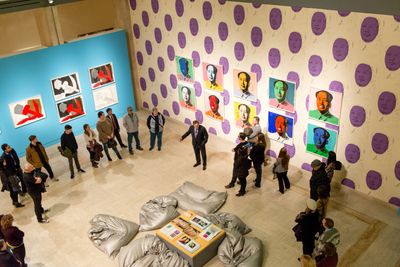
In the 1980s, Schnitzer started collecting more concertedly, focusing on multiples by postwar American artists. In 2016, the foundation organised an exhibition of 250 of Andy Warhol‘s prints at the Portland Art Museum—the most extensive presentation of the artist’s work in the U.S.—attended by more than 140,000 people.
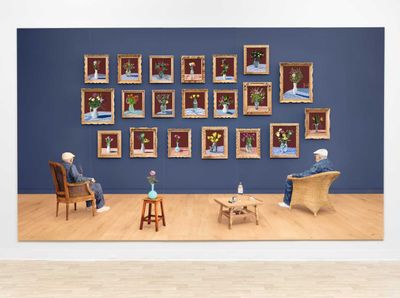
Additionally, the foundation has an array of works currently featured in several museum shows as part of its commitment to lending works at no cost to the relevant institution. Currently, the foundation is supporting Amplitude (9 August–15 December 2024) at Eskenazi Museum of Art in Bloomington, which features prints by Terry Winters; The Only Way to Hold a Weight: Richard Serra Prints at the Jewish Museum in Portland (26 October 2024–15 January 2025); and David Hockney: Perspective Should Be Reversed at Palm Springs Art Museum (23 November 2024–31 March 2025).
The Schnitzer Collection is housed in a 50,000-square-foot, purpose-built facility in Portland, run by 14 full-time staff. Schnitzer buys from dealers, artists, and through auctions. Most recently, he explained that his collection has been focused on adding artworks by previously underrepresented and marginalised groups, notably women and Indigenous artists. In Schnitzer’s view, artists such as Hock E Aye Vi Edgar Heap of Birds, Malia Jensen, Wendy Red Star, and Gibson are making some of the best work today.
Gibson’s survey show opened at Jordan Schnitzer Museum of Art, Washington State University, in August 2023 before travelling to its current destination, where a talk was held on 17 October between the artist and collector.
Instigated before Gibson’s Venice representation was announced, They Teach Love grew out of a conversation between Schnitzer and museum director Ryan Hardesty. Each year, the institution organises one exhibition that draws from the foundation’s collection, with previous shows spotlighting American contemporary artists such as Alison Saar and Polly Apfelbaum.

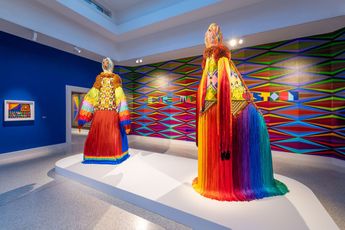
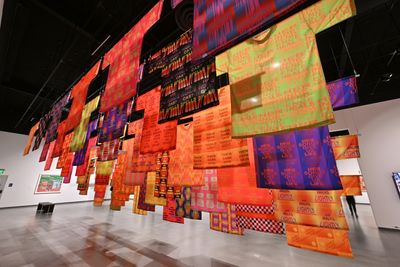
The show’s centrepiece is To Name An Other (2019), which comprises 51 screenprinted elk-hide drums and 50 wearable garments. It is related to a performance commissioned by the Smithsonian’s National Portrait Gallery in Washington, D.C., which involved volunteers who identified as members of minority racial and sexual orientation groups performing in the clothing. The project, which saw the artist embrace a collective approach for the first time, marked a pivotal moment in Gibson’s career.
Upon seeing To Name An Other, Schnitzer explains that he was struck by Gibson’s ability to use garments and drums to present the sophisticated, astonishing beauty of his Choctaw and Cherokee culture. He was also left reeling from a sense of anguish at the losses Indigenous communities have suffered. He hopes the audiences who see the show may learn something of the history Gibson’s work references.
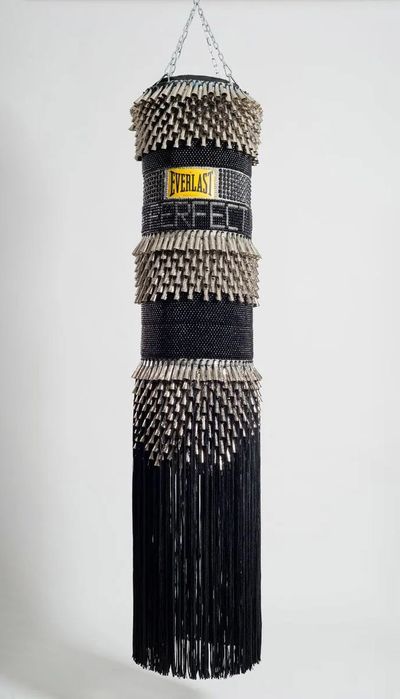
For Schnitzer, Gibson’s brilliance lies in his capacity to create tension by both honouring and contemporising his culture and history while weaving in other references, including his journey as a queer person. He cites Gibson’s ‘Punching Bags’ series (2013–ongoing): dazzling beaded punching bags—inscribed with statements of resistance, frustration, and hope—as opening up many interpretive possibilities.
‘Every visitor brings to an exhibition the sum of who they are—a million different little mosaic parts of every experience they have ever had,’ Schnitzer says. ‘If just one person is touched by the art, if their life is perhaps changed for the better, or if they come to reflect on Gibson’s experience or the experience of Indigenous people, then I see the show as a success.’ —[O]
Main image: Jordan Schnitzer with Jeffrey Gibson at his exhibition Jeffrey Gibson: They Teach Love, From the Collections of Jordan D. Schnitzer and His Family Foundation, Kennesaw State University (27 August–7 December 2024). Courtesy Jordan Schnitzer Family Foundation.



A respected voice in contemporary art discourse.
Focusing on ambitious storytelling and insightful art-world commentary. Ocula Magazine publishes in-depth interviews, critical essays and timely analysis on the artists, exhibitions and ideas driving the global art world.
Learn more about Ocula Magazine
Showcasing the best of the art world.
Ocula partners with galleries from around the world to highlight their artists, artworks and exhibitions. Gallery membership is by application and invitation, with each member vetted by an independent panel.
Learn more about Ocula Membership
Specialises in the sale of major artworks.
Led by a team with deep ties to the world’s leading auction houses, galleries and collectors. Ocula’s advisory team offers bespoke services to high-net-worth clients from around the world who are looking to acquire the best of contemporary and modern art.
Learn more about our team and services