





Elyas Alavi: Another Kind of Love
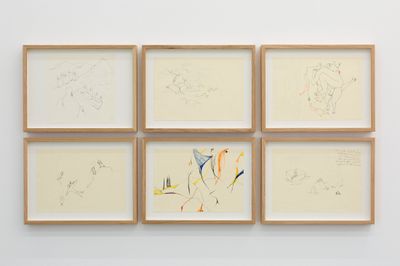
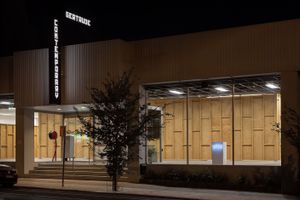
Exhibition view: Elyas Alavi, Another Kind/دیگرگونه, Gertrude Glasshouse, Naarm/Melbourne (17 November–16 December 2023). Photo: Christian Capurro.
In conjunction with his solo exhibition at Gertrude Glasshouse, Elyas Alavi held a poetry reading and music event in solidarity with Palestine. Alavi moved to Iran as a child following the intensification of war in his homeland, Afghanistan, later moving to Australia in 2007 as a refugee.
Now based in Naarm, Alavi’s practice continues to be informed by his experiences of migration and displacement, often focusing on the histories of the Southwest Asia and North Africa regions. His installation Cheshme-e Jaan (The Spirit Spring) (2023), commissioned for 2023 TarraWarra Biennial, traces historic solidarities between First Nations peoples in Australia and cameleers (camel handlers) brought to Australia by colonial British India between 1860 and 1920.
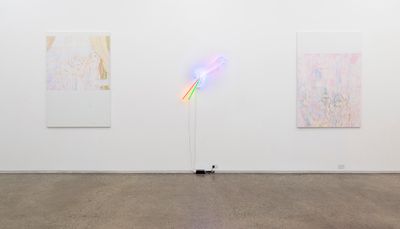
Alavi’s most recent exhibition, دیگرگونه ANOTHER KIND, continued this focus on shared histories, this time framed through his queer identity. The presentation included quietly arresting drawings, paintings, and neon works that both document and process personal and collective markers of identity.
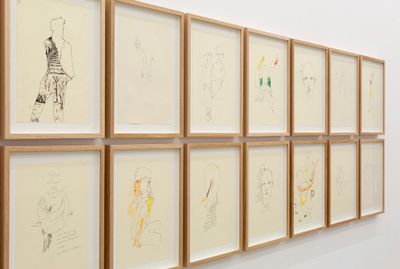
Presented along the length of one wall were Alavi’s ’ دیگرگونه ANOTHER KIND’ drawing series (2013–2023)—40 studied pen drawings on paper, inspired by dreams and poems, as well as particular events. Some depict coupled or intertwined figures; others movements or monuments and text.
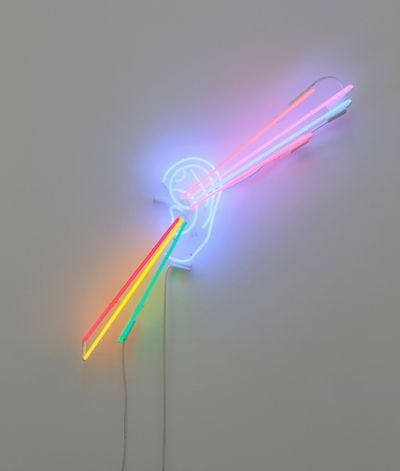
On the facing wall, the three-part installation Listen, I speak with a silent lip (2023) centres an outline of an ear in neon, with outstretching coloured lines expressing noise, perhaps a call to listen. It is framed on each side by two paintings, made with oil and wax on canvas; one a portrait of a couple in muted colours, erased from the waist down, the other dappled outlines of silhouettes against a backdrop of pastel pinks and blues.
Alavi is also a poet, with three published books of poems in Farsi. Part of his poem that accompanied the exhibition, titled ‘Another Kind’ or in Farsi/Dari, reads: ‘You asked: “Are you coming back?” / I couldn’t look at you / – “I don’t know” / and I sat in the taxi / the taxi drew away / and I didn’t look back / since our love was another kind / and was sad and secret.’
The Farsi/Dari word / Digar-gooneh translates to ‘another way’ or ‘another kind’. For many queer folk, versions of this word have become a poignant descriptor of their identity. In the wider global context surrounding Alavi’s show, the term may be read as a proposition—for an openness, and consideration for what an alternative future might look like. —[O]
Elyas Alavi:Another Kind/دیگرگونه was on view at Gertrude Glasshouse in Naarm/Melbourne from 17 November to 16 December 2023. The public programme organised by Alavi took place on 25 November 2023 at Gertrude Glasshouse and included artists Thabani Tony Tshuma, Mohamad Habib Chamas, Hasib Hourani, Farnaz Shahimi, Maya Hodge, and Elyas Alavi.
Main image: Exhibition view: Elyas Alavi, Another Kind/دیگرگونه, Gertrude Glasshouse, Naarm/Melbourne (17 November–16 December 2023). Photo: Christian Capurro.





A respected voice in contemporary art discourse.
Focusing on ambitious storytelling and insightful art-world commentary. Ocula Magazine publishes in-depth interviews, critical essays and timely analysis on the artists, exhibitions and ideas driving the global art world.
Learn more about Ocula Magazine
Showcasing the best of the art world.
Ocula partners with galleries from around the world to highlight their artists, artworks and exhibitions. Gallery membership is by application and invitation, with each member vetted by an independent panel.
Learn more about Ocula Membership
Specialises in the sale of major artworks.
Led by a team with deep ties to the world’s leading auction houses, galleries and collectors. Ocula’s advisory team offers bespoke services to high-net-worth clients from around the world who are looking to acquire the best of contemporary and modern art.
Learn more about our team and services