




Juan Ford: Artist of Seduction

Juan Ford, Recollector (2018) (detail). Oil on linen. 180 x 150 cm. 70 7/8 x 59 1/16 inches. Courtesy Galerie Du Monde.
At Galerie du Monde in Hong Kong, the ostensible centrepiece of Juan Ford’s recent solo exhibition, Blank (March 15–April 20, 2019), is Recollector (2018), a hyper‑realistic portrait of a solitary female figure framed against an unnervingly lucid blue sky and cropped, somewhat abruptly, at the knee.
Ford tends to work from photographs of friends, self‑portraits, and mannequins, all of them elaborately trussed in fabric, tape, and a confounding mix of industrial and organic detritus. Here, the model is a mannequin, though that fact is perversely difficult to discern: the arms are mummified in cloth down to the fingertips, the face is bandaged almost to the point of erasure, and an oversized pair of sunglasses serves as both shield and mask. Shrouded, her head angled just off‑centre, she reads as uncannily human, but the futuristic costume and that blank, unregistered gaze—aimed somewhere just beyond the viewer—imply that her attention has long since migrated to a world adjacent to, if not entirely distinct from, our own.
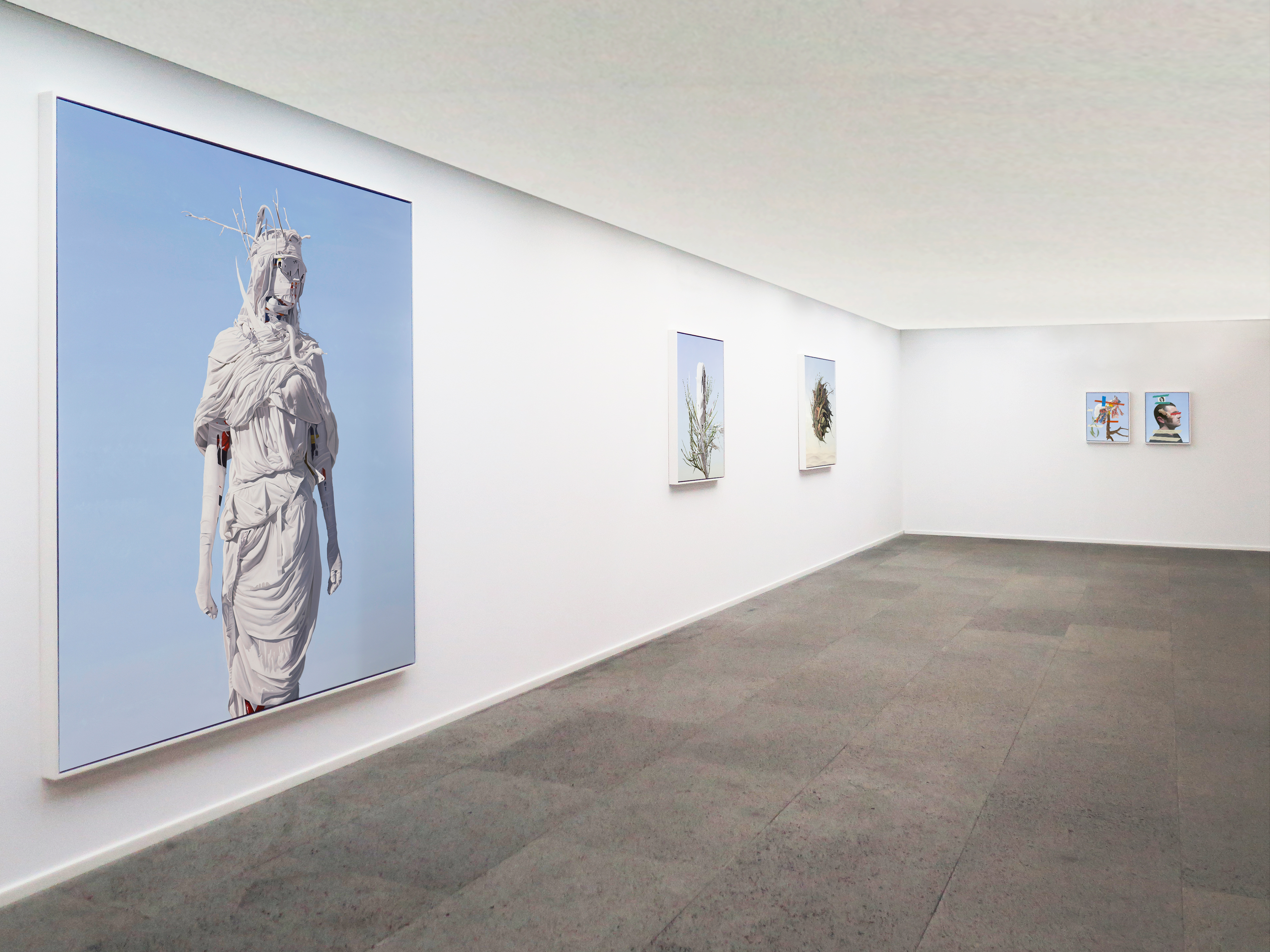
Recollector was not the first canvas Ford completed for the exhibition, yet it quickly asserted itself as the axis around which the rest of Blank began to turn. Its centrality is underscored by sheer scale: at 1.8 metres, roughly life‑size, it is the exhibition’s most imposing presence. Flanking it, two smaller portraits extend the vocabulary of the veiled, bespectacled figure and the baroque, layered costume. The Mystic (2019) offers a frontal bust, the figure presented as if for a particularly solemn passport photograph, while Naiad (2019)—titled after the minor water deities of Greek mythology—presents a comparably attired figure, cropped at the waist, as though surfacing from some toxic tide. In each, the costumes congeal under drizzles and sheets of white paint, the residue of a studio experiment in which Ford upended an entire bucket over his sculptural maquettes and, in the ensuing mess, glimpsed what he has described as “an Athenian statue or a muse of ancient times.”

From early in his career, the Australian‑born Ford has been preoccupied with the intellectual afterglow of classical antiquity. During a 2006 residency at the British School at Rome, under the auspices of the Australia Council for the Arts, he began a sequence of marble‑bust paintings—among them Husk #6, in which a dramatically lit head floats, disembodied, against a tenebrous ground like a relic rescued from oblivion. Ford has repeatedly invoked antiquity’s hold on his imagination, particularly the ancient Greek notion of light as bifurcated into lux and lumen—lux as the clear, investigative glare of reason, lumen as the more fugitive illumination of the imagination. The hard, cerulean skies that recur behind his objects and figures nod to this double register of light, their artificial clarity hovering between empirical description and metaphysical haze. They also, more prosaically, recall the harsh, desiccating light that saturates the Australian landscape from which Ford’s work emerges.
Around the same time that Ford started making references to antiquity in his work, he also started to introduce Australian fauna. Take for example the earlier works The Last Enemy (2007) in which the underside of a human skull sprouts leaves, and One Last Embrace (2008), which depicts white tape wrapped around Australian bottlebrushes, foreshadowing the later suturing of human figure, twig, and animal in Recollector. Over time, the vegetal in Ford’s paintings has assumed increasingly anthropomorphic form. Guardian (2018), also shown in Blank, stages a human bust crowned with a horned helmet of leaves, a fantastical evolution of the T‑shirt‑wearing branches of Osaka Speed (2013). In Degenerator (2013), a bespectacled figure cradles a rifle cobbled from taped tree branches, a weapon assembled from refuse and forest alike; viscous green paint oozes from beneath his sunglasses and mouth, streaking his white shirt and suggesting that his body is less flesh than pressurised toxic pigment. With her outsized eyewear and protective veil, the woman of Recollector reads as a kindred spirit, an eco‑warrior kitted out for a battle whose terrain remains tantalisingly unspecified.

Ford’s paintings wear their Australian provenance with a kind of matter‑of‑fact pride, yet they resist being corralled into a narrowly national conversation. He has said that he is reluctant to foist a single, sanctioned reading on viewers, but he also concedes that he wants the work to carry a distinctly environmental charge. A painting in Blank titled El Lissitzky—after the Russian avant‑gardist who championed artists as “agents of change”—signals the extent to which Ford regards his own practice as a quietly subversive instrument of environmental activism.

The solitary figure in Recollector can conjure, by turns, Greco‑Roman statuary, a veiled Madonna, a post‑apocalyptic road warrior out of “Mad Max,” or a contemporary shaman, depending on which art‑historical channel the viewer happens to tune in to. Portraiture has long been Ford’s dominant mode—he has been shortlisted four times for the Archibald Prize, Australia’s most prestigious portrait award—but his output is equally indebted to the traditions of landscape painting and botanical illustration. He collapses these mediums and genres into a private vocabulary, producing paintings that are, in effect, the final stage of a sculptural and photographic process. In this sense, his portraits are not simply of people; they are composite likenesses of trees, flowers, foliage, landscape, culture, history, and, not least, light itself.

Ford’s canvases are executed with a painstaking hyperrealism that, at first glance, risks tipping into the merely virtuosic. Yet the result is never a bland simulacrum of the studio set‑up. For Ford, the human figure is a stage on which to externalise an inner vision—“something that has come from play, from dreams, from thoughts,” as he has put it. The paintings accrue layers of meaning, some ostentatiously on the surface, others buried like seeds. In the catalogue accompanying Blank, the writer and curator Andrew Gaynor notes that Ford’s Masters by Research, completed at RMIT University in 2000, investigated the conjunction of painted realism and anamorphosis—a distorting device familiar from Hans Holbein’s The Ambassadors (1533) and the woodcuts of Erhard Schön (circa 1491–1542), who used it to smuggle alternate meanings into ostensibly straightforward images.
Recollector, rendered with such precision that it initially passes for a photograph, seduces the viewer with its apparent fidelity to the real, only to reveal—on closer inspection—a being conjured from paint and fantasy, her garments soaked in pigment and festooned with plastic fauna and brittle twigs. Ford’s great seduction lies in this tension: he lures us in with sheer technical bravura, then wrong‑foots us with the strangeness of what we discover, forcing us to invent, if only in passing, the world toward which Recollector so imperturbably directs her gaze—[O]
Main image: Juan Ford, Recollector (2018) (detail). Oil on linen. 180 x 150 cm. 70 7/8 x 59 1/16 inches. Courtesy Galerie Du Monde.



A respected voice in contemporary art discourse.
Focusing on ambitious storytelling and insightful art-world commentary. Ocula Magazine publishes in-depth interviews, critical essays and timely analysis on the artists, exhibitions and ideas driving the global art world.
Learn more about Ocula Magazine
Showcasing the best of the art world.
Ocula partners with galleries from around the world to highlight their artists, artworks and exhibitions. Gallery membership is by application and invitation, with each member vetted by an independent panel.
Learn more about Ocula Membership
Specialises in the sale of major artworks.
Led by a team with deep ties to the world’s leading auction houses, galleries and collectors. Ocula’s advisory team offers bespoke services to high-net-worth clients from around the world who are looking to acquire the best of contemporary and modern art.
Learn more about our team and services