





Presence and Possession: Key Works from 9 Filipino Artists

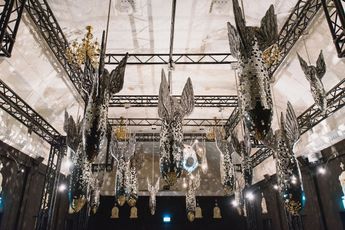
Exhibition view: Possession: To Have & To Hold, Gajah Gallery, Jakarta (11 August–8 September 2024). Courtesy Gajah Gallery.
In the Philippines, where I live, there is a cultural phenomenon that could be described as a fear of empty spaces. Household walls are crammed with family photographs, graduation diplomas, and framed medals. During fiestas, streets are festooned with colourful banderitas, leaving no corner bare. Many cultures across Indonesia similarly embellish surfaces with intricate decorative motifs, driven by the belief that any unadorned space could invite evil spirits.
The exhibition Possession: To Have & To Hold at Gajah Gallery in Jakarta features artworks by nine contemporary Filipino artists. Curated by Joyce Toh, the show considers the human compulsion to possess something, often to address an existential emptiness, that speaks to a deeper anxiety around presence.
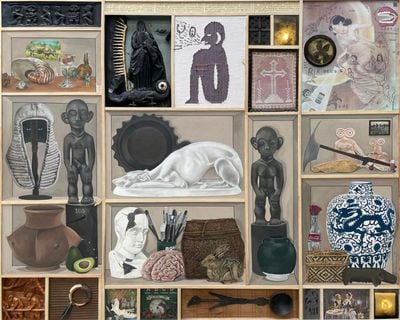
In the mixed-media assemblage Cabinet of Unearthly Delights (2024), Kawayan de Guia arranges an array of items and paintings—including local rice god idols, a Chinese blue-and-white ceramic, a Coca-Cola bottle repurposed as a vase, syncretised esoteric Christian amulets, and even a human brain—in a cabinet of curiosities. The artist, known for evoking histories of Philippine occupation and cultural exchange, here reflects on the evolution of reverence. Who or what are our gods today in a world shaped by neo-colonialism, consumerism, and capitalism? Do we possess them, or do they possess us?

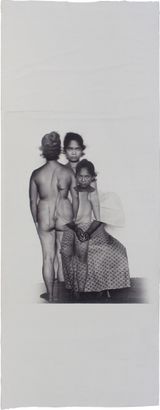
Adding a historical dimension to the exhibition is Kiri Dalena‘s canvas print, Tagalog Woman (2024). It depicts a reworked 19th century image of a woman in three superimposed stages: seated and dressed in traditional Tagalog attire; standing nude with her back to the camera; and facing forward, also nude. Hearkening to early Western anthropologists who eroticised the indigenous body, the woman meets our gaze directly, powerfully challenging our obsession with the fetishised female form and anthropological objectification.

On first impression, Nona Garcia‘s oil on canvas Last Sunday (2024) looks to be a straightforward portrayal of the interior of a run-down kitchen, with broken plywood planks on the ceiling and a damaged steel roof. This building is the artist’s grandfather’s abandoned house. Despite the evident decay, the meticulously arranged plates on the dish rack and the spotless metal basin hint that someone may still reside there. The work subtly explores how we hold on to people and places long since passed.

Rocky Cajigan‘s acrylic on canvas There Are No Saints Here (2024) depicts a satellite dish set against a snowy mountain backdrop in Nepal’s Muktinath Valley–a region revered by Hindus and Buddhists. In the far upper right corner, a stupa’s edge suggests the location’s sacredness. However, the dish is not a sophisticated device for receiving and transmitting signals to and from the cosmos; instead, repurposed, it now functions as a solar cooker, used in some remote areas as a practical means of survival.
In confronting our desire for possession, we perhaps might rise above the superficial and move towards a more fulfilling existence. —[O]
Main image: Exhibition view: Possession: To Have & To Hold, Gajah Gallery, Jakarta (11 August–8 September 2024). Courtesy Gajah Gallery.






A respected voice in contemporary art discourse.
Focusing on ambitious storytelling and insightful art-world commentary. Ocula Magazine publishes in-depth interviews, critical essays and timely analysis on the artists, exhibitions and ideas driving the global art world.
Learn more about Ocula Magazine
Showcasing the best of the art world.
Ocula partners with galleries from around the world to highlight their artists, artworks and exhibitions. Gallery membership is by application and invitation, with each member vetted by an independent panel.
Learn more about Ocula Membership
Specialises in the sale of major artworks.
Led by a team with deep ties to the world’s leading auction houses, galleries and collectors. Ocula’s advisory team offers bespoke services to high-net-worth clients from around the world who are looking to acquire the best of contemporary and modern art.
Learn more about our team and services