



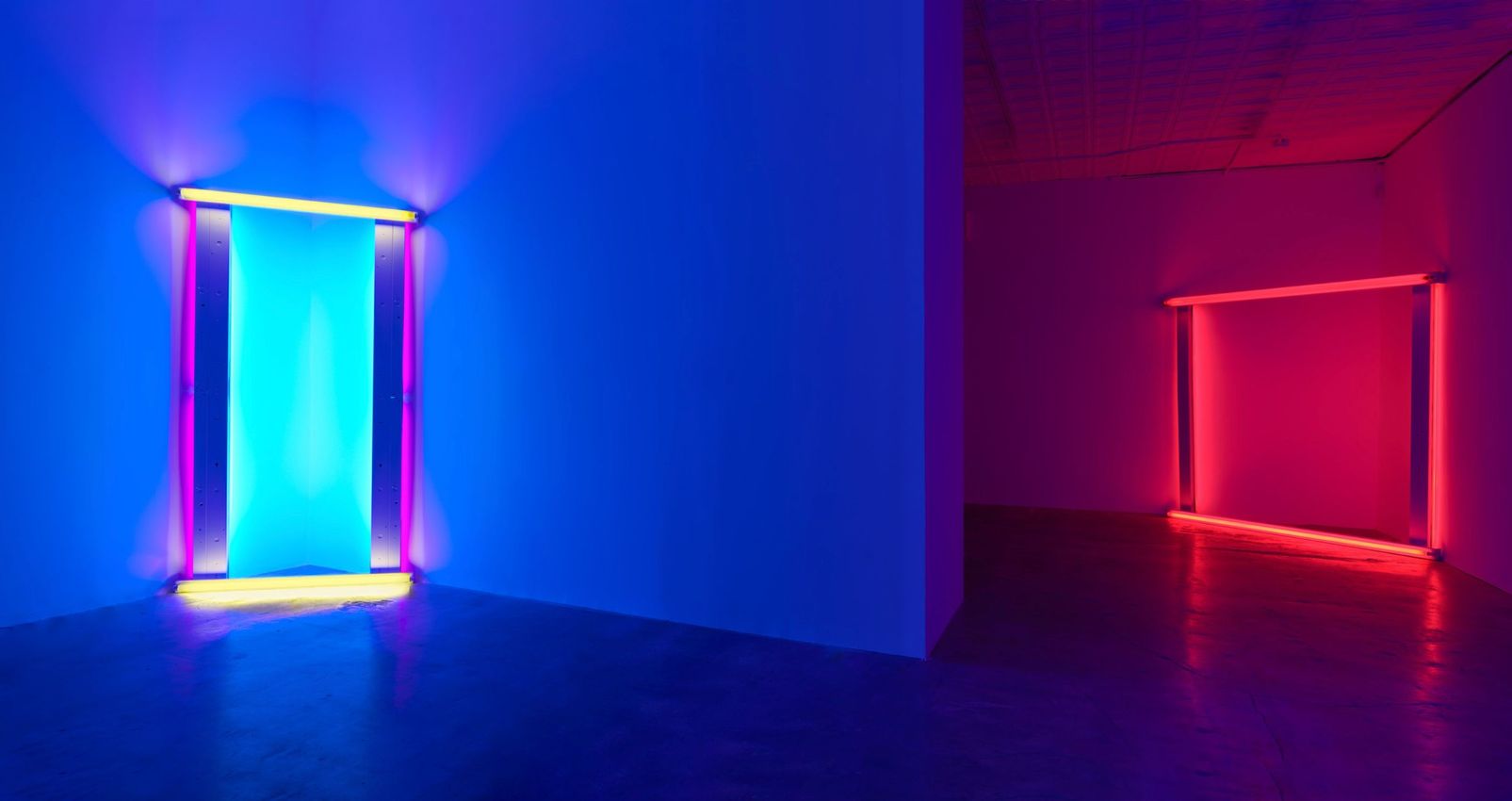
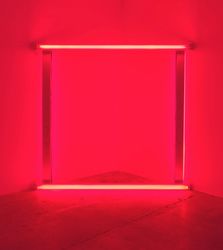
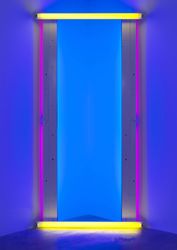

Gagosian is pleased to present two sculptures by Dan Flavin: untitled (to Barnett Newman) two (1971), and untitled (to Sabine and Holger) (1966–71). The dates of the exhibition overlap with those of exhibitions of work by John Chamberlain at 522 West 21st Street and Donald Judd at 555 West 24th Street.
Flavin used widely available fluorescent tube lights to radically alter and rearticulate the space shared by work and viewer while maintaining formal and material consistency from one project to the next. In doing so, he also circumvented the limitations imposed by handwrought armatures, as well as by pedestals and other conventional means of object display. In this way, Flavin—alongside his contemporaries including Carl Andre and Donald Judd—played a key role in directing the course of art making in the 1960s and 1970s toward the eradication of the artist’s hand.
In untitled (to Sabine and Holger), Flavin transforms the viewer’s experience through what artist Mel Bochner has characterised as ‘an acute awareness of the phenomenology of rooms.’ The work both defines the intersection of the walls and masks the darkness of the receding corner. ‘I knew the actual space of a room could be broken down and played with,’ Flavin explained, ‘by planting illusions of real light, electric light, at crucial junctures in the room’s composition.’
One of four sculptures with the same subtitular dedication, untitled (for Barnett Newman) two was produced for Flavin’s solo exhibition at Dwan Gallery, New York, in 1971. The sculptures were intended as memorials to the painter, their colour combinations referring to Newman’s four-painting series ‘Who’s Afraid of Red, Yellow and Blue’ (1966–70). As with untitled (to Sabine and Holger), the work’s autonomous formal qualities are impossible to consider independently of the environment with which they interact. Saturating the exhibition space with ambient coloured light, untitled (for Barnett Newman) two effectively transforms our perception of the room’s internal dynamics without altering its physical structure. Seen together, the two works also underscore Flavin’s interest in serial configurations.


Daniel Nicholas Flavin Jnr was a pioneer light artist and installation-maker associated with the Minimalist movement.


A respected voice in contemporary art discourse.
Focusing on ambitious storytelling and insightful art-world commentary. Ocula Magazine publishes in-depth interviews, critical essays and timely analysis on the artists, exhibitions and ideas driving the global art world.
Learn more about Ocula Magazine
Showcasing the best of the art world.
Ocula partners with galleries from around the world to highlight their artists, artworks and exhibitions. Gallery membership is by application and invitation, with each member vetted by an independent panel.
Learn more about Ocula Membership

Specialises in the sale of major artworks.
Led by a team with deep ties to the world’s leading auction houses, galleries and collectors. Ocula’s advisory team offers bespoke services to high-net-worth clients from around the world who are looking to acquire the best of contemporary and modern art.
Learn more about our team and services