




JOEL SHAPIRO
1941-2025, United StatesJoel Shapiro was a pioneering American artist whose abstract geometric sculptures redefined the possibilities of contemporary art.Shapiro’s six-decade career included more than 160 solo exhibitions and retrospectives worldwide, and his works—which included drawings and printmaking too—are held in major museum collections from the Museum of Modern Art in New York to the Tate in London.
Following his death in 2025, his gallerist Arne Glimcher, founder of Pace Gallery, said: ‘For over 30 years, it has been my honour to represent Joel Shapiro and to count him as a close friend. His early sculptures expanded the possibilities of scale, and in his mature figurative sculptures, he harnessed the forces of nature themselves. With endless invention, the precariousness of balance expressed pure energy—as did Joel. I will miss him dearly.’
Early Years
Joel Shapiro was born in New York City in 1941 and grew up in Sunnyside, Queens. He earned both his BA (1964) and MA (1969) from New York University. Between 1965 and 1967, Shapiro served in the Peace Corps in southern India, an experience that profoundly influenced his artistic direction and his understanding of the role of art in daily life. Shapiro’s first solo exhibition was held at Paula Cooper Gallery in New York in 1970, and in 1969, he participated in the landmark group exhibition Anti-Illusion: Procedures/Materials at the Whitney Museum of American Art. The later, marking the emergence of process and conceptual art and including artists such as Eva Hesse, Richard Serra, Robert Morris, and Bruce Nauman.
Joel Shapiro Artworks
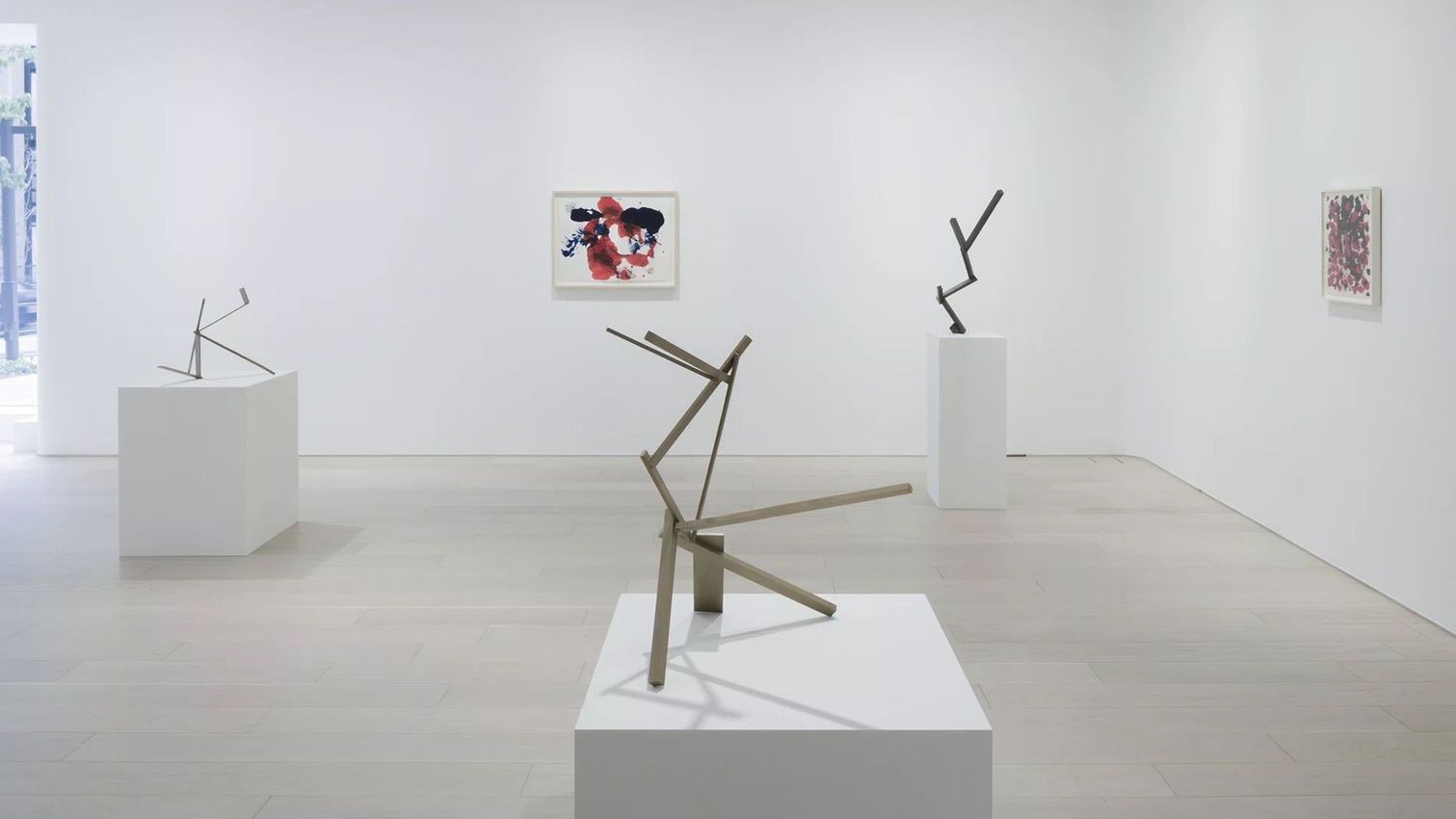
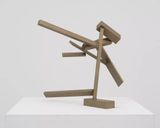
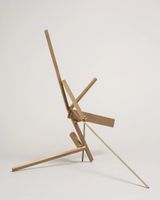
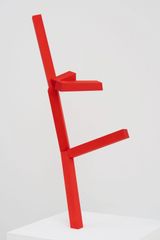
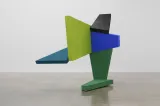
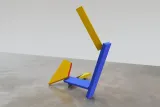
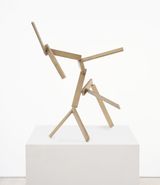
Joel Shapiro’s art is defined by abstract geometric sculpture that explores movement, balance, and the psychological impact of space. His practice is known for subverting the distinctions between abstraction and representation, often referencing the human figure through simplified, dynamic forms.
Early Small-Scale Sculpture
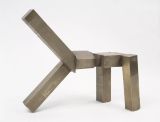
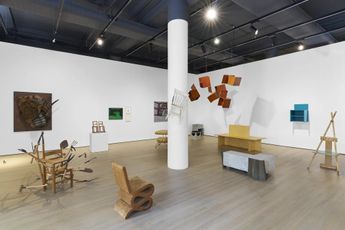
In the late 1960s and 1970s, Shapiro created small, reductive sculptures of everyday objects—such as houses and chairs—using materials like wood, bronze, and cast iron. These works presented a subtle challenge to Minimalism by introducing memory, reference, and emotion to otherwise simplified forms.
Shapiro’s early sculptures were often displayed on the floor or on shelves at eye level, encouraging a direct, intimate engagement with the artwork. An example is Bridge (1971–73), a cast-iron sculpture only four inches tall, which Shapiro installed alone in a vast room at the Clocktower in New York, inviting viewers to consider scale and psychological presence.
Life-Size and Figurative Works
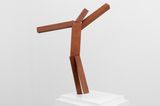
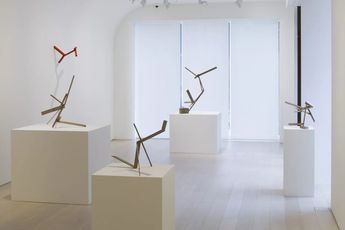
By the 1980s, Shapiro began making life-size sculptures that suggested human figures in states of animation or upheaval, using wood and bronze to evoke movement and energy. He often constructed these works by joining lengths of wooden four-by-fours to form simplified ‘heads’, ‘arms’, and ‘legs’ attached to a ‘torso’, then casting them in bronze to retain the tactile qualities of the original material. An important example is Untitled (1980–81), a nearly life-size figure balanced on one leg, leaning forward with arms extended, reminiscent of a dancer by Degas.
Shapiro’s method involved building small wooden models, then scaling them up and casting them in bronze, preserving the marks and grain of the wood to emphasise process and materiality. These works, often untitled, assert themselves vertically in space and reference the human body while remaining abstract.
Monumental and Suspended Sculpture
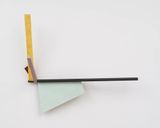
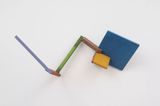
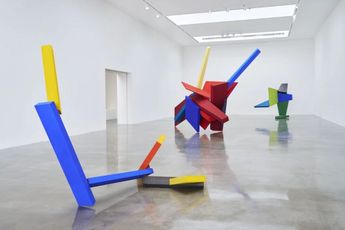
From the 1990s onwards, Shapiro produced monumental public sculptures and began suspending painted wooden elements from ceilings and walls, exploring the expressive potential of form and colour in space without architectural constraint. His later works are known for their chromatic complexity, kinetic compositions, and emotional buoyancy. A significant example is Loss and Regeneration (1993), commissioned for the United States Holocaust Memorial Museum in Washington, D.C., which consists of two bronze elements: a towering, abstract, tree-like figure and a smaller, house-like structure tipped upside down, memorialising the children who perished during the Holocaust and symbolising both loss and renewal.
The events of 9/11 had a profound impact on Shapiro’s outlook, prompting him to reflect on the fragility of life and the potential for art to offer hope and resilience; this is evident in the more buoyant and performative character of his later public works such as Blue (2019). Installed at the REACH at the Kennedy Center in Washington, D.C., Blue is an exuberant, monumental aluminium sculpture that appears to leap or kick, embodying optimism and motion.
Drawings and Prints
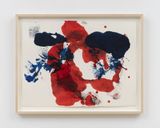
Throughout his career, Shapiro was also a prolific draughtsman and printmaker, producing works on paper that explored abstraction, colour, and spatial relationships. His drawings, often made with ink, gouache, or graphite, are characterised by loose, atmospheric compositions and a focus on the interplay of colour and structure.
Select Public Commissions
- Loss and Regeneration, United States Holocaust Memorial Museum, Washington, D.C. (1993)
- Conjunction, US Embassy, Ottawa, Canada (1999)
- Untitled, Denver Art Museum, Colorado (2001)
- Untitled, Sculpture International Rotterdam, The Netherlands (2002)
- Untitled, Major plaza, Orléans, France (2003)
- Untitled, US Consulate, Guangzhou, China (2013)
- Blue, Kennedy Center, Washington, D.C. (2019)
Select Awards and Accolades
- Elected to the Swedish Royal Academy of Art, 1994
- Elected to the American Academy of Arts and Letters, 1998
- Chevalier dans l’Ordre des Arts et des Lettres, 2005
Exhibitions
Joel Shapiro has been the subject of both solo exhibitions and group exhibitions at important institutions. Below is a selection.
Solo Exhibitions
- Joel Shapiro: Works from 1975–2024, Pace Gallery, Tokyo, 2025
- Joel Shapiro: The Bronzes, Madison Museum of Contemporary Art, Wisconsin, 2018
- Joel Shapiro: Floor Wall Ceiling, Kunstmuseum Winterthur, Switzerland, 2017
- Joel Shapiro: New Sculpture, Nasher Sculpture Center, Dallas, 2016
- Joel Shapiro: Sculpture and Drawings, Museum Ludwig, Cologne, 2011
- Joel Shapiro on the Roof, The Metropolitan Museum of Art, New York, 2001
- Joel Shapiro: Outdoors, IVAM Centro Julio Gonzalez, Valencia, Spain; Louisiana Museum of Modern Art, Denmark; Kunsthalle Zurich; Musee des Beaux-Arts, Calais, France, 1995–96
- Joel Shapiro, Walker Art Center, Minneapolis and Nelson-Atkins Museum, Kansas City, 1995–96
- Joel Shapiro, Stedelijk Museum, Amsterdam; Kunsthaus Düsseldorf; Staatliche Kunsthalle, Baden-Baden, 1985–86
- Joel Shapiro: Sculpture and Drawing, Whitechapel Art Gallery, London; Museum Haus Lange, Krefeld; Moderna Museet, Stockholm, 1980
- Joel Shapiro, Whitney Museum of American Art, New York; Dallas Museum of Fine Arts; Art Gallery of Ontario, Toronto; San Diego Museum of Contemporary Art, 1982–84
Group Exhibitions
- Anti-Illusion: Procedures/Materials, Whitney Museum of American Art, New York, 1969
- Going Public: Florida Collectors Celebrate the Norton, Norton Museum of Art, West Palm Beach, 2019
- ARTZUID, Amsterdam Sculpture Biennial, 2023
- Monochrome: Painting in Black and White, National Gallery, London, 2017
- The Human Factor: Figure in Contemporary Sculpture, Hayward Gallery, London, 2012
Joel Shapiro FAQs
Where can I see Joel Shapiro’s work?
Joel Shapiro’s artworks are held in major public collections worldwide, including the Museum of Modern Art, Whitney Museum, and Metropolitan Museum of Art in New York; Storm King Art Center, New Windsor; Buffalo AKG Art Museum; Yale University Art Gallery; Museum of Fine Arts, Boston; National Gallery of Art Sculpture Garden, Washington, D.C.; Art Institute of Chicago; Los Angeles County Museum of Art; Getty Museum; San Francisco Museum of Modern Art; Tate, London; Centre Pompidou, Paris; Stedelijk Museum, Amsterdam; Moderna Museet, Stockholm; and the Hakone Open-Air Museum, Japan.
What materials did Joel Shapiro use in his sculptures?
Joel Shapiro worked with wood, bronze, cast iron, and painted materials, often casting bronze directly from wood patterns to retain their tactile qualities.
What is Joel Shapiro’s connection to Minimalism?
Joel Shapiro’s early work challenged the ethos of Minimalism by introducing reference, memory, and emotion to simplified forms, ultimately transcending Minimalism to create a more intimate and psychologically charged mode of art.
What were Joel Shapiro’s most significant public commissions?
Joel Shapiro’s major commissions include Loss and Regeneration at the United States Holocaust Memorial Museum, Washington, D.C.; works for the US Consulate in Guangzhou, China; the US Embassy in Ottawa, Canada; Denver Art Museum; Kennedy Center, Washington, D.C.; and Sculpture International Rotterdam.
How do you pronounce Joel Shapiro’s name?
Joel Shapiro is pronounced ‘JOHL shuh-PEER-oh’.
What are some interesting facts about Joel Shapiro?
Joel Shapiro’s time in the Peace Corps in India was pivotal to his decision to become an artist, and he described his early sculptures as ‘a physical manifestation of thought in material and form’. Shapiro was also represented by Pace Gallery for over thirty years, with 17 exhibitions at Pace galleries worldwide.
Ocula | 2025

View Joel Shapiro's Artworks


















Explore Joel Shapiro's Exhibitions











Explore and Follow Artists Shaping Contemporary Art
A respected voice in contemporary art discourse.
Focusing on ambitious storytelling and insightful art-world commentary. Ocula Magazine publishes in-depth interviews, critical essays and timely analysis on the artists, exhibitions and ideas driving the global art world.
Learn more about Ocula Magazine
Showcasing the best of the art world.
Ocula partners with galleries from around the world to highlight their artists, artworks and exhibitions. Gallery membership is by application and invitation, with each member vetted by an independent panel.
Learn more about Ocula Membership
Specialises in the sale of major artworks.
Led by a team with deep ties to the world’s leading auction houses, galleries and collectors. Ocula’s advisory team offers bespoke services to high-net-worth clients from around the world who are looking to acquire the best of contemporary and modern art.
Learn more about our team and services