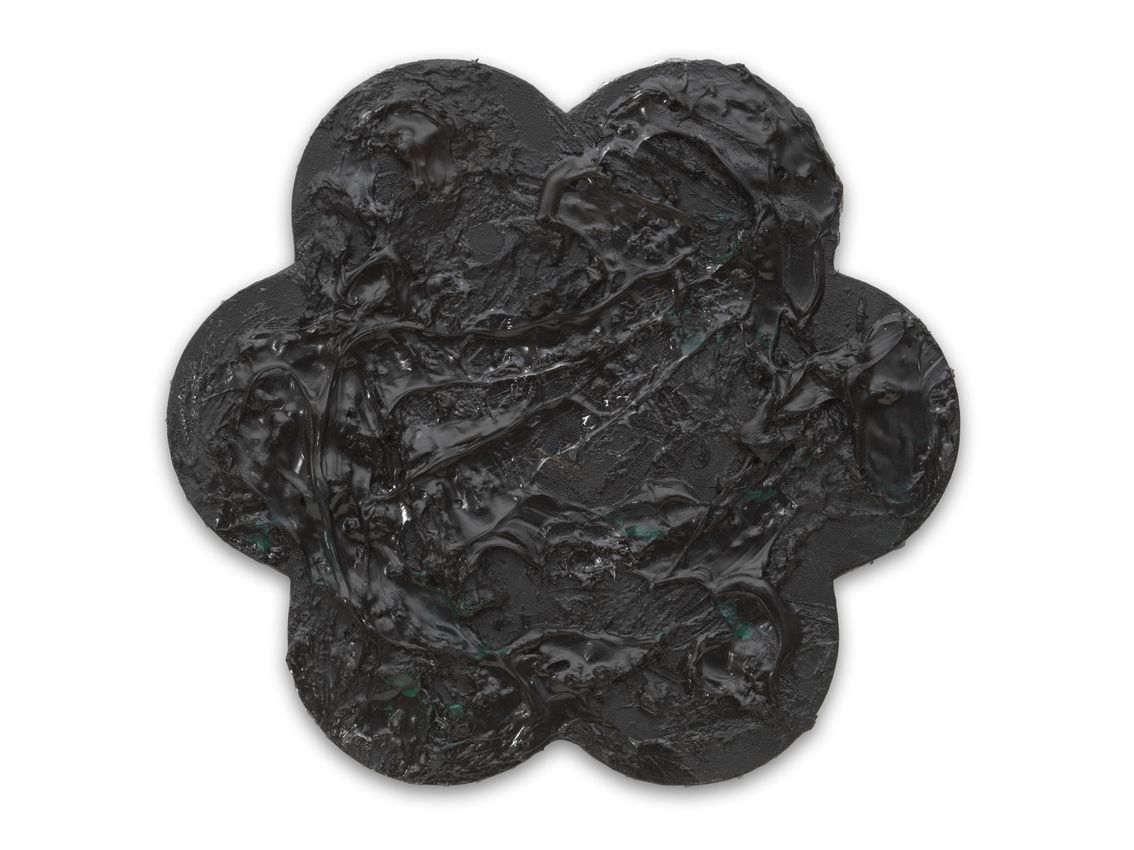
Galerie Chantal Crousel is pleased to host Jean-Luc Moulène’s seventh personal exhibition, featuring a selection of new sculptures and black and white photographs.
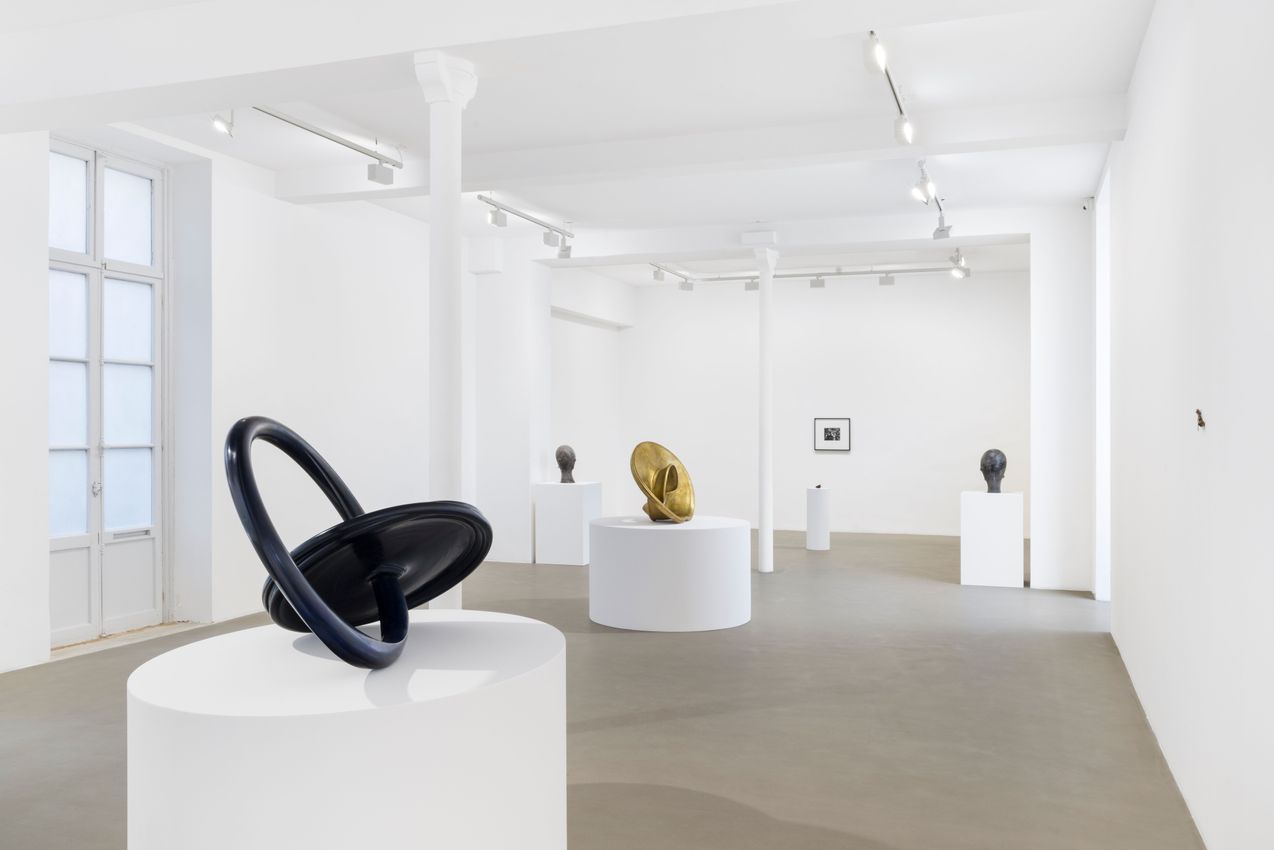
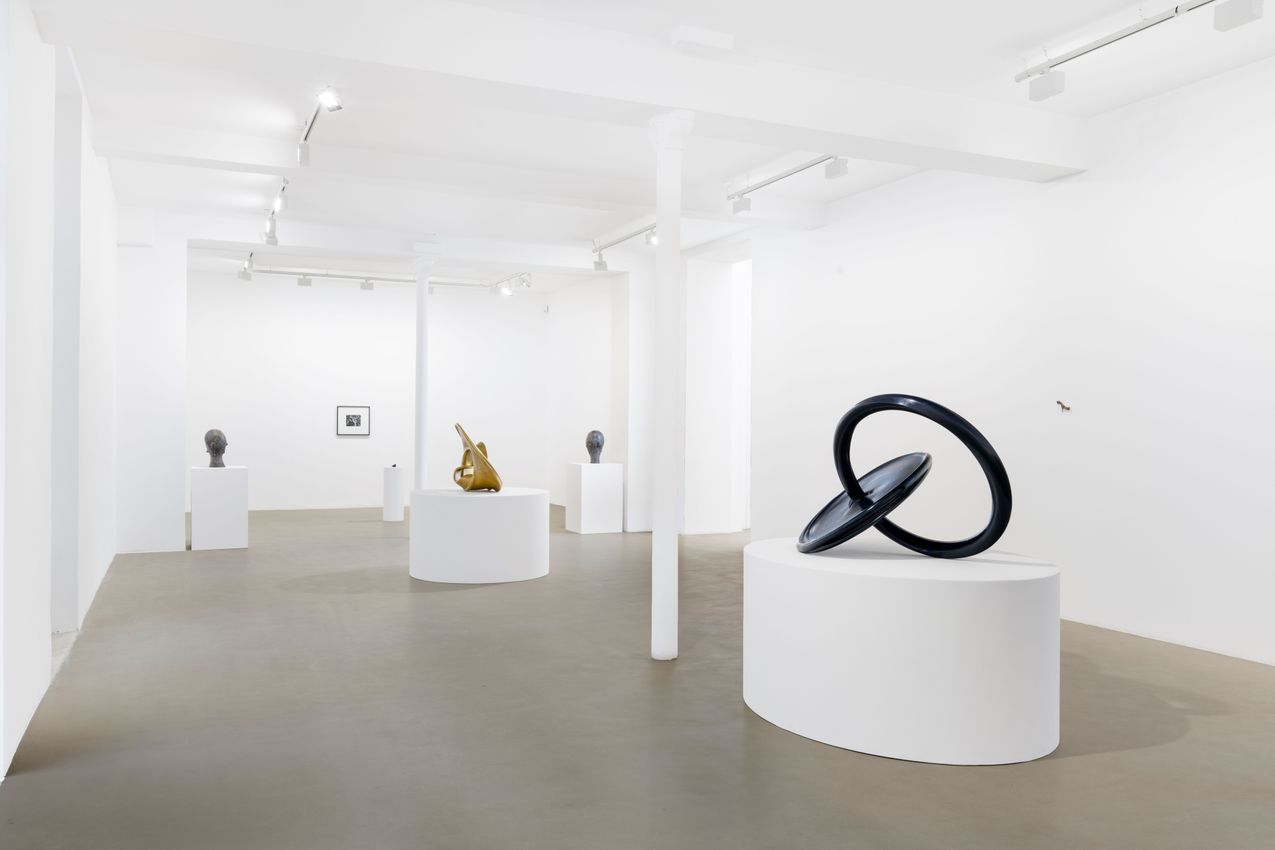
Introduced as an experimental space, the works in the exhibition operate as an ensemble and have been arranged along the lines of ‘a ritual without liturgy’1. They are organised in three sequences: relative dimensions, conditions of practice and sphere of representation.
The works reveal a multidimensional vision of the world, playing with human body mapping, abstraction, nature as a time marker. Within each space’s negative dimension (dimension -1, -2,...), the object exists through an infinity of limited and minuscule spaces, like topological shifts folding onto themselves.
A first bronze collarbone work—a collarbone with a tiny key affixed to it—opens and closes the exhibition before turning itself into a key.
The sculpture Bubu filtre holds a very strategic place. It is the zero mark of the exhibition, the identification point and figurehead of the procession. It mimicks the experience of hindsight, only to make the physical impossibility of showing negative dimensions, tangible. With this glass doll face placed on a cut plastic bottle filled with used oil, Bubu filtre gathers both body and poetry through materiality.
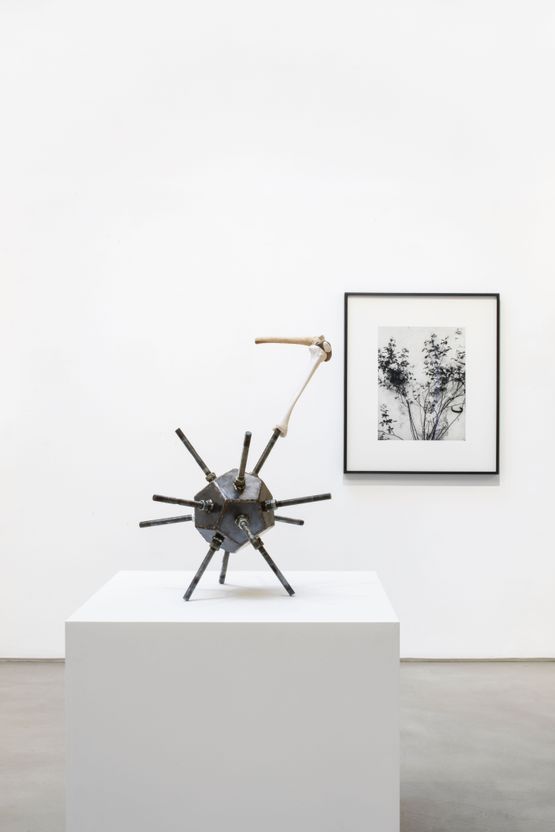
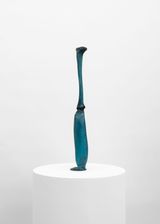
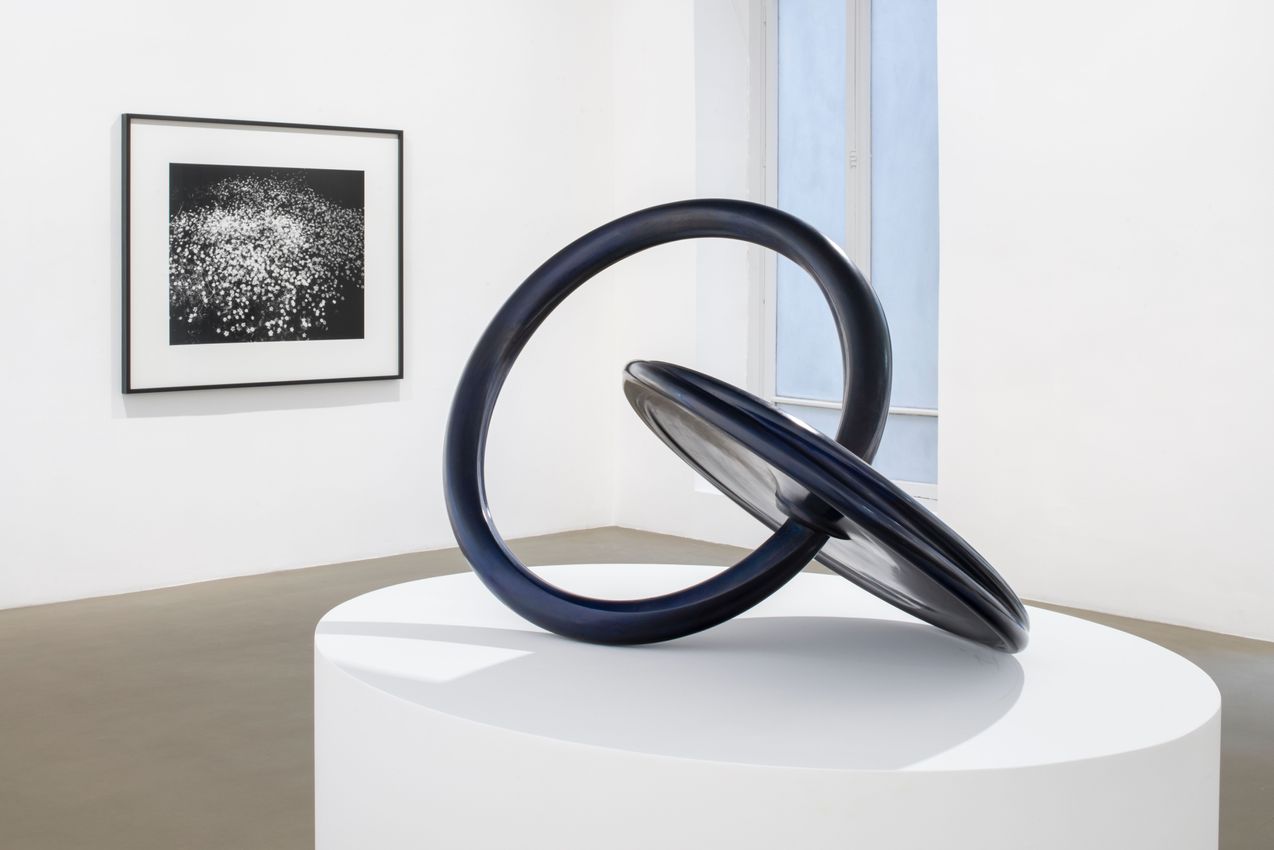
The more we dive into those negative dimensions, the larger becomes the number of formal possibilities. Four sculptures in bronze display such solutions: Figure et fond (tibia) [Figure and back (tibia)], Disque et anneau (fémur) [Disc and ring (femur)] and Articulation (humérus - clavicule) [Articulation (humerus - collarbone)] are the dimensional variations of space, confronted to the exact size of human bones. Designed digitally, they are however produced by the traditional lost-wax casting process. In the exhibition space, they follow one another with precision and overwhelm us with their size, their green, blue, yellow and red colored patinas, as well as their presentation display on cylindrical bases. Extraordinary because of their volume and density, these bronzes are neither figurative nor abstract. And as Moulène would say: “The colour could even be a fourth dimension. Any of the objects’ specifications could be a dimension. And they can all be shared!”
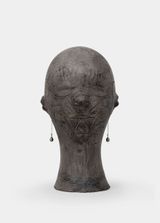
Then we have both Écorchés [Skinned], placed as ‘gardians’ on two sides of the main space and facing each other. Blind and mute as they are, they watch over the end of the demonstration. Adopting the same production process that was used for the series Tronches, 2014, the Écorchés are latex grotesque masks, whose orifices have been sewn. The masks have been overturned, filled with concrete, rubbed with waste oil than adorned with dangling culture pearls earrings.
The last and smallest cast bronze, Main (tous les os de la) [Hand (all the bones of the)], is of a more concrete approach. Having clearly expressed his attraction for this complex part of the human body, Jean-Luc Moulène discovers each time new ways to reflect on its numerous purposes, and on methods to deconstruct it. Captured, decomposed, and laid bare, all 27 bones have been gathered in the artists’ palm, and reassembled.
The hand was once the sculptor’s supreme tool. But many sculptors today work with their hands in their pockets. Not Moulène. Not always.2 —Frédéric Paul
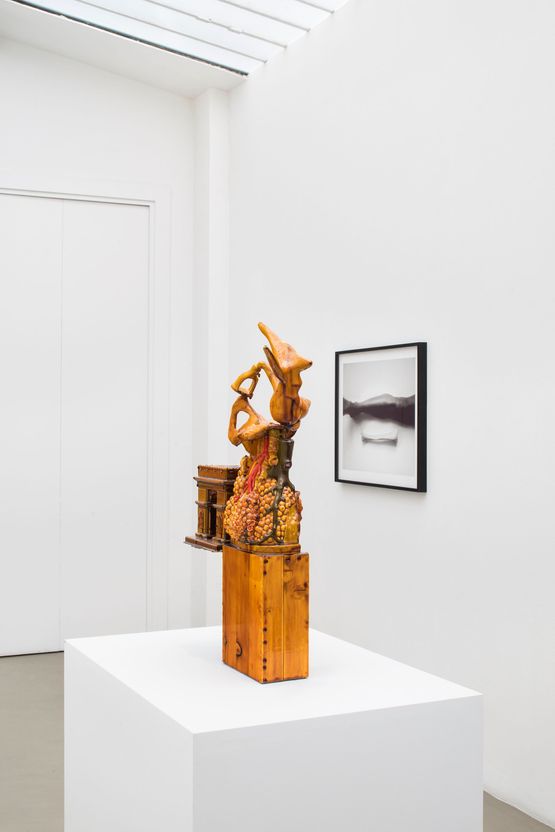
Unique object of the following sequence, Abstraction d’organes [Organ abstraction] is a work of abstraction. An assemblage of anatomical models of organs, paired with an organ of power, the Arc de Triomphe. The Arc is granted a second life, a new identity and a true role, which is to provide the work with a powerful presence, oscillating between stability and extreme frailty.
We claim that it is the same problem that motivates Moulène: manipulating unconnected organs and senses to compose an ‘emancipated body’ and ‘sensibility’, and that is formulated as a strike of signification in a mixed-up unlinking.3 —Alexandre and Daniel Costanzo.
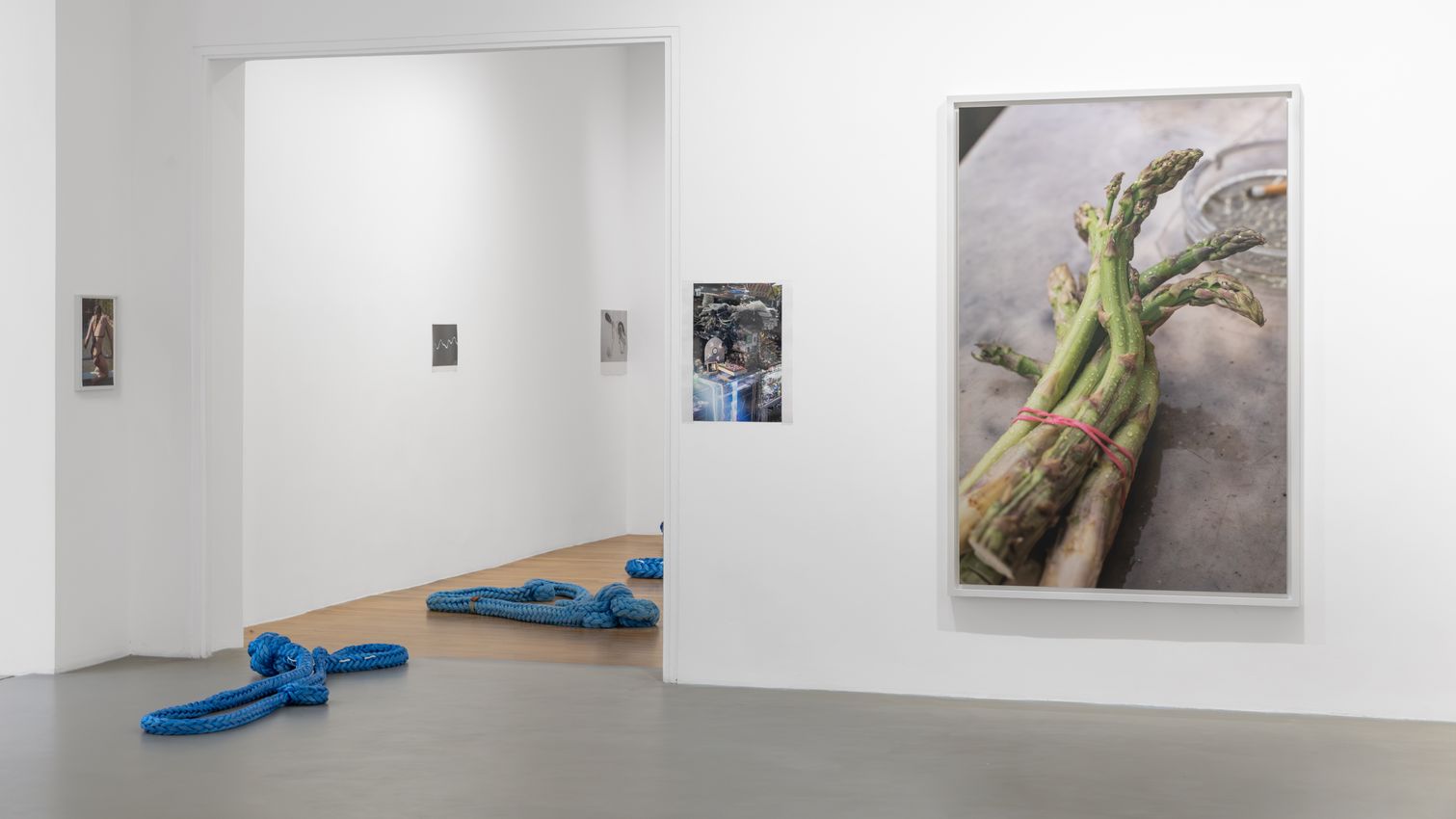
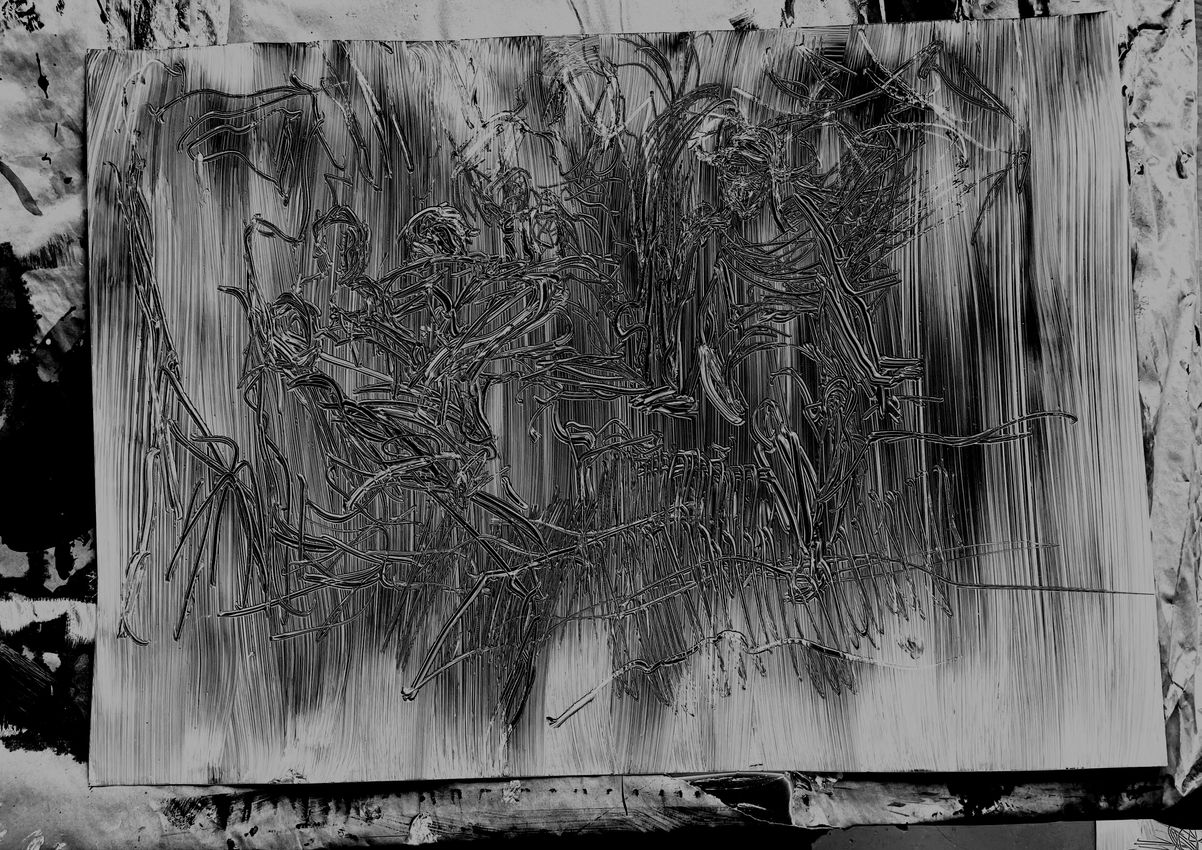
Tension between presence and representation is carried out through a new ensemble of black and white photography, with various dimensions. Landscape, objet and bodies are the subjects of this new body of work. Photography has always held a special place in Jean-Luc Moulène’s corpus of work.
These photographs were taken with a 4x5’ view camera, like a calotype4 then rendered with today’s digital technologies. Its subjects bear a unique depth, a large patch of greys and a strong rise in contrasts because of the very long time frame of the pose (up to an hour). The moment itself is not targeted, rather the combined mouvement of light and wind, Stellaires [Stellar] and Le Jardin 1 and 2 [The Garden 1 and 2].
Anatomie [Anatomy] and Jambe [Leg] are both life-size prints. The materiality of the bone breaks through, whereas the plastic bones seems to vanish, finally blending the true and the false.
In the second space of the gallery, the sculpture Excentrique [Eccentric] is at the very centre of this last sequence, with a spatial and temporal, individual and collective, vectorised and initialised presence, surrounded by flowers and landscape.
Beyond fiction where Jean-Luc Moulène’s routine implies dissecting the object and submitting it to materiality, there is also life at its full force. Imperfect objects and images constantly echoing one another, battling each other even, for the privilege of the authentic.
1 Philippe Vasset, Un rituel sans liturgie, exhibition catalogue Jean-Luc Moulène, Éditions Centre Georges Pompidouand Dilecta, Paris, 2016, p.108.
2 Frédéric Paul, How Many Fingers in My Pocket? A Polydactyl Fantasia, Jean-Luc Moulène, Éditions Centre GeorgesPompidou and Dilecta, Paris, 2016, p.125.
3 Alexandre and Daniel Costanzo, The power of the open, MOULÈNE 2007, p.33. Extract from a text by Eric deChassey, Once upon a Time, Jean-Luc Moulène, catalogue Jean-Luc Moulène, Il était une fois, Éditions Académie de France àRome, Villa Medici and Bernard Chauveaux Éditions, p.264.
4 The calotype is a photographic process on paper developed in 1840. One of its qualities is that it gives aslightly blurred image. This is because the texture of the paper blurs the light rays passing through it.
For more than twenty years, Jean-Luc Moulène has developed a complex body of work, both analytical and mysterious, of which photography has long constituted the most visible and best-known part. From the Disjunctions—a series of seemingly banal, frequently urban images that function as indeterminate topographical references at the heart of the real world—to the celebrated Objets de grève (‘Strike objects’: product shots of industrial artefacts made by striking workers, subverting the tools of their trade), Moulène’s photographs are strikingly raw, cruel and uncompromising, but always secretly metaphorical.


Located on rue Charlot in the 3rd arrondissement in Paris, Galerie Chantal Crousel presents a selection of artists highly diverse in their national and cultural origins and mediums who together contribute to a universal visual language.

A respected voice in contemporary art discourse.
Focusing on ambitious storytelling and insightful art-world commentary. Ocula Magazine publishes in-depth interviews, critical essays and timely analysis on the artists, exhibitions and ideas driving the global art world.
Learn more about Ocula Magazine
Showcasing the best of the art world.
Ocula partners with galleries from around the world to highlight their artists, artworks and exhibitions. Gallery membership is by application and invitation, with each member vetted by an independent panel.
Learn more about Ocula Membership

Specialises in the sale of major artworks.
Led by a team with deep ties to the world’s leading auction houses, galleries and collectors. Ocula’s advisory team offers bespoke services to high-net-worth clients from around the world who are looking to acquire the best of contemporary and modern art.
Learn more about our team and services