Press Release

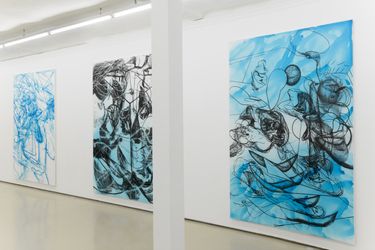
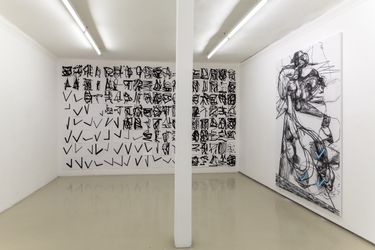
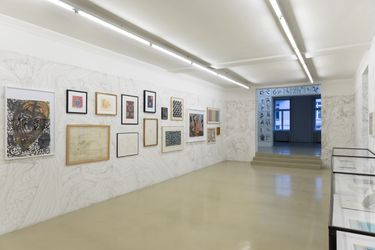
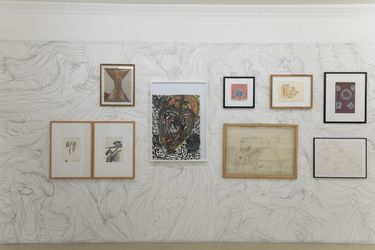
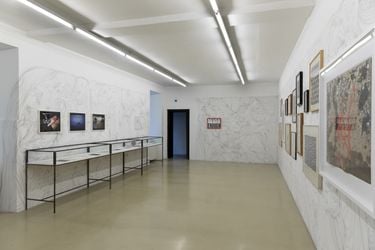
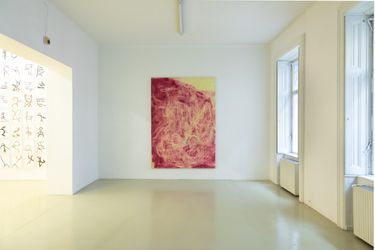
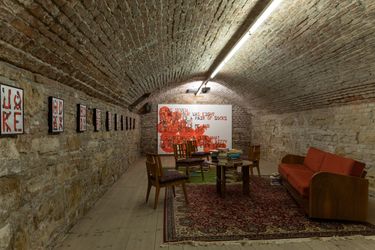
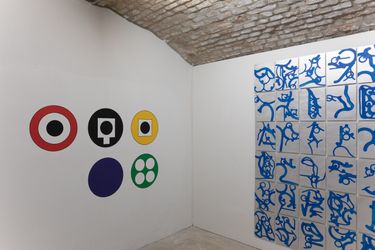
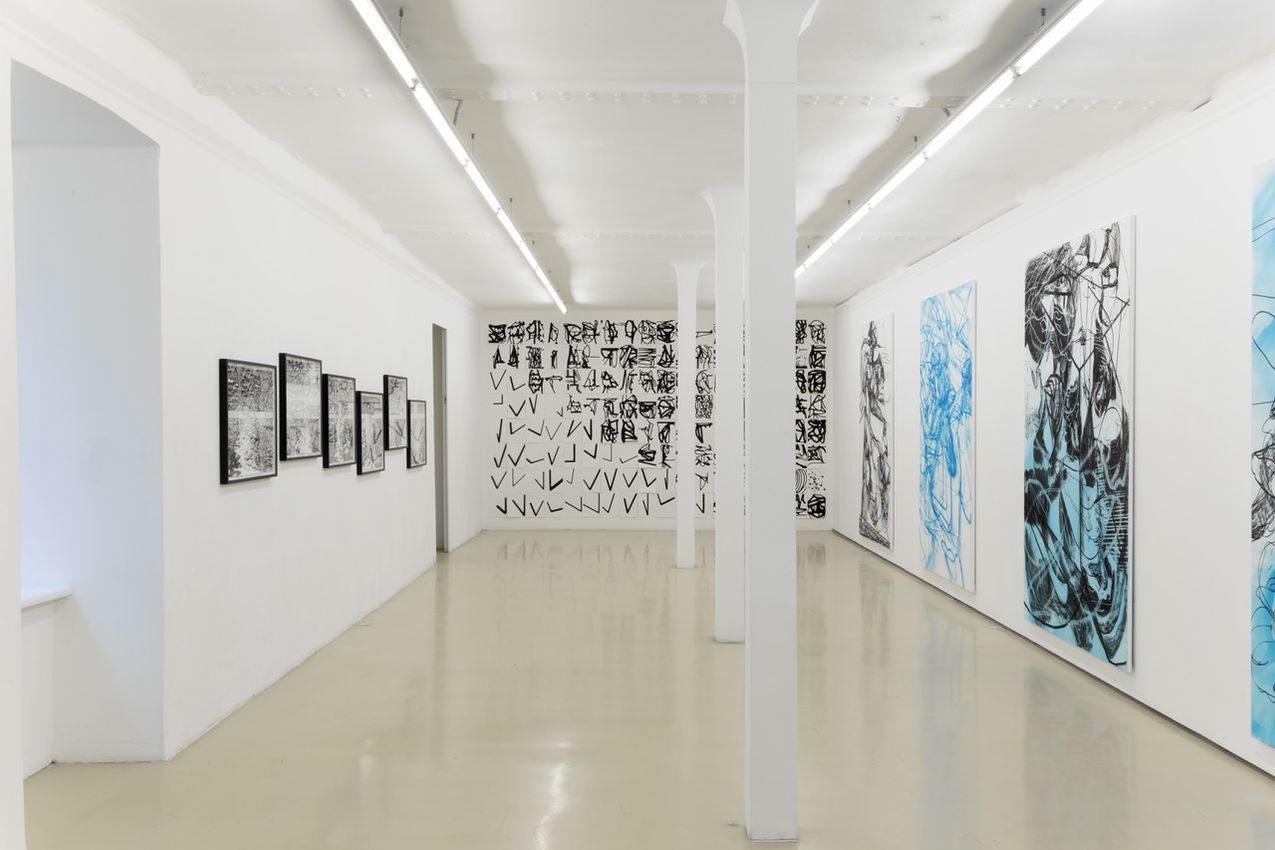
Under the title REGROUP, Krinzinger Schottenfeld presents an extensive solo exhibition by Christian Schwarzwald, who has been represented by Galerie Krinzinger since 1997. Together with recent series of drawings, the exhibition will feature editions by artists who have been formative for him.

With works of: Tauba Auerbach, Joseph Beuys, Louise Bourgeois, John Cage, Hanne Darboven, Marcel Duchamp, Nan Goldin, Dorothy Iannone, Ilya Kabakov, Imi Knoebel, Peter Kogler, Barbara Kruger, Sol LeWitt, Friederike Mayröcker, Matt Mullican, Claes Oldenburg, Oswald Oberhuber, Meret Oppenheim, Sigmar Polke, Peter Pongratz, Dieter Roth, Rosemarie Trockel, August Walla

REGROUP: The Solo Exhibition as Group Exhibition and Archaeology of the Self, a text by Dr. Klaus Speidel (translated version)

Cézanne influenced Picasso, Picasso influenced Braque, Braque and Picasso influenced the Futurists, Eric Satie and Prague. Classical art history is an almost unbroken series of artists influencing each other. Its graphic climax is Alfred Barr’s diagram of Cubism and Abstract Art: at the top is the individual Cézanne, followed only by -isms. As here, artistic greatness is a function of the breadth and temporal distance of influence. The figure of the unrecognized genius is the exception that confirms the rule and gives hope to unknown artists of all times. In art academies, students are still drilled to find references for their work and usually discover their influences only when the works are already finished.

When artists work very close to each other, such as Max Oppenheimer and Oskar Kokoschka or Camille Claudel and Auguste Rodin, later generations decide the direction of the influence, of course mostly to the disadvantage of the less well-known, especially if they are women. When it came to an open dispute between the studio neighbors Kokoschka and Oppenheimer in 1910, Kokoschka’s ‘disfiguring genius’ became for Karl Kraus the destructive indication of Oppenheimer’s epigonism. In this context, we owe one of the most original thoughts regarding the question of the ‘original’ to Kraus, which is: ‘There are forerunners of originals. If two have the same thought, it does not belong to the one who had it before, but to the one who has it better,” a quote that puts an abrupt end to the eternal search for precedence and turns hundreds of thousands of doctoral theses by side. So when the French literature group OuLiPo officially recognizes the “pastiche par anticipation,’ we fortunately do not have to clarify whether or not this happened under Karl Kraus’ influence. Nevertheless, the question of underground connections, hidden influences, and unconscious appropriations stays across the limits of genres, artistic intentions, and a time far away from fascination. Christian Schwarzwald now dedicates his exhibition REGROUP to this theme. Dr. Ursula Krinzinger and Thomas Krinzinger invited him to do so, starting from his own artist biography. The exhibition becomes an archaeology of the self, for which the artist has spent months digging for hidden reference in order to bring together with his gallery works that have influenced him or could have influenced him if he had known them. Some works stand for their creator, others become a placeholder for an artistic position that irritates.

Peter Pongratz and Oswald Oberhuber count among his early influences: Schwarzwald attended courses at Kokoschka’s ‘School of Seeing,’ the Summer Academy of Fine Arts in Salzburg at the age of 16 and 17. Thus Pongratz encouraged him early on to continue with art. Oberhuber, on the other hand, showed little interest in the young artist’s work, but gave lectures that left a lasting impression on Schwarzwald. The concept of ‘permanent change’ remains important to him until today. He explains, ‘The constant influence is always also a push for me to turn, to peel, to look for something new. At the same time, my change of position is always playful, never forced.’ Like Oberhuber, he works serially and tirelessly, constantly inventing new forms without surrendering to the rules and myths of style that turn artists into brands. Similar to Oberhuber, Birgit Jürgenssen, or Josef Bauer, Schwarzwald’s solo show often seems like a group show.

The points of reference to the other positions in the exhibition are also rarely obvious or even of the same nature. Not a few things emerge because their negation becomes productive. After all, more important than what we love are often the mothers or fathers we do not want to become. Acts of self-destruction are often forbidden for artistic self- discovery and essential to artists myths. Brancusi would not exist without rejecting his teacher Rodin, and Joseph Kosuth would not exist without the rejection of Jackson Pollock and Clement Greenberg. Hanne Darboven burned her drawings from Germany after arriving in New York and became the one we know. She appears in Schwarzwald’s exhibition because he is interested in her ‘formal comprehensibility.’ As for Sol LeWitt, he says, ‘When I first saw the work, I didn’t get it at all and wondered, ‘What’s the point?’’ Matt Mullican, who is there because he is designing a world system, also ‘repelled him at first.’ At REGROUP, irritation is at least as important as homage. Thus Schwarzwald exhibits Rosemarie Trockel because her handling of images and her open work ‘confused’ the artist.

The fact that the exhibition privileges series and multiples has not only to do with their own work, but also with the interest in questions of the original and originality or the work between idea and execution. As I argued most recently in F.A.Z., narratives about Duchamp’s works are more important to his influence on contemporary art than his ideas or the objects themselves. To understand Fountain, the urinal that Duchamp turned into art in 1917, you don’t have to go to Paris or London. Thus, even the Duchamp etching in the exhibition functions more as a placeholder for the artist’s position than to stand for itself.

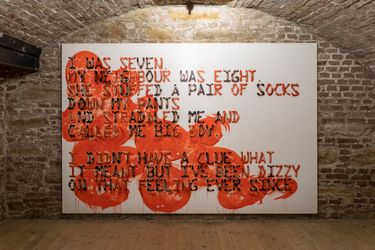
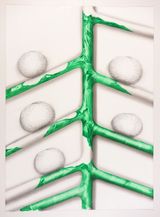
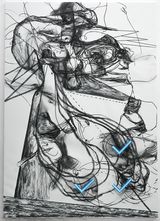
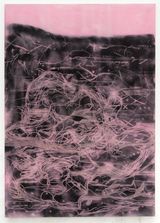
It is quite different with series of works such as VACUUM by Schwarzwald himself, for which he applies pigments to a canvas and then partially extracts them. The idea may be interesting, but the visual impression is even more so. Instead of rigorously translating ideas into artifacts that could just as easily have come from the testing and certification agency (MA 39), like early conceptual art, in his work the joy of form follows the joy of thought (and vice versa). Where compact figures stand from a distance, one discovers up close the hand of the draftsman—or the painter? Schwarzwald experiments with methods as well as instruments: Graffiti and pop culture become no less productive than the artistic avant-garde. He uses airbrushes, vacuum cleaners, and brushes, fills felt-tip pens with ink, and draws with charcoal on canvas; he paints type and writes painting, is inspired by T.S. Eliot, Ann Cotten, and emojis. Instead of executing a plan, he remains open to solutions he has not sought and rejoices in the unplanned and unusual—a joy that is palpable in the exhibition and invites us to think and look further.

Christian Schwarzwald, born in 1971 in Salzburg, lives and works in Berlin and Vienna. Since 2017, Schwarzwald has taught as a professor of graphic arts and printmaking techniques at the Academy of Fine Arts in Vienna. His work has been shown most recently at the Museum of Contemporary Art MOCA/ Chengdu, Kunsthaus Nuremberg, Galerie Krinzinger/ Vienna and Galerie Ebensperger-Rhomberg/ Berlin and Salzburg.

Exhibition selection: Regroup. (solo) Krinzinger Schottenfeld, Wien (2021), Yuan Art Museum Wuqing, Tianjin (2021), Metamodell, die Möglichkeit einer Insel, Berlin (2021), Polygraph (solo), Kunsthaus Potsdam (2021), Colla (solo), Kunstraum Friesenstrasse, Hannover (2020), Stricher (solo), iscrete Austrian Secrets, GCA The Galaxy Museum of Contemporary Art, Chongqing (2019), XXL Estampes monumentales contemporaines, Musée des Beaux-Arts, Caen (2019), Zeichen und Wunder III, Kunsthaus, Nürnberg (2018),Galerie Krinzinger, Wien (2017), Lyrcs (solo), Ebensperger, Berlin (2017)

Courtesy Galerie Krinzinger. Text: Dr. Klaus Speidel, art theorist, critic and curator.

Read More

Installation Views

About the Gallery

Galerie Krinzinger was founded in 1971 by art-historian Dr. Ursula Krinzinger. Since then, she has organized at least 500 exhibitions of national and international artists, mounting solo, group and thematic shows.

View Gallery Profile
Address
Schottenfeldgasse, 45
Vienna
Austria
Opening Hours
Tues - Fri, 12pm - 6pm
Sat, 11am - 2pm
(1)
Vienna Schottenfeldgasse, 45
Krinzinger Schottenfeld
Schottenfeldgasse, 45, Vienna, Austria

Opening hours
Tues - Fri, 12pm - 6pm
Sat, 11am - 2pm
The art world in focus