Press Release

This exhibition pairs John Chamberlain‘s early poetry with his sculptural series Gondolas and Tonks from the 1980s, years he spent working in a large-scale studio in Florida. These works epitomise the artist’s poetic approach to materials and scale. Hauser & Wirth Monaco‘s exhibition will be the first time Chamberlain’s poetry will be shown publicly, illuminating a sensitive and little-known aspect of his practice produced at Black Mountain College in the 1950s.

During the 1950s, Chamberlain spent a year at Black Mountain College, where the poet Charles Olson was his teacher, and where he experimented with poetry, composing a body of work that would subtly inform his approach to sculptural work. This interlude had a profound impact on the artist—he would later state, ‘My teachers were Kline, de Kooning, Charles Olson.’ Chamberlain would later become known for the creativity and poetry of his titles, which, like his sculptures, were assembled based on ‘fit.’ He wrote words on cards, trying different combinations to create beautiful compositions. In the early 1980s, he gifted his poems from Black Mountain College to the curator and author Julie Sylvester, who was in the process of conducting interviews for a catalogue raisonné of Chamberlain’s works. He had saved them for nearly 30 years, and she recognised in this a sign of their singular importance for him, and the insights they might afford for his work. The pages reveal his working through the images and themes, as well as his and others’ changes and annotations.

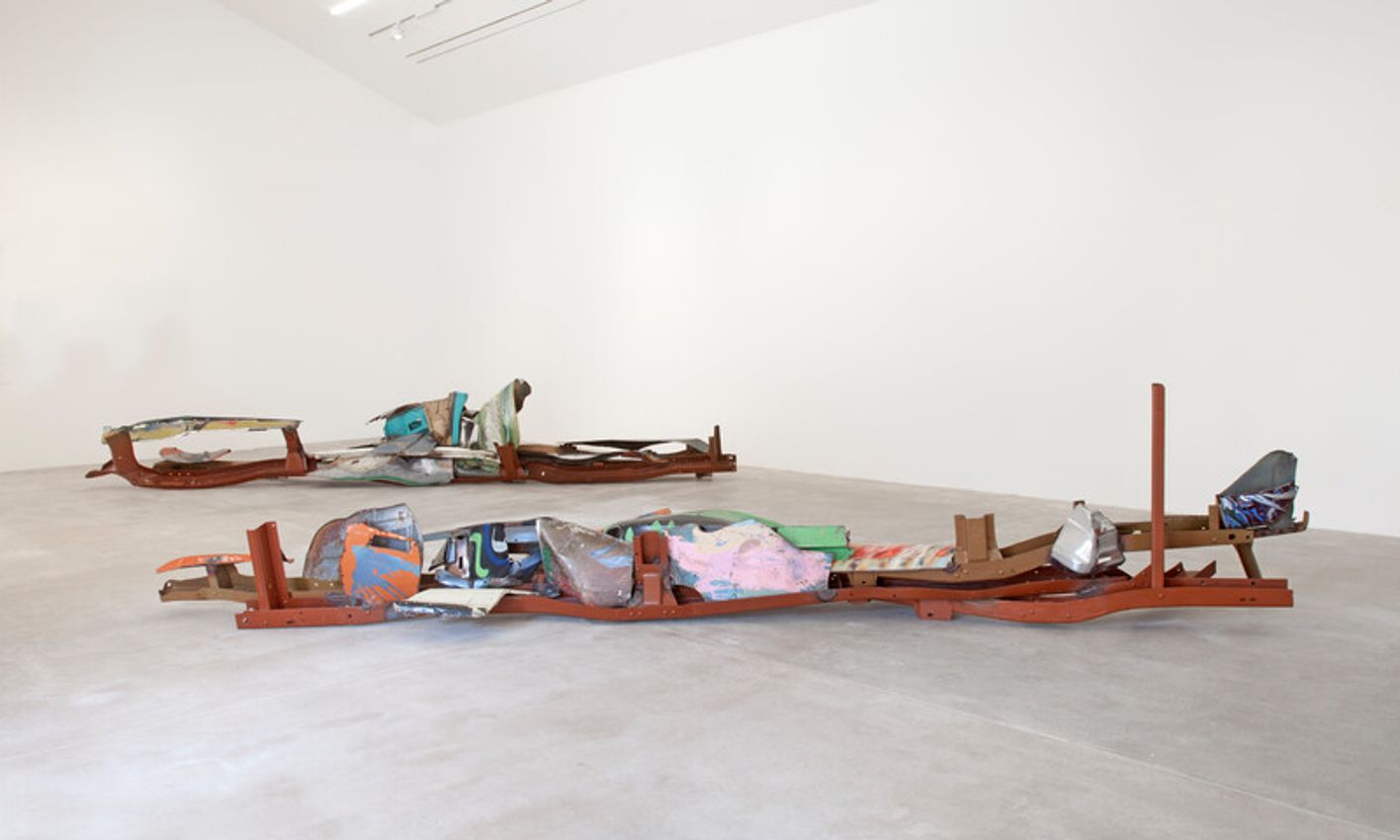
In 1980, Chamberlain had moved to Sarasota, mooring his boat, the Cocola, at a local marina. He established an outdoor studio at the back of a junkyard in Osprey, eventually occupying a large former industrial building painted bright yellow, allowing him to make work larger than ever before. The artist soon began work on a monumental sculpture commission, ‘Deliquescence’, made from truck parts. Seeing the remaining truck chassis nestled together in his studio, he was reminded of a fleet of Venetian gondolas, probably also inspired by the proximity of the sea, the vessels in the marina and along the coastline. These hefty parts became the basis of the Armada series. In 1984, Chamberlain changed the series title to the Gondolas, naming each after a notable poet—including Charles Olson, his teacher at Black Mountain College.

By the end of 1984, and in direct contrast to the large scale of the Gondolas, the artist accumulated what he called a ‘Tonka Toy junkyard’ from which he made some of his smallest works. Many of the Tonks, however, share a focus on low, horizontal form with the Gondolas. Seeing these works together demonstrates Chamberlain’s ability to work in a variety of scales—simultaneously creating some of his largest and smallest works. The opportunity to see the Tonks and Gondolas in parallel gives a unique insight into Chamberlain’s Sarasota era, a key period in the artist’s oeuvre.

Organised in close collaboration with the John Chamberlain Estate, the exhibition is curated by Tanya Barson, and will open on 10 May 2023.

Read More
About the Artist

John Chamberlain (1927 – 2011) was a quintessentially American artist, channeling the innovative power of the postwar years into a relentlessly inventive practice spanning six decades. He first achieved renown for sculptures made in the late 1950s through 1960s from automobile parts—these were path-breaking works that effectively transformed the gestural energy of Abstract Expressionist painting into three dimensions. Ranging in scale from miniature to monumental, Chamberlain’s compositions of twisted, crushed, and forged metal also bridged the divide between Process Art and Minimalism, drawing tenets of both into a new kinship. These singular works established him as one of the first American artists to determine color as a natural component of abstract sculpture. From the late 1960s until the end of his life, Chamberlain harnessed the expressive potential of an astonishing array of materials, which varied from Plexiglas, resin, and paint, to foam, aluminum foil, and paper bags.

View Artist Profile

Also Exhibiting at Hauser & Wirth

About the Gallery

Hauser & Wirth was founded in 1992 in Zurich by Iwan Wirth, Manuela Wirth and Ursula Hauser, who were joined in 2000 by Partner and Vice President Marc Payot. A family business with a global outlook, Hauser & Wirth has expanded over the past 26 years to include outposts in Hong Kong, London, New York, Los Angeles, Somerset and Gstaad. The gallery represents over 70 artists and estates who have been instrumental in shaping its identity over the past quarter-century, and who are the inspiration for Hauser & Wirth’s diverse range of activities that engage with art, education, conservation and sustainability.

View Gallery Profile
Address
One Monte-Carlo
Place Du casino
Monte Carlo
Monaco
Opening Hours
Tues - Sat, 10am - 6pm
(1)
Monte Carlo One Monte-Carlo, Place Du casino
Hauser & Wirth
One Monte-Carlo, Place Du casino, Monte Carlo, Monaco
+377 92 00 04 20
http://www.hauserwirth.com

Opening hours
Tues - Sat, 10am - 6pm
The art world in focus