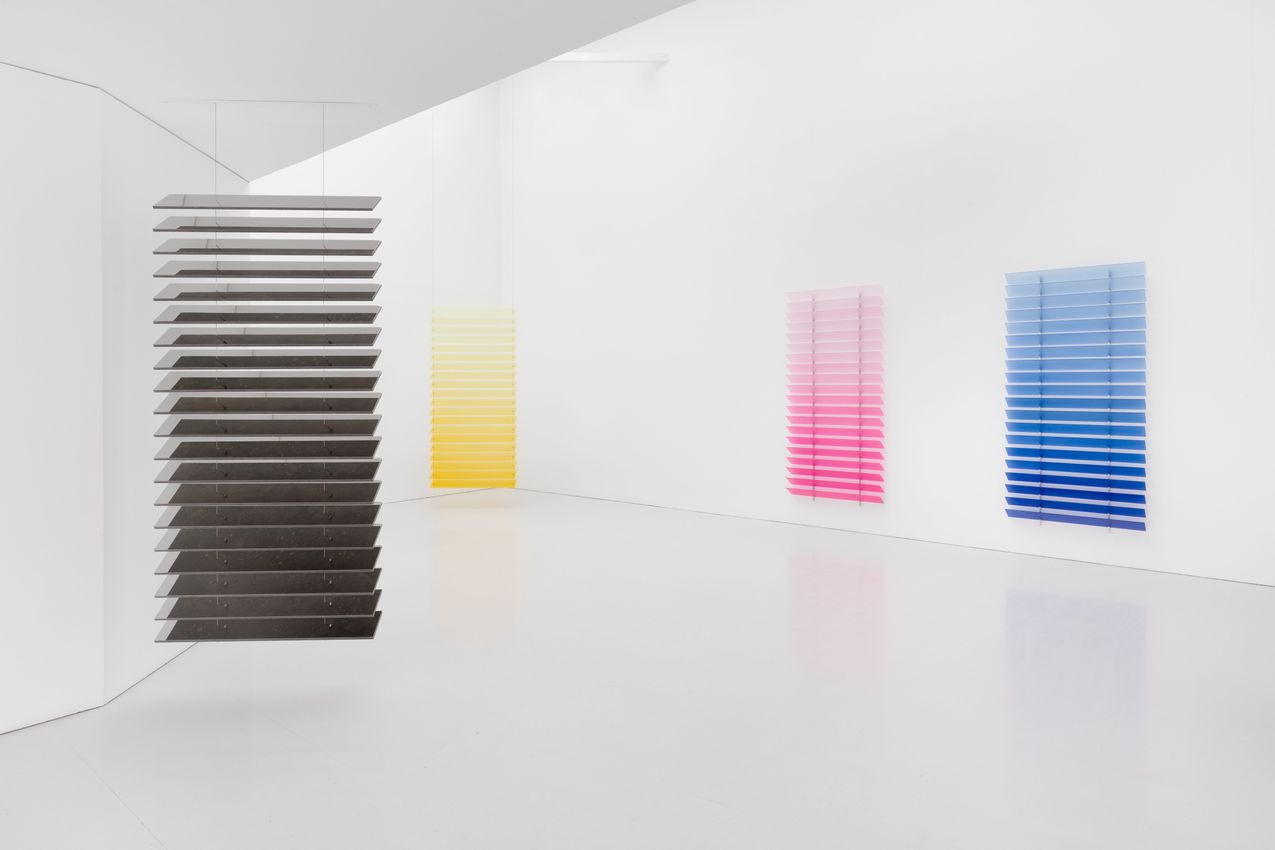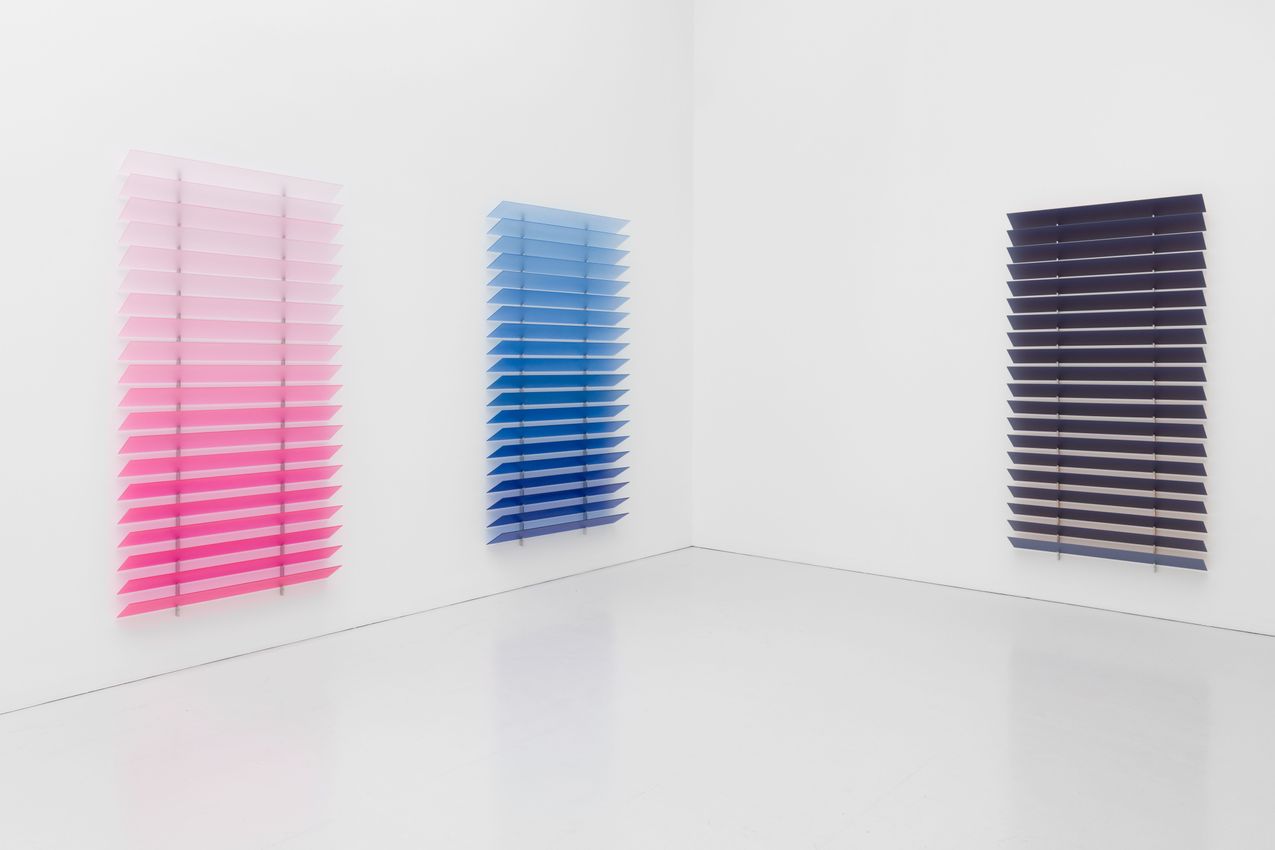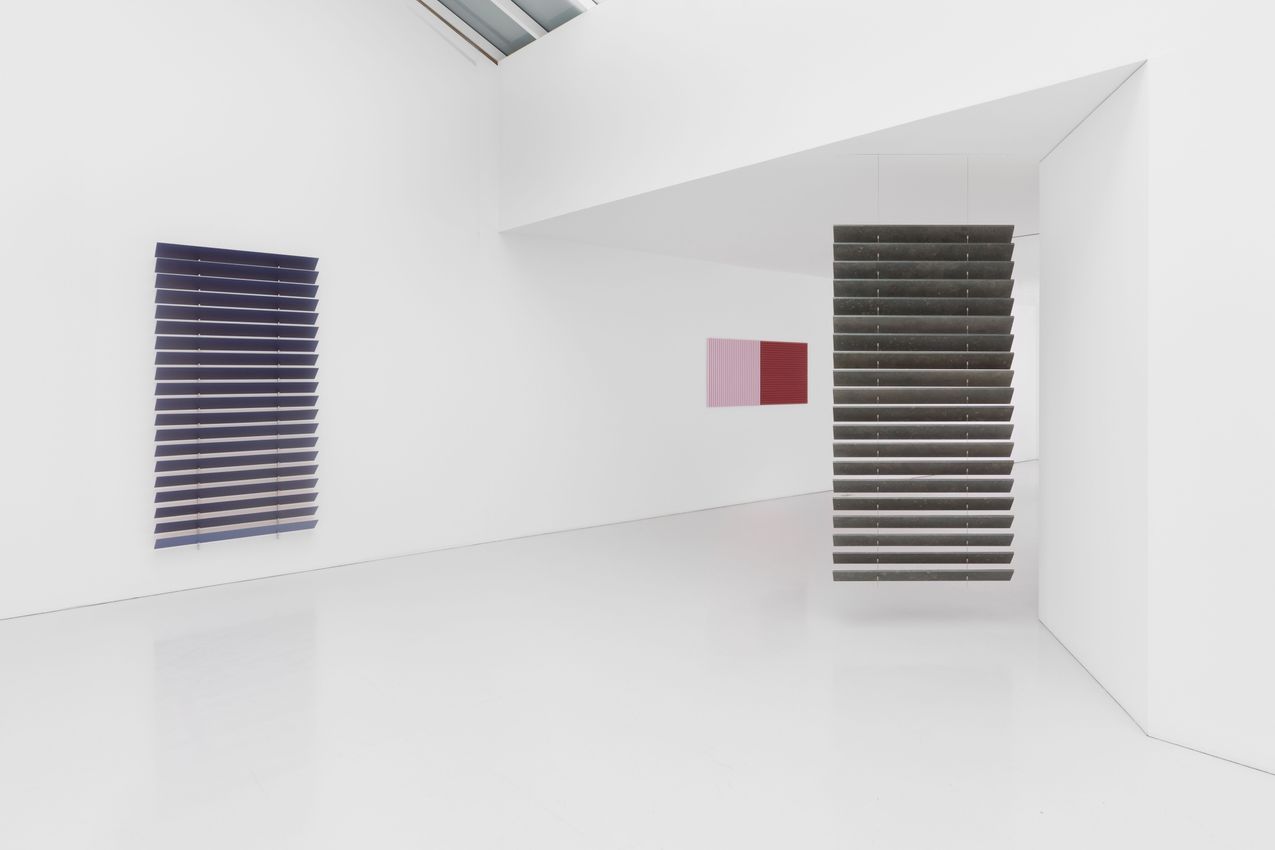
Intense colours converge or become muted, whilst solid forms seem to dissolve or even disappear, before materialising again from a different perspective. Anne Barlow for Rana Begum: Space, Light, Colour (2021)
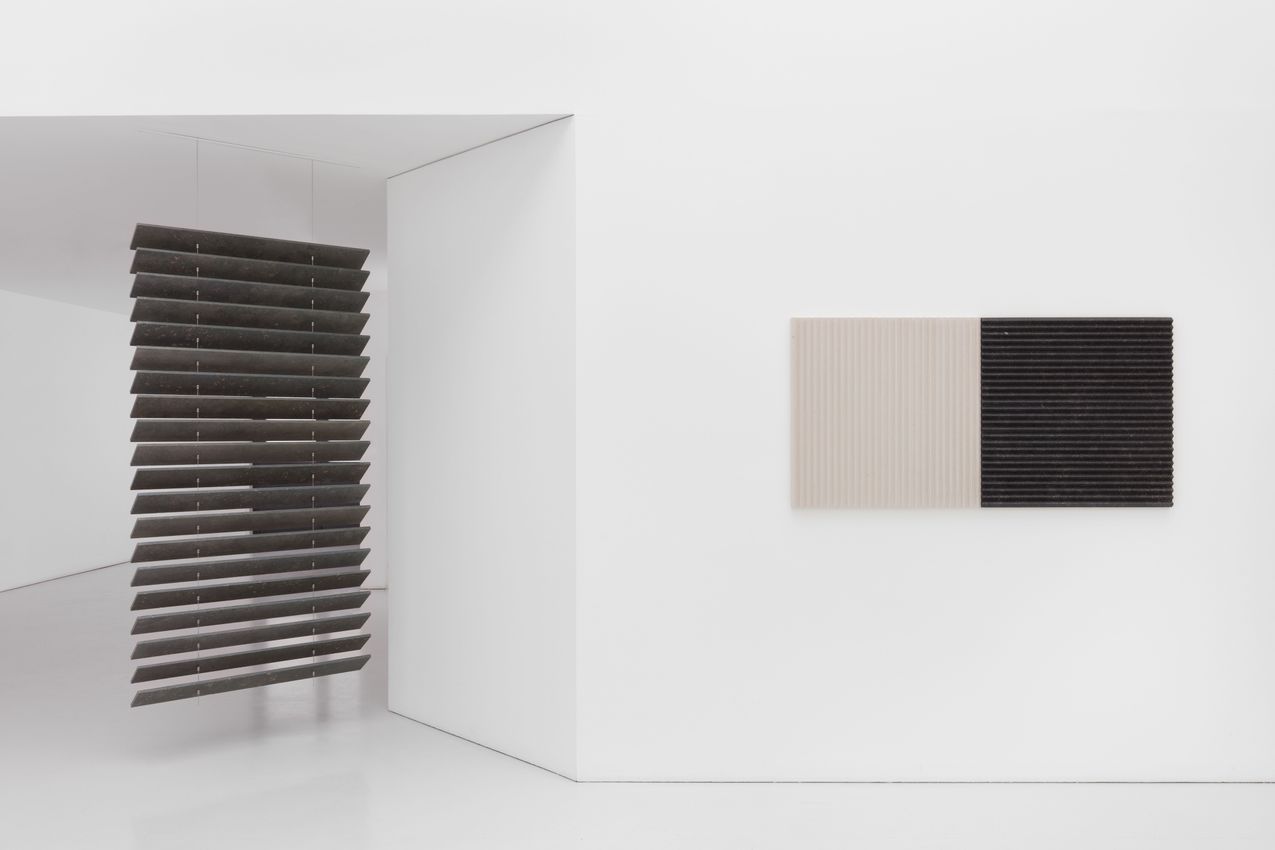
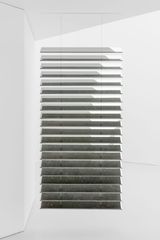
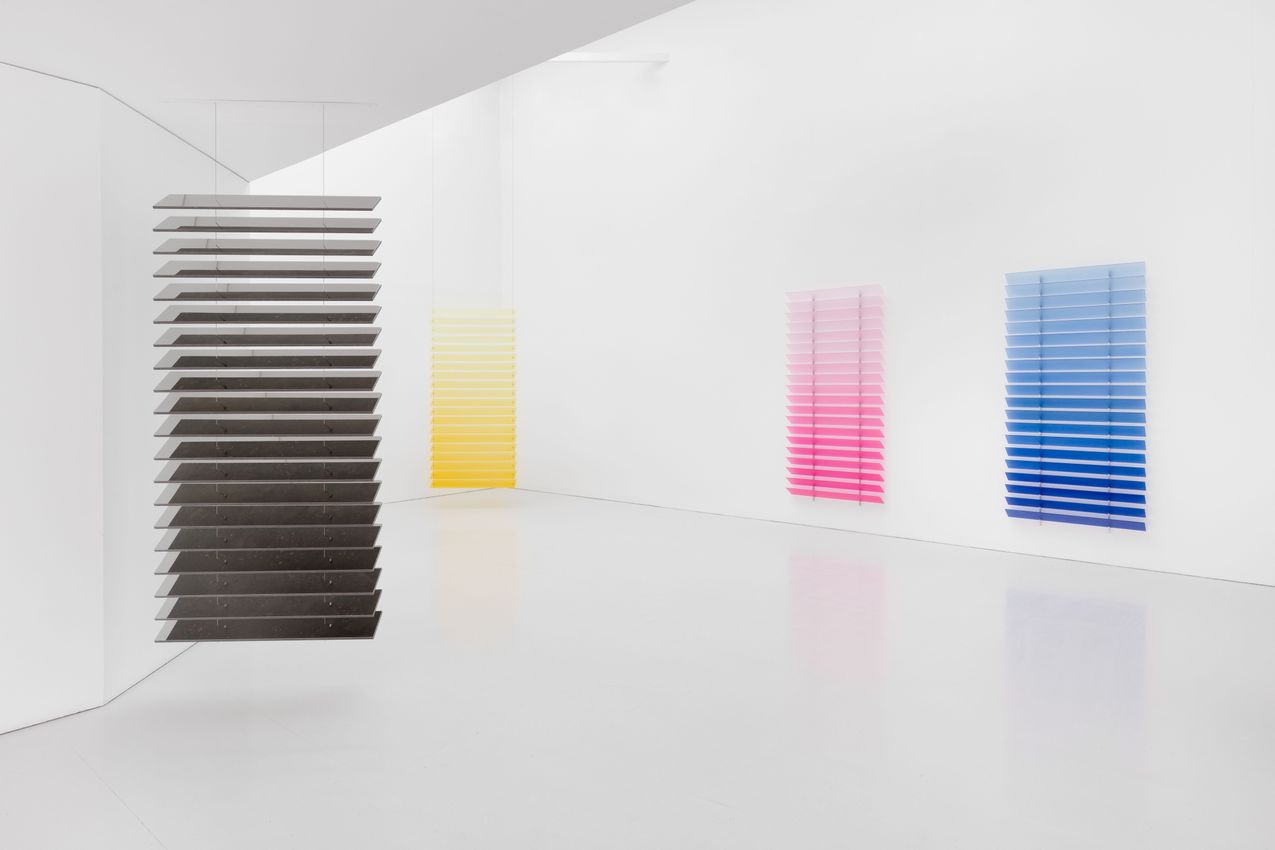
Rana Begum’s new Louvre series explores how different materials interact with light and considers texture, density, reflection and transparency. Uniform panels of glass, stone and metal are tilted and repeated to create suspended and wall-based works. There is a familiarity to these compositions, observed throughout our urban landscapes in ventilation panels, façades and blinds. The functional geometry enables a process of filtration, controlling how air or light passes through a partition. By focusing on materiality, Begum brings this notion to the foreground, exploring how light is filtered, dispersed, fragmented, or absorbed.
Begum’s second solo exhibition at the gallery demonstrates a move towards a more meditative practice that seeks to distil and simplify, creating a space for contemplation. Colour and material are brought into focus and explored with restraint and deliberation, considering the intangible effect these elements have on a space and our relationship to it. The lightness of glass is accentuated through the application of gradated colour, creating vibrant, solid planes that soften into transparency. Glowing against the wall, the pigment appears to gently evaporate. The weight of stone contrasts with this immateriality, offering a sense of solidity and grounding.
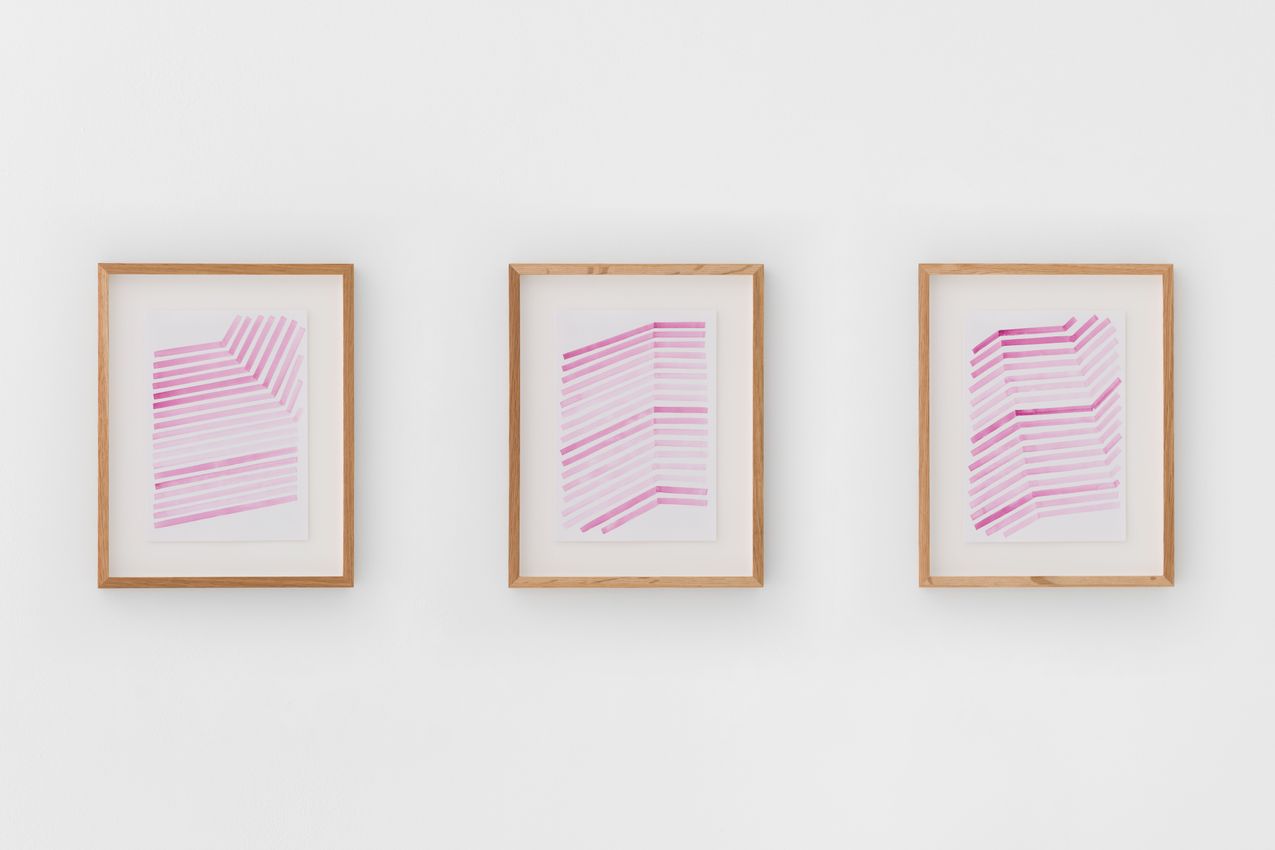
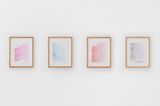
In the new Relief Panel series, Begum revisits ideas developed early in her career. Referencing façade and moulding motifs, Relief Panels in stone and painted aluminium explore angular form with horizontal and vertical emphasis. Alongside these works are a series of watercolours created during a residency. An essential travel companion, Begum’s watercolours respond to architecture, space and light, capturing the rhythm of her environment as the medium resists rigid boundaries. The immediacy of these paper studies demonstrates the continuous process of observation that informs the accompanying sculptural works. This practice of observation, translation and distillation runs throughout the show, connecting different strands in an ongoing narrative that seeks to capture an experience that remains, as yet, undefined.
Rana Begum was born in 1977 in Bangladesh. She lives and works in London. Recent solo exhibitions include Ordered Form at St Albans Museum + Gallery, UK (2023 –24); Dappled Light at Mead Gallery, UK (2021), Pitzhanger Manor, UK (2022), Concrete at Alserkal Avenue, Dubai, UAE (2023), The Box, Plymouth, UK (2023); Infinite Geometry, Wanås Konst, Sweden (2021); A Conversation with Light and Form, Tate St Ives, Cornwall, UK (2018); Space, Light, Colour, Djanogly Gallery, Nottingham, UK (2018), Sainsbury Centre, Norwich, UK (2017) and The Space Between, Parasol Unit, London, UK (2016). In 2017 Begum curated Occasional Geometries at Yorkshire Sculpture Park featuring works from the Arts Council Collection. Begum’s work has been included in group exhibitions at The Whitechapel Gallery, London, UK (2023); Desert X, Palm Springs, USA (2023); Dhaka Art Summit, Shilpakala Academy, Dhaka, Bangladesh (2023); Creative Folkestone Triennial, Kent, UK (2021); Gemeente Museum, Den Haag, The Netherlands (2016); Kettles Yard, Cambridge, UK (2018) and The 11th Gwangju Biennale, Gwangju, Korea (2016). A comprehensive monograph, Rana Begum: Space Light Colour, was published by Lund Humphries in 2021. Begum was elected a Royal Academician in 2020.
Rana Begum is an Anglo-Bangladeshi contemporary artist who experiments with the boundaries between painting, design, and architecture. She is influenced by both Minimalism and her childhood experiences of Islam and Islamic art and architecture. Born in Sylhet, eastern Bangladesh, the artist moved to England when she was only eight years old. She now lives and works in London and describes it as a city that is ‘constantly morphing and changing’. She combines her early childhood’s sense of steady repetition and calm contemplation with urban structures and industrial materials to create a conversation between form, colour, and light. The artist finds inspiration in her childhood memories of light hitting the water in Bangladesh’s rice fields, as well as the ritual of praying five times a day.
The gallery was founded by Kate MacGarry in 2002 on Redchurch Street, London, where some of its represented artists, including Goshka Macuga (Poland), Francis Upritchard (New Zealand), Ben Rivers (UK) and Dr Lakra (Mexico) had their first commercial gallery exhibition. The current gallery space, originally designed by architect Tony Fretton, is on Old Nichol Street where they present six exhibitions a year. The gallery participates in international art fairs including Art Basel and Frieze London where they have presented solo projects since 2010. The gallery represents 25 emerging and established artists; most recently adding Dawn Ng, Rio Kobayashi and Mark Corfield-Moore to the roster.

A respected voice in contemporary art discourse.
Focusing on ambitious storytelling and insightful art-world commentary. Ocula Magazine publishes in-depth interviews, critical essays and timely analysis on the artists, exhibitions and ideas driving the global art world.
Learn more about Ocula Magazine
Showcasing the best of the art world.
Ocula partners with galleries from around the world to highlight their artists, artworks and exhibitions. Gallery membership is by application and invitation, with each member vetted by an independent panel.
Learn more about Ocula Membership

Specialises in the sale of major artworks.
Led by a team with deep ties to the world’s leading auction houses, galleries and collectors. Ocula’s advisory team offers bespoke services to high-net-worth clients from around the world who are looking to acquire the best of contemporary and modern art.
Learn more about our team and services