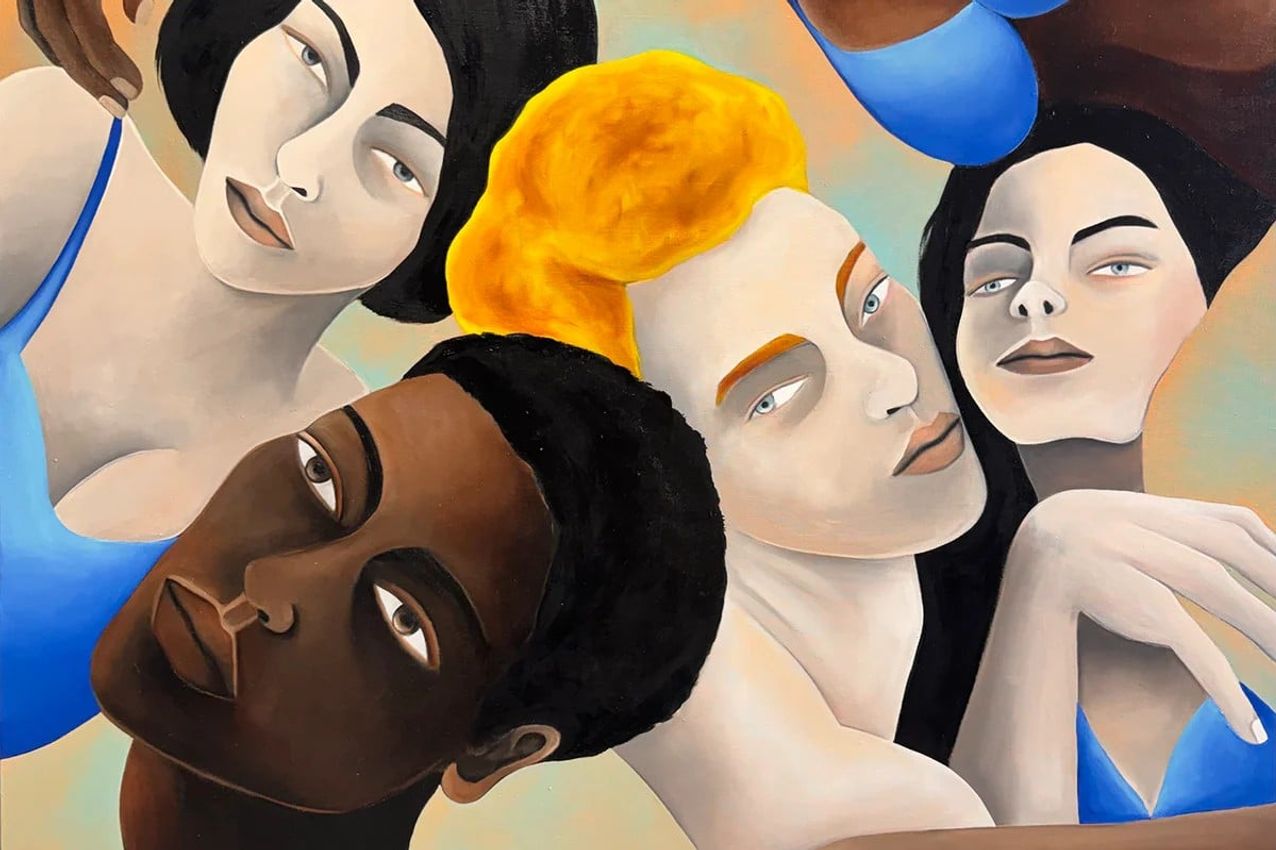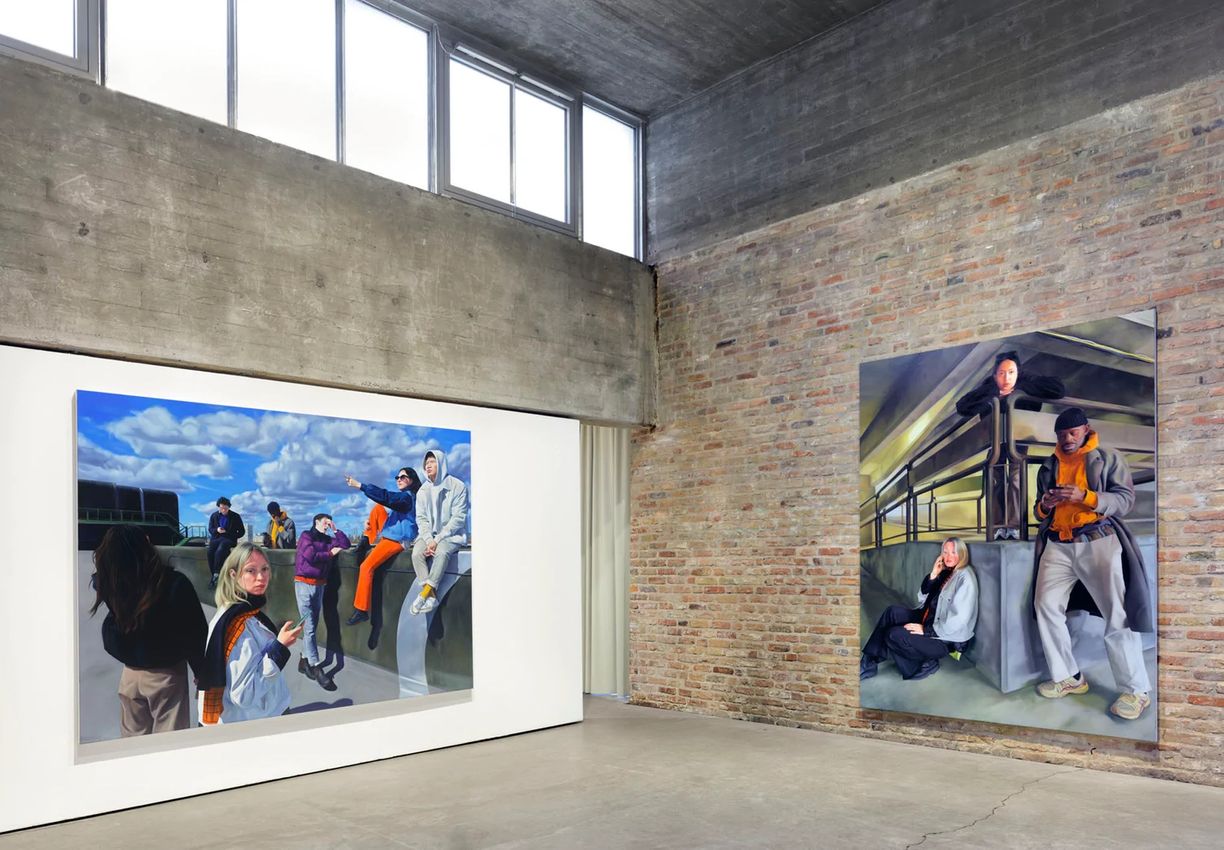
Christopher Hartmann is a London-based artist who uses the medium of painting to create near-photorealistic scenes of young characters in various states of repose, enervation, and ennui. His work is defined by the contrast between its intense intimacy and its depiction of alienation, where his subjects are often disassociating from one another and their surroundings. For NO SIGNAL, Hartmann created six new oil on linen works that will cover the interior and exterior walls of the Chapel at St. Agnes–four large-format paintings on the interior walls, and two smaller works on the exterior wall.
The works that comprise NO SIGNAL are derived from photographs that the artist staged with young, urban denizens in the British capital at the close of lockdown in Spring 2022, whose arrangement was inspired by a scene in Michelangelo Antonioni’s 1964 film, Il deserto rosso (Red Desert), where Giuliana (Monica Vitti) directly addresses the camera with her gaze. The scene in Red Desert is shrouded by the industrial suburbs around Ravenna, Italy, and Hartmann made sure to include signs of late industrialism in the backdrops of his paintings. Hartmann has previously captured intimate scenes of similar, young, urban characters, but for these new works, the backdrop of London plays an important role, framing the subjects as they each inhabit their own psychological worlds, grouped together but otherwise detached from one another. In this sense, the show’s title, NO SIGNAL, has a double meaning–the loss of a signal as a literal loss of communication on a cellular device and as a metaphor for the listless state that the characters find themselves in, devoid of external stimulus or input.
In ELEVATOR 7, a group is gathered inside the eponymous lift, an appropriate scene for NO SIGNAL as it epitomises the liminal state of being together with others without necessarily having anything to do with those around you. The detailed faces and bodies are slightly larger than life-size, standing in direct dialogue with viewers as they appear preoccupied with their various activities, awaiting arrival or departure, whatever might come. The self-absorbed states that Hartmann depicts in this scene are exemplary for his larger impulse behind all of the works in NO SIGNAL: portraying moments in which interiority is hinted at but never rendered as legible, outward expression. This dialectic between inside and outside is one that is extended from the depiction of the psychological condition of individual characters to the scenography in which they are captured, with London itself a character held in a similar state of inertia.
The statis–of emotion, but also of action–is one that belongs intrinsically to the technical conditions of the camera, which Hartmann deploys to create the images that he then translates into his paintings. They are moments that unfold in NO SIGNAL, which only the camera can depict: an instant. For Hartmann, though, such instances can last an eternity. It is as if the characters have been stranded on their own psychic island, lingering, frozen in a state before, or after, something else. In the two smaller works, MISSED CALL I & II–repainted sections from two of the larger paintings – this effect is brought into sharp focus. It is not all uncertainty, though, as such moments are also rife with possibility, that the signal, any signal, will return and give these individuals a direction, a sense of purpose, or orientation. To witness this languid state in painted form, and in life-size scale, is a powerful rejoinder to the transitory conditions of the digital image, staking out a territory and potential for large-format group portraits to realise something other than grand gestures or actions. For all of their depth and exacting detail, Hartmann’s paintings are quiet, restrained, holding back as much as they give forth, offering viewers time to experience the longue durée of a single moment.


KÖNIG GALERIE, founded in 2002, has evolved into a dynamic platform for contemporary art in Berlin and beyond. The gallery specializes in showcasing the work of both emerging and established international artists, with a particular emphasis on younger generations. Its program is characterized by interdisciplinary, concept-driven approaches, encompassing a wide array of artistic media, from sculpture and painting to video, installation, printmaking, photography, and performance.

A respected voice in contemporary art discourse.
Focusing on ambitious storytelling and insightful art-world commentary. Ocula Magazine publishes in-depth interviews, critical essays and timely analysis on the artists, exhibitions and ideas driving the global art world.
Learn more about Ocula Magazine
Showcasing the best of the art world.
Ocula partners with galleries from around the world to highlight their artists, artworks and exhibitions. Gallery membership is by application and invitation, with each member vetted by an independent panel.
Learn more about Ocula Membership

Specialises in the sale of major artworks.
Led by a team with deep ties to the world’s leading auction houses, galleries and collectors. Ocula’s advisory team offers bespoke services to high-net-worth clients from around the world who are looking to acquire the best of contemporary and modern art.
Learn more about our team and services