




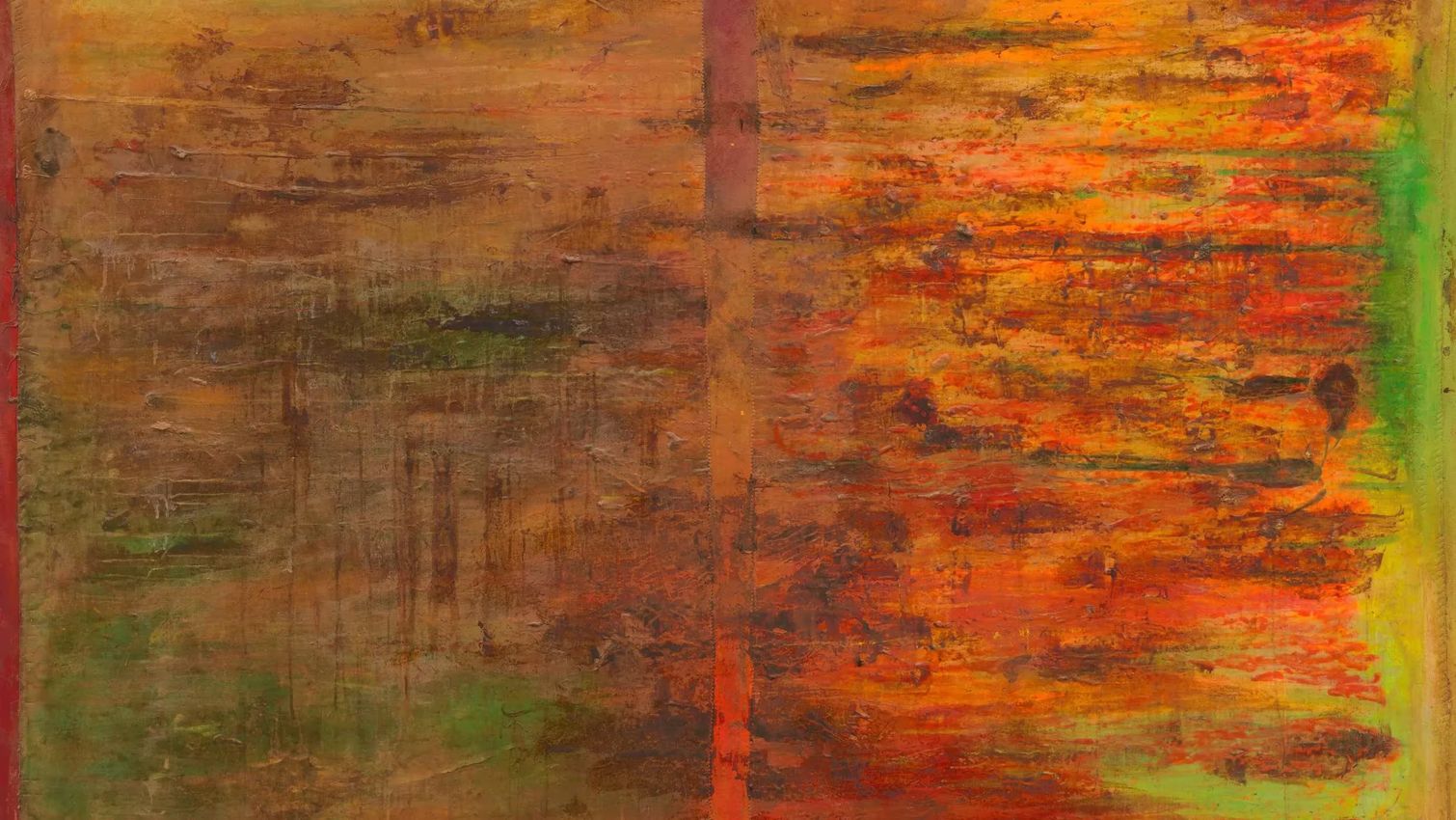
FRANK BOWLING
b. 1934, GuyanaCelebrated for his pioneering approach to abstraction, Frank Bowling is a Guyanese-born British artist whose vibrant, map-like paintings blend formal experimentation with autobiographical and postcolonial themes, earning him recognition as a transformative figure in contemporary art.
Early Years
Frank Bowling was born in Bartica, British Guiana (now Guyana), and moved to London in 1953. Initially drawn to poetry and literature, Bowling shifted his focus to art and enrolled at the Royal College of Art, graduating in 1962 alongside David Hockney and R.B. Kitaj. During this formative period, he absorbed both the lyrical figurative tendencies of British painting and the emerging language of American abstraction.
Following a move to New York in the late 1960s, Bowling became immersed in the New York art scene, engaging with artists such as Clement Greenberg and connecting with debates around abstraction and Black identity. Dividing his time between studios in London and New York, Bowling developed a unique visual language that pushed the boundaries of modernist painting while also addressing themes of diaspora and memory.
Frank Bowling Artworks
Frank Bowling’s artworks are defined by their sensuous handling of colour, layered surfaces, and conceptual engagement with geography, identity, and postcolonial history.
Map Paintings
Emerging in the late 1960s, Bowling’s Map Paintings are among his most iconic contributions to contemporary art. These expansive canvases—often saturated in luminous acrylic washes—feature stencilled outlines of South America and Africa layered into gestural abstract compositions. Works such as Mel Edwards Decides (1970) and Who’s Afraid of Barney Newman (1968) reflect Bowling’s engagement with the formal debates of modernist abstraction while infusing his paintings with autobiographical and postcolonial commentary. By embedding geopolitical cartography into abstraction, Bowling challenged dominant Western paradigms of painting and identity.
Poured Paintings
In the 1970s, Frank Bowling developed his distinctive Poured Paintings, a technique that involved tilting canvases and allowing acrylic paint to cascade and flow across the surface. This method was not only an embrace of chance and process but also a conceptual reframing of gravity and control in the act of painting. Works such as Tony’s Anvil (1975) and Middle Passage (1970) demonstrate his mastery of layering and transparency, with paint pooling into organic, topographical forms that evoke rivers, coastlines, and psychic landscapes. These works align Bowling with the Colour Field movement, while remaining rooted in his personal and cultural history.
Layered and Collaged Surfaces
From the 1980s onwards, Bowling expanded his material vocabulary to include collage, stitching, foam, and metallic pigments. These additions intensified the textural complexity of his paintings and suggested a deeper exploration of the painting as both object and image. Great Thames II (1989) exemplifies this period, with embedded objects and stitched seams creating a sculptural dimension to the canvas. These works maintain his commitment to abstraction, while engaging with ideas of fragmentation and reconstruction—evocative of memory, geography, and diaspora.
Later Works (2000s–present)
In his later works, Bowling continues to experiment with new materials and vibrant colour palettes while maintaining his rigorous engagement with the history and future of painting. Paintings such as Dan Johnson’s Surprise (2006), Sacha Jason Guyana Dreams (2014), and Cover Me (2021) reflect a painter at ease with scale and experimentation, often fusing gestural brushstrokes with poured surfaces, acrylic gels, stitched fabrics, and embedded matter. These paintings pulse with luminous energy and emotional resonance, speaking to themes of belonging, legacy, and the ongoing possibilities of the medium.
Even in his ninth decade, Bowling’s art retains a sense of urgency and vitality. His commitment to process and his refusal to be categorised within one movement or identity have secured his place as a leading figure in post-war and contemporary art.
Awards, Accolades and Public Commissions
Include:
- Wolfgang Hahn prize, Gesellschaft für Moderne Kunst am Museum Ludwig, Cologne (2022)
- Knight Bachelor for his Services to the Arts (2020)
- Pouring Over, Tate Britain mural commission (2020)
- The Royal College of Art, Honorary Doctorate, London (2020)
- OBE: Order of the British Empire. Painter and writer and Services to Art (2008)
- Royal Academician, Royal Academy of Art, London (2005)
Exhibitions
Frank Bowling has been the subject of both solo and group exhibitions at important institutions. A selection of important exhibitions is provided below.
Solo Exhibitions
- Frank Bowling: The New York Years 1966–1975, San Francisco Museum of Modern Art (2023)
- Frank Bowling’s Americas, MFA Museum of Fine Arts, Boston (2022)
- Frank Bowling, Tate Britain, London (2019)
- Mappa Mundi, Haus der Kunst, Munich (2017). Travelled to: Sharjah Foundation, UAE (2018)
- Frank Bowling. Map Paintings, Dallas Museum of Art (2015)
- Roll, Slide, Drip... Frank Bowling’s Poured Paintings 1973 – 78, Tate Britain, London (2012)
- Journeyings. Recent Works on Paper by Frank Bowling RA, Royal Academy of Arts, London (2011)
- Frank’s Colour. Painting by Frank Bowling RA, Royal Academy of Arts, London (2006)
Group Exhibitions
- Pop Forever. Tom Wesselmann & ..., Fondation Louis Vuitton, Paris (2024)
- Entangled Pasts, 1768–now. Art, Colonialism and Change, Royal Academy of Arts, London (2024)
- Life Between Islands. Caribbean – British Art 50s - Now, Tate Britain, London (2021). Travelled to: Art Gallery of Ontario (2023)
- Afro-Atlantic Histories, National Gallery of Art, Washington (2022)
- Postwar Modern. New Art in Britain 1945-1965, Barbican, London (2022)
- Soul of a Nation. Art in the Age of Black Power, The Museum of Fine Arts, Houston (2020)
Website and Instagram
Frank Bowling’s website can be found here and his Instagram can be found here.
Critical Reception
Bowling’s practice has been featured in leading magazines including ARTnews, The Art Newspaper, and The Guardian.
Frank Bowling FAQs
What is Frank Bowling’s most preeminent series?
Frank Bowling’s most renowned and influential body of work is his Map Paintings series, produced between the late 1960s and early 1970s. These large-scale abstract artworks fuse stencilled cartographic outlines—particularly of South America and Africa—with expressive fields of acrylic colour. The series marks a critical juncture where Bowling integrates autobiographical, geopolitical, and postcolonial narratives within the visual language of abstraction. By inserting personal and cultural geography into modernist aesthetics, the Map Paintings extends the conceptual scope of abstract painting. They remain among his most celebrated artworks and a landmark in the history of contemporary art.
How has Frank Bowling contributed to contemporary art?
Frank Bowling has significantly shaped contemporary art by expanding the language of abstraction to include narratives of identity, diaspora, and memory. Throughout a six-decade career, he has consistently pushed the boundaries of painting, introducing innovative techniques such as pouring, staining, and embedding materials into canvas. As one of the few Black artists of his generation to be fully embraced by both British and American art institutions, Bowling’s work has challenged Eurocentric canons and opened space for more inclusive definitions of modernism. His legacy is one of experimentation, resilience, and a lifelong commitment to the material and conceptual potential of painting.
What medium does Frank Bowling work in?
Frank Bowling primarily works in acrylic on canvas, but his medium is distinguished by a highly experimental approach that incorporates a wide range of materials and techniques. Over the years, he has poured, layered, and embedded gels, dyes, fabric, metallic pigments, stitched seams, and found objects into his richly textured artworks. His innovative use of materials creates depth, translucency, and complex surfaces that challenge conventional definitions of painting. Bowling’s process often involves working with gravity—tilting his canvases to manipulate the flow of paint—resulting in dynamic compositions that blur the line between painterly gesture and sculptural form in contemporary art.
Annabel Downes | Ocula | 2025













Frank Bowling in Ocula Magazine






Explore and Follow Artists Shaping Contemporary Art
A respected voice in contemporary art discourse.
Focusing on ambitious storytelling and insightful art-world commentary. Ocula Magazine publishes in-depth interviews, critical essays and timely analysis on the artists, exhibitions and ideas driving the global art world.
Learn more about Ocula Magazine
Showcasing the best of the art world.
Ocula partners with galleries from around the world to highlight their artists, artworks and exhibitions. Gallery membership is by application and invitation, with each member vetted by an independent panel.
Learn more about Ocula Membership
Specialises in the sale of major artworks.
Led by a team with deep ties to the world’s leading auction houses, galleries and collectors. Ocula’s advisory team offers bespoke services to high-net-worth clients from around the world who are looking to acquire the best of contemporary and modern art.
Learn more about our team and services