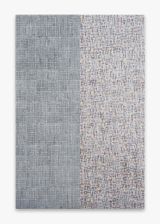
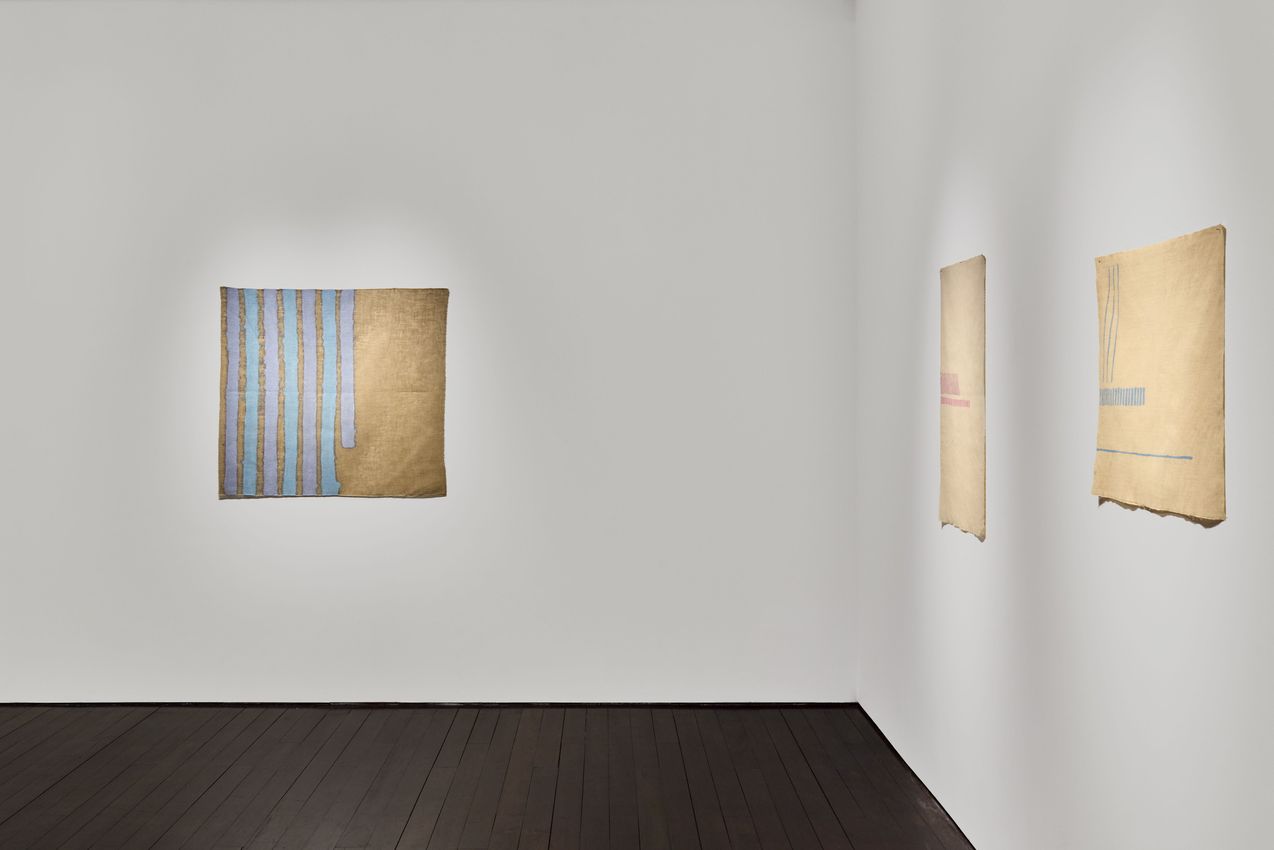
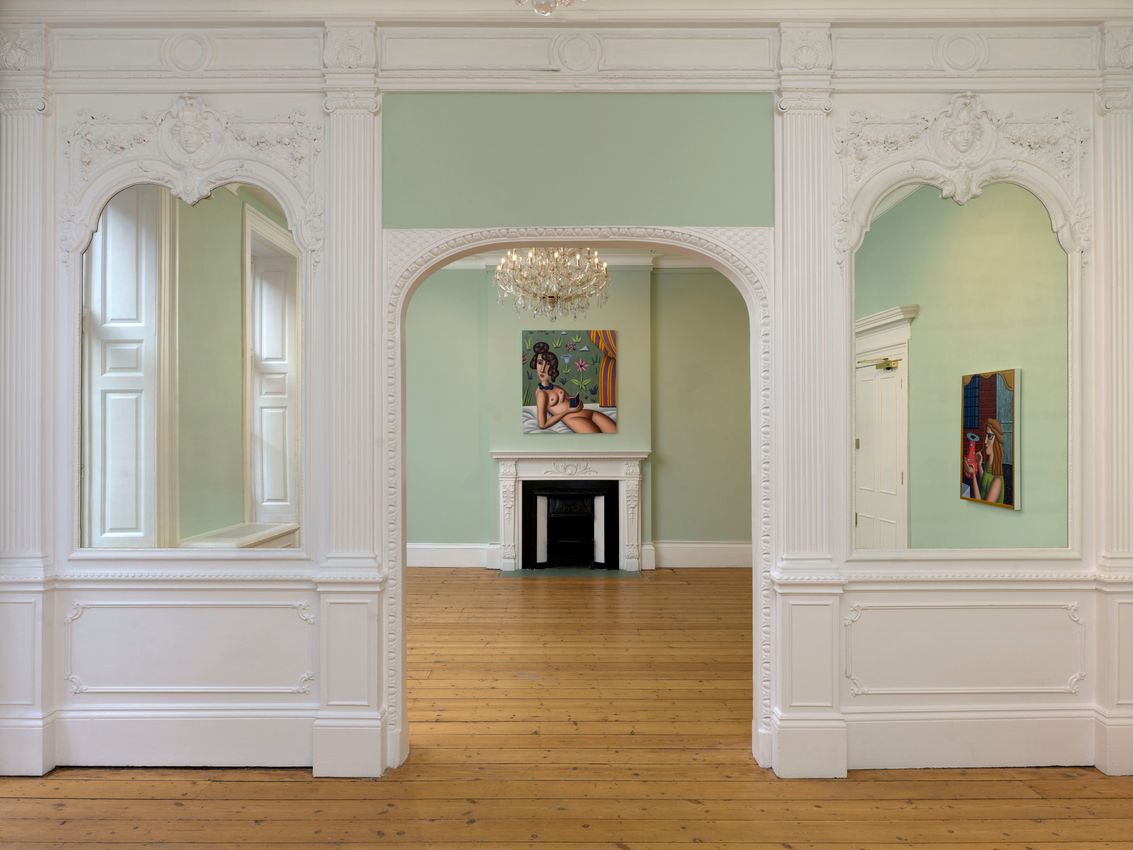
MASSIMODECARLO is pleased to present Circles and Squares, an exhibition of new paintings by McArthur Binion. For more than half a century, Binion has built his abstractions on a hidden layer of his own life. In Circle/Square, a series made in 2026, he reduces his language to its two most essential shapes. From 20-inch panels to boards six feet across, every painting holds a circle. The exhibition also includes a new group of Visual:Ear works on paper.
Circle and square are the most elementary shapes, and among the most loaded: in 1915 Malevich set a black square and a black circle at the threshold of abstraction, and Binion counts him among his forebears. Yet for Binion they are not a clean slate but a residue, what remains once everything unnecessary has been worn away. “I’m working toward simplicity,” he says.
Binion works without a brush, drawing every line by hand in ink and paintstick, with his right hand and his left, building the grid square by square. The circle is the one form that refuses the grid’s straight lines, and here the two meet head-on. The disc swells until it nearly touches the edges, sometimes declared in full color – orange on magenta, turquoise on deep violet – sometimes so close in tone to its ground that it surfaces only as the eye adjusts.
The square, by contrast, is where Binion stores his memories. Since the mid-1980s he has built his works on what he calls the “under:conscious”: personal documents and photographs, photocopied and collaged into a checkerboard. In these paintings it gathers in the border: the house in Macon, Mississippi, where he was born in 1946, built by his grandfather; pages from the address book he has kept since the 1970s; family photographs beside a score by his friend, the Pulitzer Prize-winning jazz composer Henry Threadgill. The border reads like a patchwork quilt.
Inside this perimeter of memory, the field is dense with small dark marks. The artist explains that they recall the works he made in New York in the 1970s, pressing industrial marking crayons, the kind used in lumberyards and steel mills, slowly onto aluminum. That patient, repeated gesture returns here, now in color, which has opened up only recently: for much of his career Binion worked mostly in one or two hues.
Music runs through all of this. Binion has argued that the Abstract Expressionists learned to improvise from bebop jazz, a debt he says art history has yet to acknowledge. For him, jazz is not an influence but a relative: “Me and jazz come from the same place. We recognize each other.” His first work in graduate school, Drawn Symphony: in: sane minor (1971), was drawn on music manuscript paper, and the term “visual ear” first appears in his 1973 thesis. The Visual:Ear works in the exhibition continue that idea, with grids of colored pencil drawn over the notation of Threadgill’s score, a piece Binion commissioned from him.
“There are two things I’m happy about: I was born poor. And I stuttered,” Binion has said. He has turned both into strengths. Minimalism set out to remove the artist’s feelings from the work; Binion put them back in. From a distance his paintings in Circles and Squares look like pure geometry, but up close, they reveal a life.
Courtesy MASSIMODECARLO


McArthur Binion (b. 1946, Macon, Georgia) lives and works in Chicago, Illinois.


MASSIMODECARLO gallery was founded in 1987. It switfly stood out on the international artistic scene for its bold, counter-current choices: the gallery focused on lesser-known artists in Italy such as John Armleder, Olivier Mosset, Steven Parrino and Carsten Höller. In the following years, the gallery program expanded to include prominent young artists of the time such as Alighiero Boetti, Cady Noland, Rudolf Stingel, and Felix Gonzalez-Torres.

A respected voice in contemporary art discourse.
Focusing on ambitious storytelling and insightful art-world commentary. Ocula Magazine publishes in-depth interviews, critical essays and timely analysis on the artists, exhibitions and ideas driving the global art world.
Learn more about Ocula Magazine
Showcasing the best of the art world.
Ocula partners with galleries from around the world to highlight their artists, artworks and exhibitions. Gallery membership is by application and invitation, with each member vetted by an independent panel.
Learn more about Ocula Membership
Specialises in the sale of major artworks.
Led by a team with deep ties to the world’s leading auction houses, galleries and collectors. Ocula’s advisory team offers bespoke services to high-net-worth clients from around the world who are looking to acquire the best of contemporary and modern art.
Learn more about our team and services