



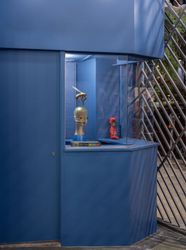
Perrotin inaugurates new Los Angeles location with fitting exhibitionof work by Japanese artist Izumi Kato.
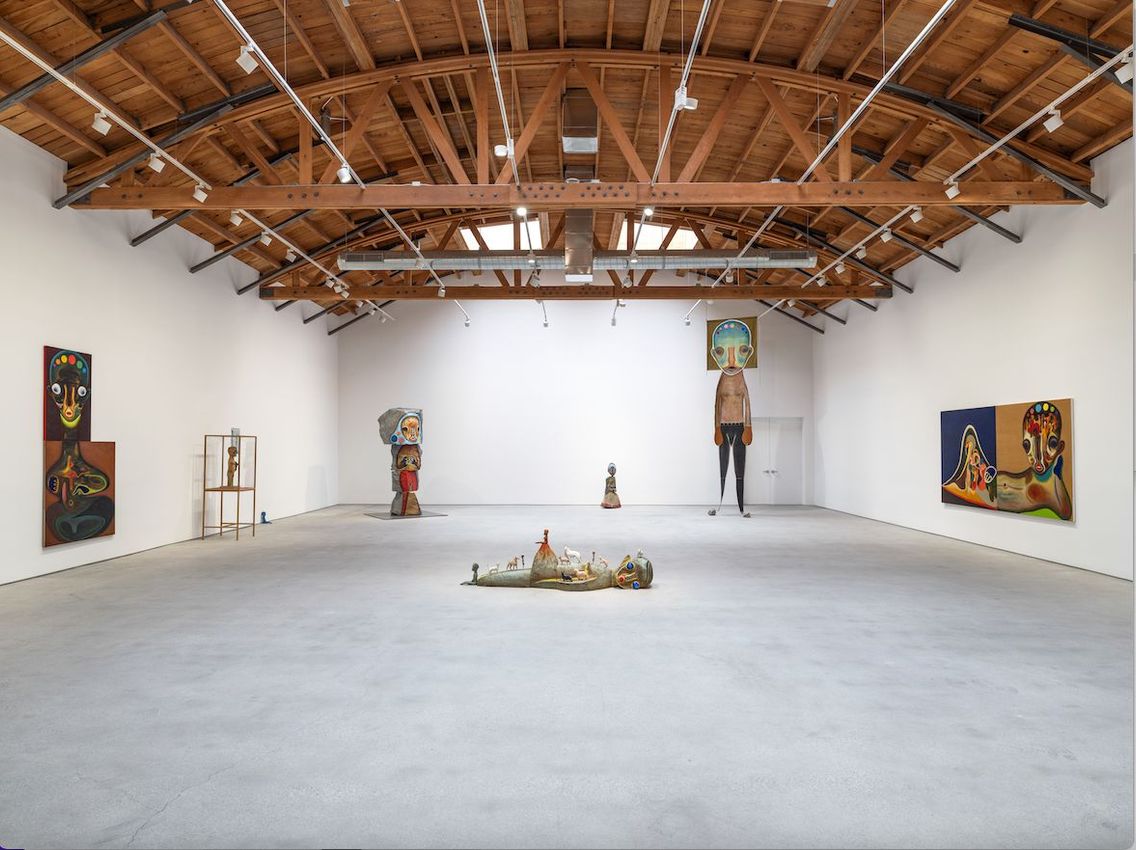
Imagine, for a moment, that Izumi Kato’s figurative subjects have a life oftheir own. From the artist’s studio in Tokyo, his subjects have traversed theocean, crossing the Pacific to emerge in Los Angeles. Making their way toPico Boulevard, they appear utterly at home in Southern California—aplace where one can encounter the extremes of both prehistoric geologyand urban modernity, where tar pits coexist with gleaming new buildings,where eternal ocean cliffs abut concrete highway. These binaries of ancientand modern, geological and man-made, are dualities that also coexist inKato’s work, making his exhibition a fitting choice for Perrotin’s inauguralexhibition in Los Angeles.Both primitive and pop, the simple geometries and biomorphic shapesKato uses to compose his distinctive figures seem to nod at the elemental forms found in petroglyphs and cave paintings, while also channeling thecharacter-driven aesthetic of contemporary culture. He uses timelessnatural materials such as wood and stone alongside manufacturedcreations such as plastic and vinyl. And Kato employs the most primal oftools—his own hands—to paint his canvases, while simultaneouslyexperimenting with forms of production that only modern technology canenable. His not-quite-human figures could just as easily be apparitions fromthe future as conjured spirits from the past.
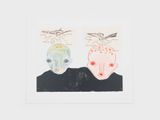
In Los Angeles, visitors to Perrotin are met by the artist’s recent figurativecreations. On first encounter, their protruding round eyes and unsmilingmouths might appear to be menacing, but the more time one spends withKato’s figures, the more one can perceive that he imbues his subjects witha stoic tenderness. Like the main character in Guillermo del Toro’s Shapeof Water, Kato’s subjects, in their almost-human form, compel us to identifywith them despite their strangeness.
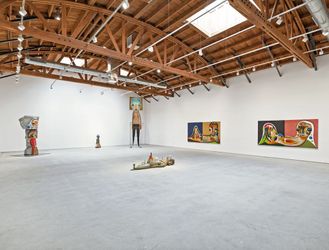
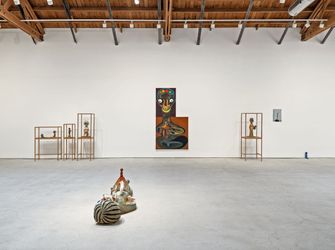
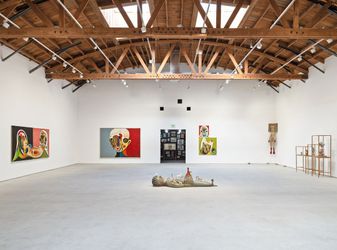
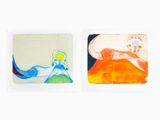
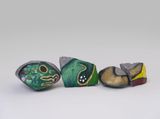
Although trained as a painter, Kato works across media, and his exhibitionin Los Angeles features both paintings and sculptures, the latterconstructed from materials including stone, cast aluminium, and fabric. Amonumental fabric figure, measuring over 17 feet (4.5 meters) tall, hoversabove the exhibition, hanging from the soaring bow truss of Perrotin’sspacious gallery. At the opposite end of the size spectrum is a plasticmodel kit, an edition inspired by the artist’s own memories of toy models.On view and also available for sale, these model kits provide owners withthe materials to create their own plastic miniature versions of Kato’s stonesculptures.
Born in 1969, Kato grew up in the Shimane Prefecture, an area of Japanwhere the Shinto god Ōkuninushi was believed to have lived. As other artcritics have noted, the experience of growing up with the surroundingcontext of Shinto shrines and the natural landscape of mountains and seamay have implicitly informed the role of mythology and nature in Kato’swork. Though he pursued formal art education at Musashino Art Universityin Tokyo, Kato’s specific techniques and artistic vocabulary cannot betraced back to academic art training, but are rather the products of the artist’s self-taught and unique approach to technique and materials. Kato’sintuitive practice is especially notable for his skill as a colorist and thecompelling palettes he develops for each painting.
Los Angeles is regularly cited as having the largest population of Japanesenationals outside of Japan, as well as being home to the second-largestnumber of Japanese-Americans living in a major metropolitan area in theUnited States (surpassed only by Honolulu, Hawaii). Perrotin’s presentationof Kato to inaugurate its Los Angeles space represents the first of manyfuture ocean crossings to celebrate artistic dialogues across the Pacific.
Press release courtesy Perrotin


Izumi Kato was born in 1969, in Shimane, Japan. He graduated from the Department of Oil Painting at Musashino University in 1992. He now lives and works between Tokyo and Hong Kong. Since 2000’s, Kato has garnered attention as an innovative artist through exhibitions held in Japan and across the world. In 2007, he was invited to the 52nd Venice Biennale International Exhibition, curated by Robert Storr. Children with disturbing faces, embryos with fully developed limbs or ancestor spirits locked up in bodies with imprecise forms–the creatures summoned by Izumi Kato are as fascinating as they are enigmatic. Their anonymous silhouettes and strange faces with absent features are above all simple forms and strong colours. Their elementary representation, an oval head with two big, fathomlessly deep eyes shows no more than a crudely figured nose and mouth. Bringing to mind primitive arts, their expressions evoke totems and the animist belief that a spiritual force runs through living and mineral worlds alike. The aura that they exude seems to manifest the first movement of life while the intensity of their expression gives us access to a knowledge of man founded less on reason than on intuition. Embodying a primal, universal form of humanity, these magical beings invite viewers to identify themselves as if looking in a mirror.


A respected voice in contemporary art discourse.
Focusing on ambitious storytelling and insightful art-world commentary. Ocula Magazine publishes in-depth interviews, critical essays and timely analysis on the artists, exhibitions and ideas driving the global art world.
Learn more about Ocula Magazine
Showcasing the best of the art world.
Ocula partners with galleries from around the world to highlight their artists, artworks and exhibitions. Gallery membership is by application and invitation, with each member vetted by an independent panel.
Learn more about Ocula Membership

Specialises in the sale of major artworks.
Led by a team with deep ties to the world’s leading auction houses, galleries and collectors. Ocula’s advisory team offers bespoke services to high-net-worth clients from around the world who are looking to acquire the best of contemporary and modern art.
Learn more about our team and services
