Press Release

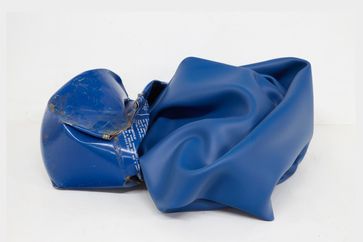
Step into Kennedy Yanko’s current studio, a former industrial sign shop. She’s there but only half visible in a dramatic pas de deux of sculpture making, a demonstration of intense corporeality. Yanko’s head and upper body are temporarily concealed beneath what appears to be a vibrant draped cape, enhancing the artist’s superpower where her magic is unfettered. When she finally moves out from under that cloak of creativity—she describes the mutable material as a ‘skin’ of colourful poured paint—she has deliberately wrestled with, then attached, the free-flowing organic expanse onto a wreck of jagged industrial scrap. Yanko’s art lives and breathes in tense contrasts: the flowing materiality of hardened paint heaved onto, across, or around junkyard castoffs. It is the edge of existence where, once she emerges from the interiority of placement, rendering, and inventive scrutiny, Yanko steadies her footing and the choreography of her work is complete. Steeped in techniques and materials that are resolutely contemporary, Yanko’s art has the burning urgency of the new but with precedents both ancient and modern.

Even the title of her exhibition at Salon 94, Retro Future, alerts viewers to an awareness of the sources that have made an impact on her current objects. At thirty-six, Yanko is a diligent student of the past with unexpected fields occupying her vision: among the influences are ancient Greek and Roman statuary of figures wearing voluminous drapery, and metal sculptures by American artists from the 1940s and ‘50s. She recently described their significance to her practice: ‘My colour washes, monochrome paint skins, found metal skeletons and shadow perspectives respectively call upon abstract expressionism, color field painting, a post-minimalist sensibility and the light and space vernacular; they all coexist as a whole, unsequenced.’

In antiquity, bodies in motion were often represented adorned in swaths of cascading fabric. This formal device that concealed and revealed a figure’s sex and bearing occupies a central place in Yanko’s creative rationale. She has been enthralled by the Hellenistic Winged Victory of Samothrace (190 BCE) since first viewing it at the top of the Louvre’s Daru Staircase around 2015 when she was in her mid-twenties. Her reminiscences reveal a decadelong gaze from a biracial woman sculptor onto one of the great images of a woman in the history of art. Yanko recalled: “I just remember a lot of my time at the Louvre was spent looking out the windows at the architecture and the space that it was occupying. And when I saw this piece, it was incredible to be framed so beautifully by the space, to see a piece of art so ancient and triumphant gently floating in modern architecture.”

The clarity of looking was seeded in her youth. Yanko, born in 1988, grew up in Saint Louis; the city whose art museum collections include the two-foot-high marble Running Artemis (late second century BCE–early first century CE), which was on view in the 1990s when she visited those galleries. Like the Winged Victory, this fragmentary work also displays stylized wet drapery plastered to the female body in spectacular movement. The representation of the torqued female form in other sculptures dating to thousands of years ago, whose very existence summoned agency, has marked Yanko’s work.

Yanko attended the San Francisco Art Institute, where she studied art history and painting. She moved to New York in 2008, initially working at the Living Theatre, an experimental company on the Lower East Side. She credits the experience of watching performers centering their bodies in physical space as formative to her individual movement from painter to sculptor. In their bodily gestures, so carefully observed by Yanko, there were connections to classical art.

The life spirit that resides within such venerable objects also guides Yanko’s preoccupation with certain examples of modern art, similarly consumed by an existential commitment to vitalism. Artists who were active during and after World War II found the terrible and great innovations of battle and survival central to a new visual language. Innovative sculptors of this era used tools of industry, like the oxyacetylene torch. Yanko has researched various artists—among them Ruth Asawa, Lee Bontecou, John Chamberlain, Herbert Ferber, Richard Hunt, and Seymour Lipton—for whom the method of making three-dimensional abstractions developed from harsh political and social realities and simultaneous mandatory invention linked to the struggle for existence born of the war. It’s not lost on Yanko that midcentury American artists, including those identified as Abstract Expressionists, reacted to worldwide conflagration and grappled with communicating the undeniable language of human fallout. She acknowledges the impact of their towering works, which some may consider outdated because they were made in the studio by hand without computer-generated assistance. Yet the reach of that period was expansive, collective, and personal.

During a recent visit in her studio, Yanko was transported when a guest opened the conversation of how the horror of current matériel employed to destroy people, their lands, and their histories—tanks and drones, explosives and robots, handheld weapons and combat gear—may eventually find a way into artists’ studios, as swords turn into ploughshares. She likewise considers her campaign from salvage yards (where she scours for scraps among the plentiful castoffs) to the studio (where she stockpiles metal fragments whose former use is hinted at by surface paint flecks). Yanko lives with those loaded pieces until she discovers a role for them. The painted skin, poured paint that hardens into relevance, is her origin story, especially when she describes herself as a painter who makes sculpture.

Yanko’s pieces sit on the floor, hang from the ceiling, or cling to the wall, shapeshifting from human-to architectural-scale. A 2021 residency at the Rubell Museum in Miami propelled a confident visual language when she installed immense works, some with accordion-like crashes of dangling steel. The next year, she was featured in a group show Brooklyn Abstraction: Four Artists, Four Walls at the Brooklyn Museum. She creates while anticipating a range of tasks, materials, forms, contexts. In this way, her process is firmly in the present while it envisions the future.Yanko stands in the realm of sculptors today who create nonrepresentational work, often in metal, and who are indebted to coloration or texture to enhance dynamism: Alice Aycock, Nairy Baghramian, Carol Bove, Melvin Edwards, Maren Hassinger, Arlene Shechet. And Yanko’s inclusion of work by Kiah Celeste, John Chamberlain, James Dinerstein, Leonardo Drew, Suzanne Jackson, and Frank Stella in her current exhibition is an open-armed recognition of artists who have profoundly reached her with the virtuosity of their sculptural practices. If these artists aren’t, as were preceding generations, linked by a historic inferno that transformed the tools of creativity, they and other contemporary sculptors push and prod the potential in material, scientific or community impact, scale, and technique. This is what galvanises their work—and what inspires Yanko. As she expresses indebtedness to mid-twentieth-century and contemporary artists, her output can also be embedded with subversion.

In a new body of work distinctive for the patterning and vitality of color in her painted skins, Yanko identified junked parts—all red—that were formative to her process. She described the sources for this group, installed in one room as coloration coheres formerly disparate elements: ‘They’re all collected from different places over time and come from different things. I’m not really sure what they were. One part had to be from a car, another from some kind of electrical box. Another one was maybe part of an industrial door.’ Any past life or intended function vanishes once Yanko claims the metal odds and ends.

In Talisman (2024), an almost six-foot-high relief that hugs the wall, a painted skin is draped in the lower register, casually resting on a vertical metal door. The sculpture is in dynamic motion; Yanko created it with the Winged Victory in mind. Lodged in Talisman is also a classic Hollywood movie story, with a glamorous sultriness and tough-guy stance. Look closely at that organic wrap, so carefully placed: it resembles a canvas, even a Color Field painting of the 1950s or ‘60s that has been rolled up, tossed off, consigned to yesterday. We’re thrust into the realm of an ambiguous homage to Helen Frankenthaler, Sam Gilliam, or Clyfford Still, with acknowledgment that their work isn’t unfurling gloriously, but is instead before us as a remnant, a reminder of art-historical antecedents.Paludamentum (2024), at just twenty-eight inches high, incorporates the same materials in smaller scale. The colorful painted skin lists amorously to one side and nestles into the salvaged red steel ground that welcomes and expels its softer counterpart. The title is a further response to Yanko’s fascination with garments worn in the ancient world—here, a mantle secured on a military commander’s shoulder. Unlike other examples in this series, the wall relief Rupture Future (2025) is harmonious; a folded paint skin is closely tucked into its same-shaped metal counterpart, and their pairing takes wing with an antenna gently dropping from the sculpture. Balance is subtly, expertly, cogently disrupted in Yanko’s hands. That elegant instant is surrendered in the floor work Stretched to Break (2025), where paint skin and metal collaborate so provocatively that they are on the precipice of combustion. Yanko executes the duality with two traces of red: one on the furious painted surface of the skin, the other with a suspension of netting trickling from the metal.

In With Fire and Blood (2024), the red metal column is consumed, overwhelmed by drapery at the top of the two-foot-high tabletop object, in a state of metamorphosis from refuse to requisite. Studio tools are implicated in this work as their incendiary role reinforces the act of making. And in Cy’s Vision (2024), a slithering skin gently winds around a metal frame, swallowing its rigidity with enveloping softness. Yanko’s work is nonrepresentational, but as we linger over the physical potential for continuing transformation of materials, there is room for narrative.

Gone is a strictly pointed dialogue between soft and hard, organic and industrial, present and future when we confront Jetstream Dreams (2024), some eight-and-a-half feet high, eight feet wide, and five feet deep. The title is a play on the colorful digital renderings of paths in the atmosphere and the circulating air currents that motivate the sculpture’s station. Vitality from those natural phenomena and from Yanko’s work are deep-seated when we question the imagery she offers. Have we seen this object before? Is it futuristic or planetary? Linked to cyberspace or technology? Is it so analog that it has recognisable roots in the past?

Inquiry and close looking are stimulated through works of art. Yanko’s sculpture demands intimate observation. A paint skin is wedged between two silvery metal forces: one reaching skyward, the other pushing into the ground plane. A central painterly gesture binds the centripetal power in the lower register to the centrifugal strength in the upper. With its position between floor and ceiling and the reflectivity of its metallic silver surface, Jetstream Dreams is a study in motion where the clash and harmony of materiality summon our unsettled present, guiding us to a potential for resolution in the future.

Yanko insists on surveying the past. She culls from the ancients the capacity of movement to generate a scenario suffused with energy while also harnessing from mid-twentieth-century American artists their responses to worldwide conflagration. At the same time, she looks to the future, advancing her own materials to solve the most pressing issues prompted by the studio and collective circumstances. It is this insistence and this steady gaze that thrusts her work forward.

Brooke Kamin Rapaport is the former Artistic Director and Martin Friedman Chief Curator at Madison Square Park Conservancy, New York. In Winter 2025, she was a Visiting Scholar at the American Academy in Rome. brookekaminrapaport.com

About Retro Future****

In April 2025 Yanko staged her largest exhibition to date at Salon 94 in collaboration with James Cohan. At Salon 94 Retro Future encompasses the entirety of the gallery’s three-story landmarked townhouse on the Upper East Side and includes new and recent sculptures both intimate and monumentally scaled. On this occasion Yanko has curated Metal and Memory, a group exhibition of sculpture and painting by artists who have shaped the landscape of abstraction, including John Chamberlain, Suzanne Jackson, Frank Stella, Leonardo Drew, James Dinerstein, and Kiah Celeste.

Read More
About the Artist

Kennedy Yanko is an American sculptor, painter, and installation artist whose works speak to the process-driven mantra of the Abstract Expressionists, whilst simultaneously engaging in the physicality of her unique materials—scrap metal and ‘paint skin’. In 2021, Yanko was the first sculptor to be awarded a residency at the Rubell Museum, Miami.

View Artist Profile Kennedy Yanko contemporary artist
About the Gallery

Salon 94 is an art gallery with three spaces in Manhattan, NYC. Since its creation in 2002, the mission of Salon 94 has grown from exhibiting special projects by emerging and renowned artists alike in the home of Jeanne Greenberg Rohatyn to representing artists such as Marilyn Minter, Lorna Simpson, Jon Kessler and Takeshi Murata.A satellite exhibition space debuted in September 2007 with sculptural work by Huma Bhabha. In 2010, a third exhibition space opened on the Bowery with a show of Richard Prince’s T-Shirt paintings. Located steps from The New Museum in New York’s Lower East Side, both galleries strive to provide more accessibility to visitors to the developing downtown art scene.Salon 94 is a member of the ADAA (Art Dealer’s Association of America).

View Gallery Profile
Address
3 East 89th Street
New York
United States
(1)
New York 3 East 89th Street
Salon 94
3 East 89th Street, New York, United States
+1 212 979 0001
https://salon94.com
The art world in focus