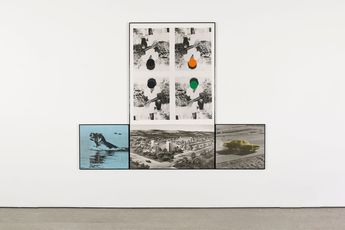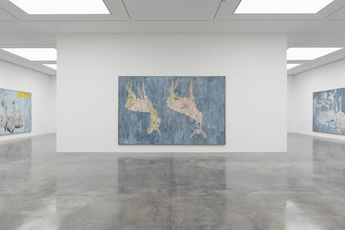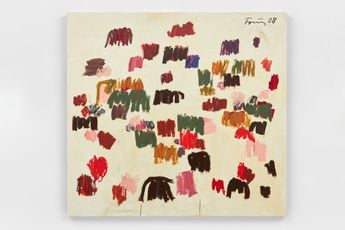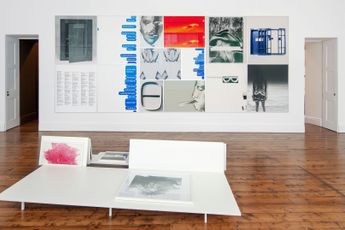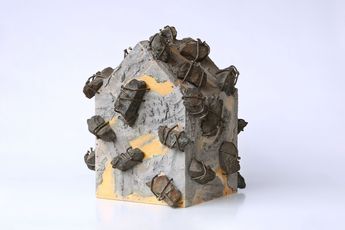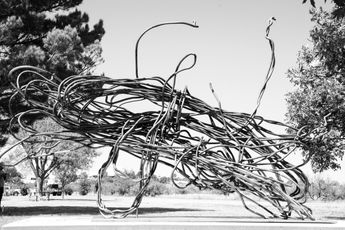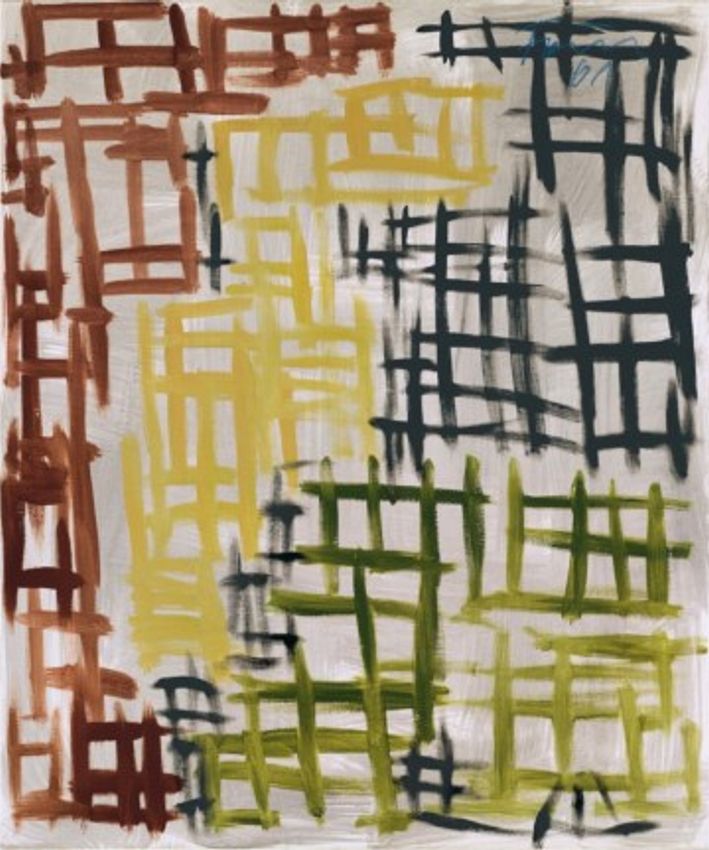
Skarstedt Paris is pleased to announce Network, a show that traces the grid’s formal possibilities as an avenue through which to grasp and represent the world—mentally, spiritually, and physically, over the past forty years. Featuring works by John Baldessari, Georg Baselitz, George Condo, Günther Förg, Martin Kippenberger, Yayoi Kusama, Sigmar Polke, Rosemarie Trockel, Günther Uecker, Sue Williams, and Christopher Wool, the artists chosen for Network are not geometrically abstract artists, or even strictly abstract artists. In selecting those whose oeuvres are not defined by the use of the grid, and yet harness it as an infrastructure of their vision, the show aims to reveal the grid’s universality as a symbol and a framework beyond its quintessential uses. Indeed, the show revisits the grid’s position as the ultimate ‘emblem of modernity,’ which can be called upon to exercise a multitude of ideas.
Characterised by its flattened, geometric, and ordered nature, the use of the grid can be technically traced back to the Renaissance as an optic tool to transfer the newly discovered laws of perspective. However, over the nineteenth and twentieth centuries it flourished into a language of its own, from the atmospheric dotted grid of Post-Impressionist Pointillism to the perspectival upending of conventional space in Cubism, then evolving into a subject in its own right in works by Piet Mondrian, followed by the spiritual and pure Minimalist grids of the 1960s. Despite its inherently abstract nature, this history makes plain that the grid’s origins are largely rooted in figuration, an idea that regained a foothold in art after the 1960s, when Network’s dialogue begins. John Elderfield and Rosalind Krauss, who have both remarked on this lineage and trace the modern use of the grid back to the representation of the window. Rosalind Krauss, in particular, notes, ‘behind every twentieth century grid there lies—like trauma that must be repressed—a symbolist window parading in the guise of a treatise on optics.’
Skarstedt was founded in 1994 by Per Skarstedt to present a program of museum-level exhibitions by contemporary European and American artists. Recognized for its critically acclaimed historical exhibitions, Skarstedt works closely with artists and estates to re-unite seminal bodies of work and offer focused surveys of pivotal moments in the history of twentieth-century art. Representing some of the most celebrated artists of their generations, Skarstedt also mounts ground-breaking exhibitions of new work, which continue to challenge the boundaries of contemporary identity.

A respected voice in contemporary art discourse.
Focusing on ambitious storytelling and insightful art-world commentary. Ocula Magazine publishes in-depth interviews, critical essays and timely analysis on the artists, exhibitions and ideas driving the global art world.
Learn more about Ocula Magazine
Showcasing the best of the art world.
Ocula partners with galleries from around the world to highlight their artists, artworks and exhibitions. Gallery membership is by application and invitation, with each member vetted by an independent panel.
Learn more about Ocula Membership

Specialises in the sale of major artworks.
Led by a team with deep ties to the world’s leading auction houses, galleries and collectors. Ocula’s advisory team offers bespoke services to high-net-worth clients from around the world who are looking to acquire the best of contemporary and modern art.
Learn more about our team and services