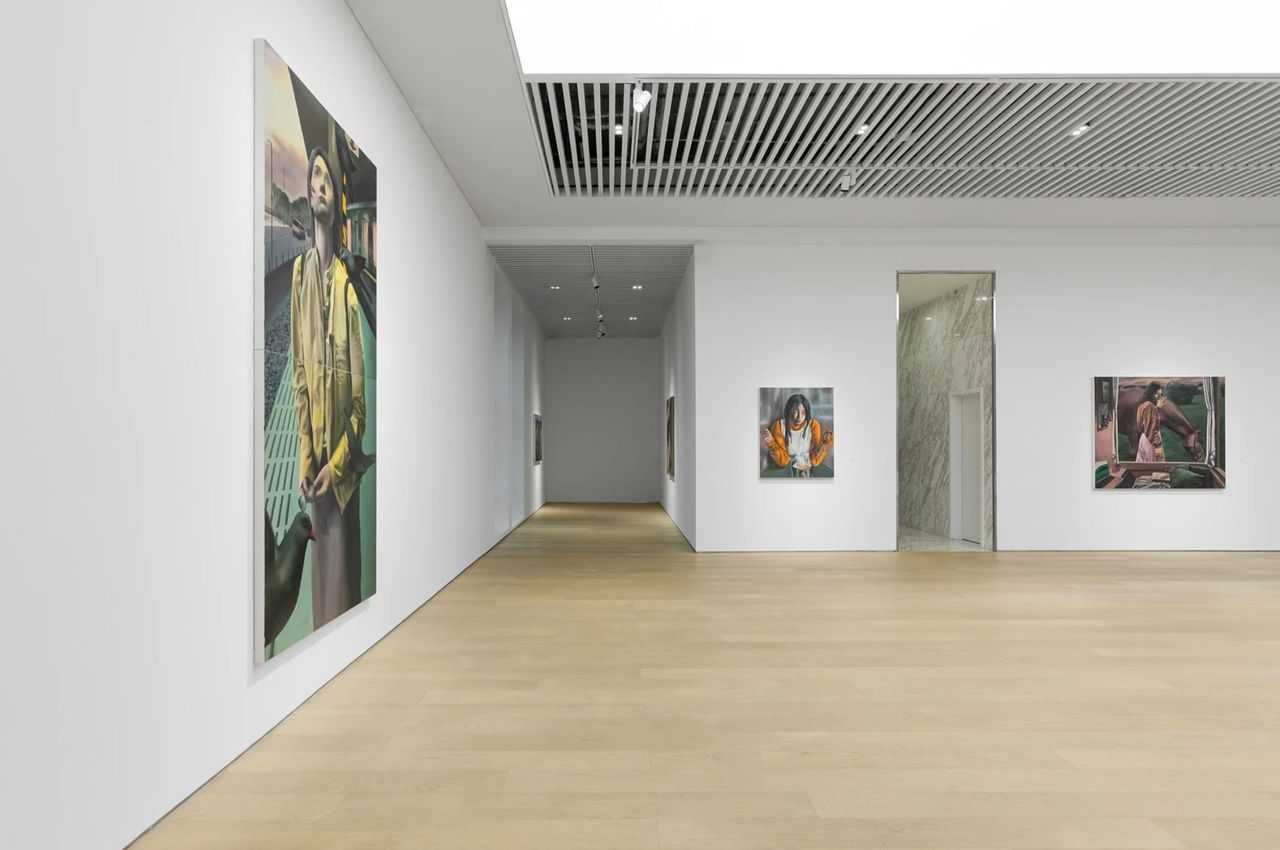
Tang Contemporary Art is pleased to announce the opening of ‘300 Seconds in the Park,’ a solo exhibition by young artist Feng Juejia, on 21 September 2024 at 4pm at its Beijing Headquarters Gallery Space. Curated by Fiona Lu and Huang Ying, the exhibition features over ten paintings, including Feng Juejia’s previous significant works and her latest creations. The title of the exhibition is derived from the ‘20-Minute Park Effect,’ which suggests that a 20-minute visit to a park every day can effectively reduce the level of stress hormones in the body and help people regain a better state of mind. This seems quite understandable: parks, as deliberately separated pockets of nature, serve as speed bumps for modern life, offering a peaceful space to reconnect with daily life.
Similarly, Feng Juejia treats boredom as a kind of escape from an alienating environment, enjoying moments of zoning out and daydreaming, as if the mind is freely wandering in a park. In particular, the artist shortens this symbolic escape to 300 seconds—five minutes, which is also the amount of time that people typically spend observing a painting in the midst of a fast-paced life. The shortened timeframe intensifies the anxiety over the end of the brief respite, while also symbolising a broader inner struggle in contemporary life. The works in this series capture these moments: brief episodes of zoning out alternating with a stark return to reality, where dark, moody tones are underscored by an undercurrent of unease. Living in the age of social media and the digital era, young people experience subtle fractures and disconnections between real-life relationships and self-representation. Through her works, the artist seeks to explore these nuances. If boredom implies a lack of meaning and is the ultimate experience of commodified linear time in an age of overloaded information, the time in Feng Juejia’s works is stagnant, as solid as it is easy to cut apart.
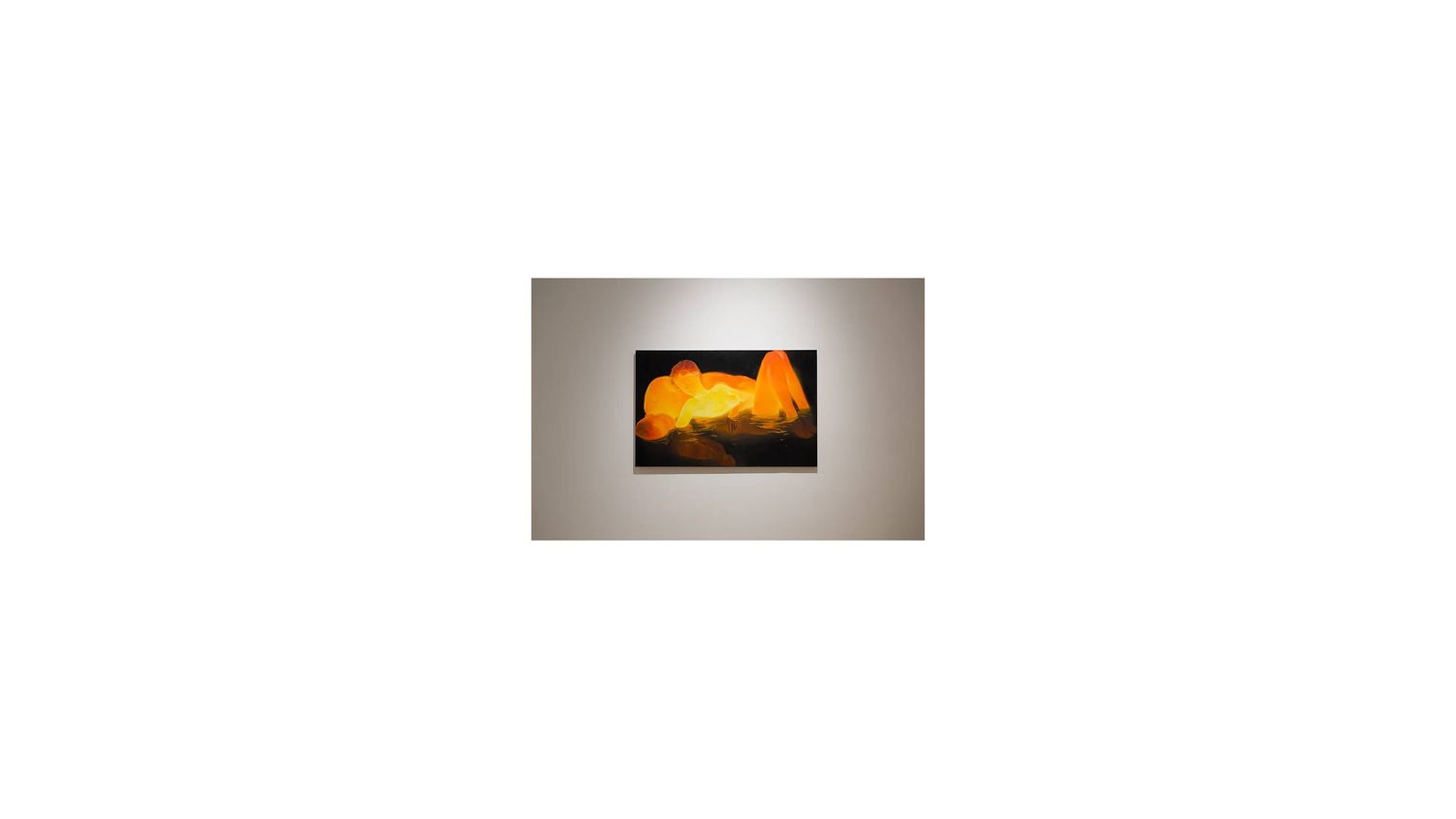
In the works in this exhibition, Feng Juejia has suspended her earlier philosophical and conceptual pursuits, incorporating more personal and subjective experiences. The seemingly plausible everyday scenes in the paintings are collages from the artist’s photographs and online images, thus erasing specific moments while infusing reality with strands of fantasy. The significance of the semi-translucent tabletop in the centre of 300 Seconds in the Park is ambiguous; the only thing that can be confirmed is that it serves as a means for the figures to relate to each other. Under Feng Juejia’s treatment, the faces of the figures become blurry, the lighting on their face is exaggerated, and a sense of out of sync arises between them and their surroundings. These faces, influenced by ancient Buddhist statues and game modelling, are smooth and stiff, with slight distortions, as if reflected in a stained mirror. The sculptural sense emphasised by light and shadow is the striking feature of her work, firm while concrete. The undulating creases and folds in the figures’ bodies evoke a sense of visual gravity, with their external surfaces filled with dynamic flows. Chaotic curves represent the dynamic changes, constructing a purely formal space out of the materiality of the figures’ bodies in the paintings. All of this brings about a temporal fixation, eternally solidifying fleeting moments and feelings. However, the stability of sculpture is challenged by the fragile nature of human relationships.
Feng Juejia’s works are permeated with subtle emotions, which are impossible to ignore, carrying a strong sense of fatigue and collision. The figures are in close physical proximity yet cannot reach to each other, intimate but distant. As Feng Juejia puts it, this arises from ‘our embarrassment in talking about our emotions, our hesitation, turning away, and remaining silent.’ In works like Piling up, Better Than Being Alone, and We, the folds of young men and women’s clothing occupy and compress the thin air between them, while the tired impulse of lust pulls them closer only to push them further away. It just what Peter Handke says, ‘The two had irreversibly separated, each entering their own summit of exhaustion, not ours, but mine here and yours there.’ The tightly closed lips of the figures refer to a refusal or impossibility of communication, leaving behind the emotional ambiguity, only eyes that seem to flee. Is this a deliberate attempt to maintain a sense of boundaries or is it the punishment for the individual who is now trapped in the narcissistic ‘hell of homogenisation’ and no longer tries to enter the world of the others? For Walter Benjamin’s insatiable people, who have ‘devoured’ all the culture of vanity, how can their hunger and deprivation caused by the unfulfilled desire for genuine connection be soothed? She puts these elusive emotions into her images and transforms the slightest tremors and twists in relationships into folds and sketches. In this way, the artist attempts to break free from the trapped relationships, seeking an entry point that can express the impoverished external and internal environments of human beings, in order to generate something real from within. ‘The desiring body and its emotions cannot remain perfunctory, remain reduced to abstract fragments of time, to be disposed of arbitrarily.’
Feng Juejia captures moments of flawed relationships in the boredom and triviality of everyday life, consciously acknowledging people’s inability—a kind of ‘anti-competent.’ While this may seem frustrating, the prerequisite for forming real connections with the others is to recognise this ‘ungraspable, unattainable, and unrecognisable’ state, serving as a reminder in the search for self-meaning. In the 300-second moment of zoning out, the artist selectively creates a moment of rest. This is not only a re-experience of the temporality of life but also an acceptance of one’s own deficiencies and desires, a reaffirmation of one’s emotions, feelings, and subjectivity.


Tang Contemporary Art was established in 1997 in Bangkok, later establishing galleries in Beijing and most recently Hong Kong. Tang Contemporary Art is fully committed to producing critical projects and exhibitions to promote Contemporary Chinese art regionally and worldwide and encourage a dynamic exchange between Chinese artists and those abroad.

A respected voice in contemporary art discourse.
Focusing on ambitious storytelling and insightful art-world commentary. Ocula Magazine publishes in-depth interviews, critical essays and timely analysis on the artists, exhibitions and ideas driving the global art world.
Learn more about Ocula Magazine
Showcasing the best of the art world.
Ocula partners with galleries from around the world to highlight their artists, artworks and exhibitions. Gallery membership is by application and invitation, with each member vetted by an independent panel.
Learn more about Ocula Membership

Specialises in the sale of major artworks.
Led by a team with deep ties to the world’s leading auction houses, galleries and collectors. Ocula’s advisory team offers bespoke services to high-net-worth clients from around the world who are looking to acquire the best of contemporary and modern art.
Learn more about our team and services