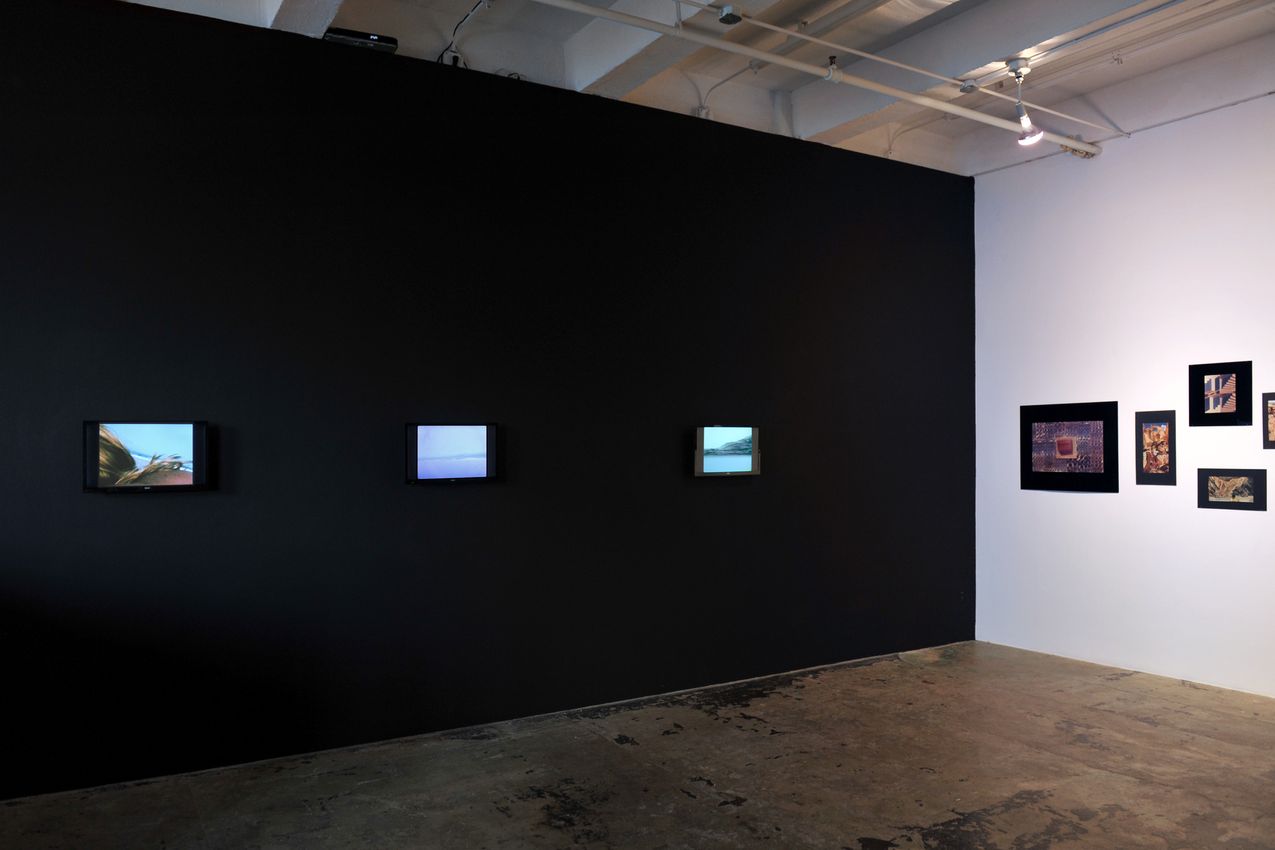
Thomas Erben is pleased to present four works by seminal New York avant-garde filmmaker Barry Gerson (b. 1939, Philadelphia, PA), dating from 1970 to 1975. Gerson’s films were part of the now historic Castelli-Sonnabend Video and Film Collection, where he was–in addition to Paul Sharits–the only filmmaker included. Grounded in an acute sense of the spiritual in the physical world, Gerson explores the fundamentals of perception of both the camera and the eye, using slow movements and small changes to give his images a mesmerising quality.
Using a basic human impulse–to watch and try to understand what we see–Gerson tricks us into examining the foundations of our own perception. He does this through subtle manipulation of various aspects of the filmmaking process. For example, the opaque fields seen in many of his images are mattes, placedin front of the camera, which serve the dual purpose of focusing our attention on one particular part of a scene, and emphasizing the image plane. While any storyline is withheld, as is a comprehensive field of vision, we are forced to adapt our viewing to the particular paradigm ofeach film and give in to the rhythm of shifting scenes. The result is astrange combination of soothing and unsettling: a meditation on the unfamiliar.
Similarly, predating current digital possibilities, Gerson collaged images from National Geographic into his own ‘constructions’–surreal scenes where perspective is simultaneously deepened and flattened. Here, the disconnect between our impulse to makesense of what we see and the inherent impossibilities of the image results in a struggle between content and surface, corresponding to thatof the films. In an era where we are constantly required to maneuver through a never-ending torrent of images, Gerson quietly pulls us in andmakes us shift our focus just slightly, from what we are seeing to how.
Barry Gerson, whose current practice includes video, cinematic fragment pieces and mixed painting/photo works, is most noted for his films, which have been on display in solo exhibitions at The Whitney Museum (1976, 1978), MoMA (1970, 1978, 1985), The Guggenheim (1971) and many other venues internationally. His work was included in The American Century, The Whitney Museum (2000) and in shows/screenings at Montreux Film Festival, Anthology Film Archives, Leo Castelli Gallery, Louisiana Museum of Modern Art (Denmark), Moderna Museet (Stockholm) and Stedelijk Museum (Amsterdam), to name just a few. Such institutions as MoMA, the Moderna Museet (Stockholm), and the Centre Pompidou (Paris) have his work in their collections.
Established in 1996, Thomas Erben Gallery focuses on rediscovering and introducing artworks that expand or deviate from the media usually associated with an artist.

A respected voice in contemporary art discourse.
Focusing on ambitious storytelling and insightful art-world commentary. Ocula Magazine publishes in-depth interviews, critical essays and timely analysis on the artists, exhibitions and ideas driving the global art world.
Learn more about Ocula Magazine
Showcasing the best of the art world.
Ocula partners with galleries from around the world to highlight their artists, artworks and exhibitions. Gallery membership is by application and invitation, with each member vetted by an independent panel.
Learn more about Ocula Membership

Specialises in the sale of major artworks.
Led by a team with deep ties to the world’s leading auction houses, galleries and collectors. Ocula’s advisory team offers bespoke services to high-net-worth clients from around the world who are looking to acquire the best of contemporary and modern art.
Learn more about our team and services