




JEFF KOONS
b. 1955, United StatesJeff Koons is an American contemporary artist born in York, Pennsylvania in 1955, renowned for highly polished sculptures that fuse popular culture, luxury materials, and large-scale spectacle. His work spans stainless steel, porcelain, inflatables, and living plants, and engages directly with consumerism, mass media, and the aesthetics of desire.
Rising to prominence in the 1980s New York contemporary art scene, Jeff Koons has become a defining figure in global contemporary art through his monumental mirror-polished stainless-steel Balloon Dog sculptures, gilded porcelain sculptures of pop icons, and immersive large-scale installations that attract international museum and gallery audiences.
His mirror-polished reflective surfaces, balloon-like stainless-steel sculptures, and brightly coloured large-scale installations blur boundaries between fine art, mass culture, luxury branding, and consumer spectacle, inviting viewers to see themselves reflected in the work and reinforcing his status in the international art market.
Early years and influences
Jeff Koons studied at the Maryland Institute College of Art (MICA) in Baltimore, earning his Bachelor of Fine Arts in 1976, and also attended the School of the Art Institute of Chicago, where he met Chicago painter Ed Paschke and worked as his studio assistant in the late 1970s.
Born in York, Pennsylvania in 1955, Koons later moved to New York City, where he initially worked selling memberships at the Museum of Modern Art and then as a commodities broker to finance his artistic practice, before returning to being a full-time artist in the city where he is still based.
Koons has cited a wide range of artistic and cultural influences, from Salvador Dalí and Surrealism to Man Ray, Marcel Duchamp‘s readymades, and the ornate aesthetics of Rococo porcelain.
His deep engagement with advertising, mass-produced objects, and marketing strategies helped shape his interest in how art functions within consumer culture, branding, and the broader public sphere.
Neo-Geo and 1980s context
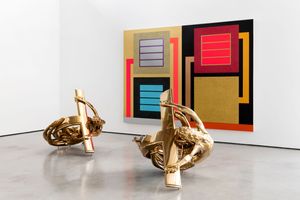
During the 1980s, Koons was associated with the loosely defined Neo-Geo (Neo-Geometric Conceptualism) movement, alongside artists such as Ashley Bickerton and Peter Halley, whose work explored abstraction, systems, and the impact of late-capitalist consumer and media culture.
Neo-Geo is often framed as a critical response to the commodification of the art object and the saturation of images in contemporary life, themes that Koons amplified through his use of commercial display strategies, industrial fabrication, and showroom-like presentations.
Keff Koons Key Artworks and Series
Koons frequently works in distinct series and across media, using readymade objects or meticulously fabricated objects that appear mass-produced yet are produced with extreme technical precision in his studio.
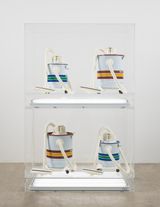
- ‘The New’ (1979–1987): This early series presents pristine, branded vacuum cleaners displayed in acrylic vitrines, some first shown in the windows of the New Museum in New York in 1980, arranged like showroom displays around illuminated signage reading ‘The New’. These works engage ideas of cleanliness, aspiration, and the fetishisation of consumer products, positioning household appliances as icons within contemporary art.
- ‘Easyfun-Ethereal’ (2001): In this series, Koons created large-scale multimedia paintings that collage imagery of bikinis, lips, eyes, cars, food, and landscapes, appropriating the seductive visual language of advertising to create densely layered, hyperreal compositions that speak to global consumer culture.
- ‘Inflatable sculptures’: Works such as Acrobat (2003–2009), depicting a brightly coloured lobster balanced between a bin and a chair, exemplify Koons’s deceptive play on the readymade and the inflatable. Although it appears to be a lightweight inflatable pool toy, with realistic painted highlights and convincing ‘crinkles’, Acrobat is in fact cast in stainless steel and is extremely heavy, underscoring the tension between surface appearance and material reality.
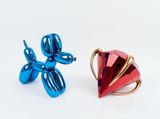
- More Iconic works and series: Koons is widely recognised for his ‘Balloon Dog’ sculptures from the Celebration series, monumental mirror-polished stainless-steel works that mimic twisted party balloons in luminous, saturated colours and have become emblematic of his practice.
- Other key series include ‘Banality’ and the porcelain sculpture Michael Jackson and Bubbles (1988), a gold-toned work that crystallises his interest in celebrity, kitsch, and mass devotion within contemporary culture.
Jeff Koon’s ‘Rabbit’
Jeff Koons’ Rabbit is a 1986 stainless-steel sculpture based on a shiny inflatable rabbit, and it is widely regarded as one of the most important works by the American contemporary artist Jeff Koons. Cast from an inflatable toy and finished with a mirror-polished surface, the Rabbit sculpture reflects its surroundings like a chrome balloon, combining the look of a cheap party decoration with the weight and permanence of high-end contemporary sculpture. Today, Jeff Koons’ Rabbit is famous both for its critical reception—often cited as a key artwork of late twentieth-century American art—and for its record-breaking auction sale, which made it one of the most expensive works ever sold by a living artist.
Public works, Puppy, and fabrication
Koons is perhaps best known to the wider public for his large-scale outdoor sculptures and public art commissions, many of which occupy highly visible urban and institutional sites.
Puppy (1992), a 13-metre (43-foot) topiary sculpture of a West Highland Terrier composed of tens of thousands of flowering plants, blends historical European garden traditions with contemporary spectacle and tourism-driven visibility.
Originally installed in various locations, Puppy was presented at Darling Harbour, Sydney, in 1995 in association with the Museum of Contemporary Art Australia, and in 1997 it was acquired by the Solomon R. Guggenheim Foundation and installed permanently outside the Guggenheim Museum Bilbao in Spain.
Shortly before the museum’s inauguration in 1997, Spanish police foiled a plot by ETA terrorists, disguised as gardeners, who intended to hide remotely detonated explosives in flowerpots around the sculpture; the attack was prevented, though a police officer was killed in the operation.
The construction of Puppy is highly technical, involving 3D computer modelling of the stainless-steel armature, hand-moulded wire mesh lined with soil, an internal irrigation system, and seasonal planting to ensure continual growth and flowering.
Koons’s large works are realised with the assistance of a substantial studio team in New York, employing fabricators and technicians to help refine concepts, maintain exacting production standards, and execute ambitious projects at significant scale.
Jeff Koons Exhibitions
Jeff Koons has exhibited widely across major international museums, galleries, and contemporary art institutions, reinforcing his global profile and visibility.
Solo exhibitions include:
- Jeff Koons: Apollo, DESTE Foundation Project Space, Slaughterhouse, Hydra, Greece (21 June–31 October 2022), an installation of new sculptures and readymade objects that created a dialogue between contemporary art and ancient Greek culture.
- Jeff Koons: A Retrospective, Whitney Museum of American Art, New York (27 June–19 October 2014), his first major New York retrospective, spanning multiple decades and series.
- Jeff Koons: Versailles, Château de Versailles (9 October 2008–1 April 2009), where his works were installed among the historic interiors and gardens of the palace.
- Easyfun-Ethereal, Solomon R. Guggenheim Museum, New York (19 July–3 September 2002), which showcased the Easyfun-Ethereal paintings and sculptures.
- Jeff Koons: Retrospective, Stedelijk Museum, Amsterdam (28 November 1992–3 January 1993), an early institutional survey of his work in Europe.
Selected recent and notable group presentations include
- Reflections: Picasso / Koons, Museo de Bellas Artes de Granada, in the Palace of Charles V at the Alhambra, organised by Museo Picasso Málaga, Granada (17 December 2024–16 March 2025), bringing together works by Koons and Picasso to explore dialogue between historical and contemporary art.
- Tropic of Cancer, Pace Gallery, Palm Beach (9 February–12 March 2023).
- NGV Triennial, National Gallery of Victoria, Melbourne (19 December 2020–18 April 2021).
- Postmodernism: Style and Subversion 1970–1990, Victoria & Albert Museum, London (24 September 2011–15 January 2012).
- The American Century: Art & Culture 1900–2000, Part II, Whitney Museum of American Art, New York (26 September 1999–13 February 2000).
Jeff Koon at DESTE
Koons’s most major solo exhibition, Jeff Koons: Apollo at the DESTE Foundation’s Project Space in Hydra, Greece, ran from 21 June to 31 October 2022 and marked his first solo show in Greece in more than two decades.
Installed in the island’s former slaughterhouse, the exhibition combined new sculptures—including works featuring classical motifs, Gazing Ball Tripod, and Plato’s Solid Forms Wind Spinners—with carefully selected readymade objects, encouraging viewers to consider the relationship between antiquity, mythology, and contemporary visual culture.
Collections and visibility
Jeff Koons’s works are held in major public and private collections worldwide, including institutions such as the Museum of Modern Art (MoMA) and the Whitney Museum of American Art in New York, the Centre Pompidou in Paris, and other leading museums.
His sculptures and installations have been exhibited at venues including the Guggenheim Museum, the Louvre, and historic sites such as the Château de Versailles and the Alhambra, as well as prominent public locations like Rockefeller Center.
Jeff Koons Market and records
Koons remains a prominent figure in the global contemporary art market, represented by leading galleries and consistently appearing at major auctions and international art fairs.
In May 2019, his stainless-steel sculpture Rabbit (1986) sold at Christie’s in New York for over 91 million USD, setting a record at the time for the highest auction price achieved by a work by a living artist.
Jeff Koons FAQs
Who is Jeff Koons?
Jeff Koons is an American contemporary artist, born in 1955 in York, Pennsylvania, known for monumental sculptures that transform and merge high art, everyday objects, popular culture, and luxury materials into highly polished icons. Working across stainless steel, porcelain, inflatables, and living plants, his practice explores consumerism, spectacle, and desire.
What is Jeff Koon’s best known for?
Jeff Koons is best known for sculptures such as Balloon Dog, Rabbit, Tulips and Puppy, which use mirror-polished stainless steel and bright colour to turn banal or playful objects into monumental works of art.
What is Jeff Koon’s most famous work?
Rising to prominence in the 1980s New York contemporary art scene, Jeff Koons has become a defining figure in global contemporary art through his monumental mirror-polished stainless-steel Balloon Dog sculptures, gilded porcelain sculptures of pop icons, and immersive large-scale installations that attract international museum and gallery audiences.
Why did Jeff Koon’s Make his Balloon Dog?
Jeff Koons made Balloon Dog as part of his Celebration series, using a simple party balloon animal to explore how fleeting moments of joy and childhood wonder can be turned into enduring monuments. He wanted to take something cheap and temporary—a balloon that usually deflates and is discarded—and remake it at monumental scale in mirror-polished stainless steel, merging the language of toys and mass culture with the craft and permanence of sculpture. The reflective surface is central to this aim: by mirroring viewers and their surroundings, the work literally incorporates people into the piece, inviting them to see themselves inside an object associated with parties, gifts and spectacle. In doing so, Koons uses Balloon Dog to question how value is created, how desire and nostalgia operate in consumer society, and how ordinary objects can become powerful symbols in contemporary art.
Where does Jeff Koons live and how old is he?
Jeff Koons was born on 21 January 1955, making him 71 years old in 2026. He lives and works in New York City, where his large studio oversees the production of his sculptures and installations.
What influences Jeff Koons’s art?
Jeff Koons draws on advertising, mass production, and the visual language of marketing, transforming everyday consumer objects into monumental artworks. He also references art history, from Rococo porcelain and classical sculpture to Surrealism and Marcel Duchamp’s readymades, linking contemporary kitsch to older traditions of ornament and display.
Where can I see Jeff Koons’s art?
Jeff Koons’s works are held in major international collections, including the Museum of Modern Art (MoMA) and the Whitney Museum of American Art in New York, and the Centre Pompidou in Paris. His sculptures have been exhibited at institutions such as the Guggenheim, the Louvre, and Palazzo Strozzi, and his monumental public works—including Puppy and Balloon Dog—have appeared at sites like Rockefeller Center, Versailles, and Guggenheim Bilbao.
What is Jeff Koons’s most expensive artwork?
In May 2019, Koons’s stainless steel sculpture Rabbit (1986) sold for 91.1 million USD at Christie’s New York, setting a record at the time for the highest auction price for a work by a living artist. Other high-priced works include Balloon Dog (Orange), which sold for 58.4 million USD in 2013, underscoring his strong presence in the global art market.
Who bought Jeff Koon’s Rabbit?
Jeff Koons’ Rabbit that sold at Christie’s New York in May 2019 was bought by art dealer Robert (Bob) Mnuchin, who was bidding in the room on behalf of a private client. Multiple reports have since identified that client as hedge fund manager and prominent art collector Steven A. Cohen, making him widely regarded as the buyer of the record‑breaking Rabbit sculpture.
Why is Jeff Koons considered controversial?
Jeff Koons is often considered controversial because his work openly embraces kitsch, luxury, and commercial imagery, prompting debate about whether it critiques or celebrates consumer culture. His industrial studio production methods, use of assistants, and record-breaking prices also raise questions about authorship, value, and spectacle in contemporary art.
How much is Jeff Koon’s net worth?
Public estimates suggest that Jeff Koons has a net worth in the range of 400–500 million USD, placing him among the richest living artists in the world. Figures vary by source—some list his net worth at around 400 million USD, while others suggest it may exceed 500 million USD or even approach 950 million USD—reflecting the difficulty of valuing private art holdings, long-term commissions and undisclosed deals.
What is clear is that Koons’ wealth comes primarily from decades of record-breaking auction sales (including Balloon Dog and Rabbit), major museum and public commissions, and high-profile collaborations with global brands, which have made him one of the most commercially successful contemporary artists.
Is Jeff Koons still alive, active and what is his latest exhibition?
Jeff Koons remains active, with recent projects including the solo exhibition Jeff Koons: Apollo at the DESTE Foundation Project Space in Hydra, Greece (21 June–31 October 2022). He continues to participate in major international shows, such as Reflections: Picasso / Koons in Granada (2024–2025), reinforcing his ongoing visibility in the global contemporary art scene.
Ocula | 2026

Explore Jeff Koons' Exhibitions On Now


View Jeff Koons' Artworks
























Jeff Koons in Ocula Magazine








Explore and Follow Artists Shaping Contemporary Art
A respected voice in contemporary art discourse.
Focusing on ambitious storytelling and insightful art-world commentary. Ocula Magazine publishes in-depth interviews, critical essays and timely analysis on the artists, exhibitions and ideas driving the global art world.
Learn more about Ocula Magazine
Showcasing the best of the art world.
Ocula partners with galleries from around the world to highlight their artists, artworks and exhibitions. Gallery membership is by application and invitation, with each member vetted by an independent panel.
Learn more about Ocula Membership
Specialises in the sale of major artworks.
Led by a team with deep ties to the world’s leading auction houses, galleries and collectors. Ocula’s advisory team offers bespoke services to high-net-worth clients from around the world who are looking to acquire the best of contemporary and modern art.
Learn more about our team and services