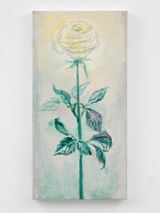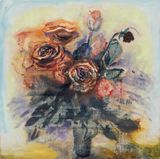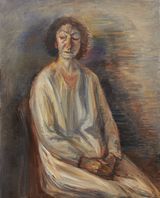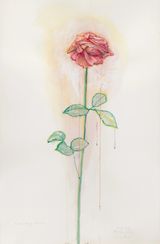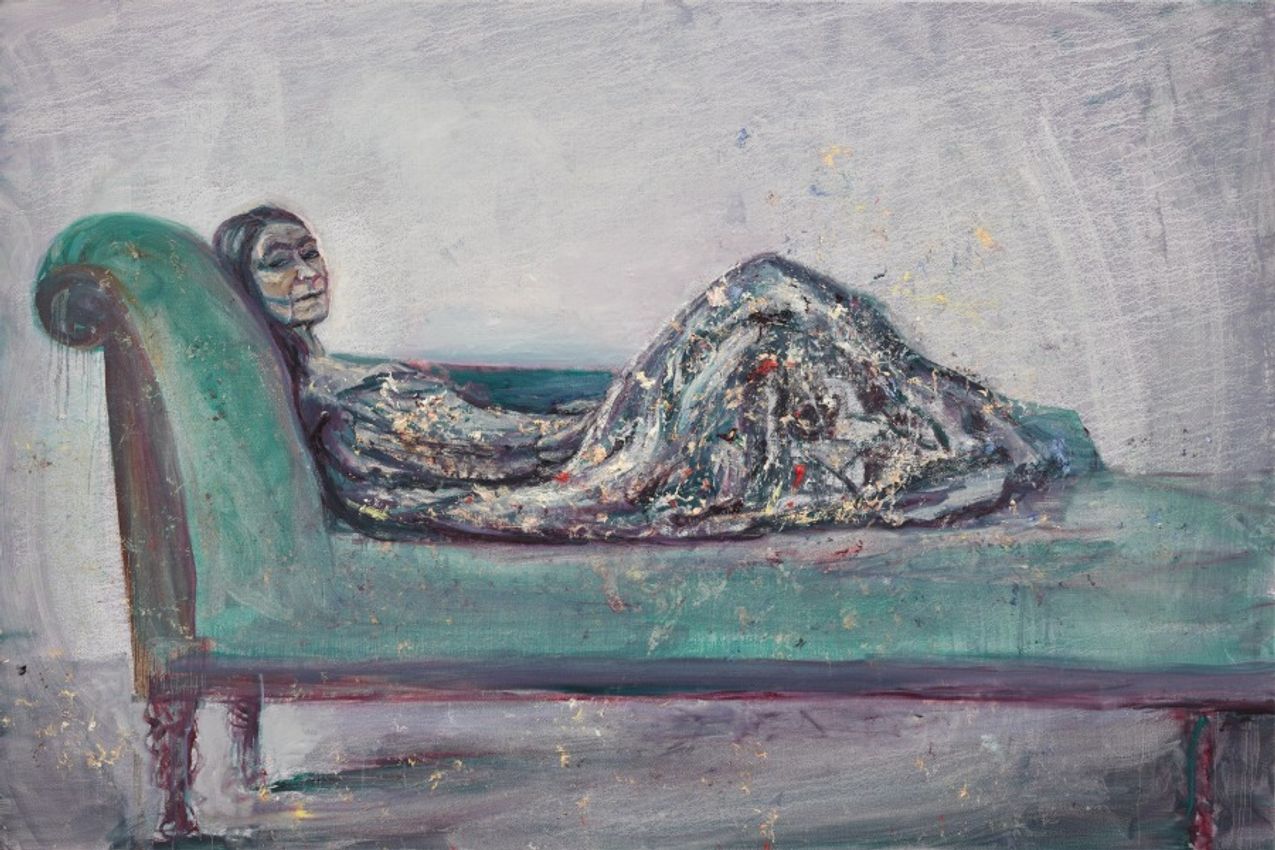
Victoria Miro is delighted to present new paintings by Celia Paul. The artist’s eighth solo exhibition with the gallery, _Colony of Ghosts _coincides with the launch of a major new monograph, published by MACK in March 2025, spanning some fifty years of painting by the artist.
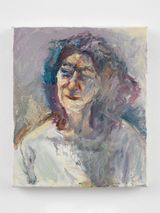
Celia Paul has always mined complexities of interior and exterior life, looping back and forth through time to the people and places closest to her. It is this highly personal consideration of time, and painting’s unique relationship to it, that underpins her latest body of work. Figures from the artist’s past appear, while the exhibition also features several new self-portraits alongside other cornerstones of Paul’s art – seascapes, paintings of her Bloomsbury studio and family members including a new painting of her four sisters.
Constancy and change, and how the past is always held in dialogue with the eternal present of the painted image, are, for Paul, inextricably linked to a consideration of self: the immediate self as well as the selves we have been in shadows, mirrors or memories, and the many selves we recognise or perhaps refute in the perception of others. Writing in her forthcoming monograph, the artist comments, ‘My young self and I – we are the same person. I can stretch out my old hand – with its age spots – and hold my young unblemished hand.’
The work that gives the exhibition its title, Colony of Ghosts is inspired by John Deakin’s well-known photograph of School of London painters lunching together in Wheeler’s restaurant in Soho in 1963. In Paul’s painting the focus is tightened to four men: Lucian Freud, Francis Bacon, Frank Auerbach and Michael Andrews. It is partly a homage, partly an examination of Paul’s residual anxiety around acceptance into this male club: ‘They represent “home” to me because I belong among them, even if they can’t let me in,’ the artist comments. In a companion work, Reclining Painter, the artist lies on a chaise-longue in her Bloomsbury studio, her head turned towards the viewer, her gaze inward. ‘I am thinking of the past,’ she writes, but ‘the paint lives in the present tense, always.’ The contrast of mood between these identically proportioned works, and the dialogue between them, is intentional: ‘A group of male painters is empowered by solidarity; the opposite is true for women. For a female painter to achieve lasting recognition, she needs to succeed on her own.’
Several recent self-portraits including Painter at Home were inspired by photographs of the artist taken in her studio in 2021, shortly after the death of her husband, Steven Kupfer, when, as she writes, ‘grief had sharpened my perception of my singularity.’ The artist describes her apartment facing the British Museum, where she has lived and worked since 1982, as ‘the world that I alone have created,’ and where at times ‘my memories are more alive than my present existence.’
Home as a quest and a question is an encompassing theme of the exhibition, while water, representing the eternal, the flow of time, or a sense of bodies becoming dissolute and consciousness shifting to a more elemental plane, is a constant motif – in works such as My Sisters by the Sea, Painter Against Water and The Sea, The Sea. Together, they lend Paul’s work its particular tempo of movement and stasis, while a new-found sense of self-acceptance, even defiance, in Paul’s recent self-portraits suggests that concepts of rootedness and belonging might reside not in a physical place so much as in a state of being, which for Paul lies in the act of painting.
New monograph
Published by MACK in March 2025, this expansive and long-overdue monograph includes new writings on Celia Paul by Hilton Als, Clare Carlisle, Karl Ove Knausgård, Edmund de Waal and Rowan Williams, as well as a new text by Paul herself. Beginning with the earliest works made by Paul at the age of fifteen, this 500-page volume weaves a chronological sequence of work across fifty years. Within the rhythms of the book there appear themes and figures that Paul has returned to again and again: her mother, her sisters, the sea, and, crucially, the artist herself. In doing so, these works express the tireless inquisitiveness with which Paul approaches her subjects, and the ways painting offers an understanding of the world around her.
About the artist
Celia Paul was born in 1959 in Trivandrum, India. She lives and works in London. Major solo exhibitions have included Celia Paul, curated by Hilton Als, at Yale Center for British Art, New Haven, Connecticut, USA (2018) travelling to The Huntington, San Marino, California, USA (2019); Desdemona for Celia by Hilton, Gallery Met, New York, USA (2015–2016); Gwen John and Celia Paul: Painters in Parallel, Pallant House Gallery, Chichester, UK (2012–2013); The Grave’s Art Gallery, Sheffield, UK (2005) and Abbot Hall, Kendal, UK (2004).
The artist’s work has been featured in group exhibitions including Acts of Creation: On Art and Motherhood, Arnolfini, Bristol, UK (2024), travelling to MAC Birmingham, UK; Millennium Gallery, Sheffield, UK (2024–2025) and Dundee Contemporary, Scotland, UK (2025); Real Families: Stories of Change, The Fitzwilliam Museum, Cambridge, UK (2023);Joan Didion: What She Means, curated by Hilton Als, Hammer Museum, Los Angeles, USA (2022–2023);Pictus Porrectus; Reconsidering the Full-Length Portrait, Bell House, Newport, Rhode Island, USA (2022); Me, Myself, I – Artists’ Self-Portraits, Royal West of England Academy, Bristol, UK (2022); _All Too Human: Bacon, Freud and a Century of Painting Life, _Tate Britain, London, UK (2018); La Diablesse, Tramps, London, UK (2016); NO MAN’S LAND: Women Artists from the Rubell Family Collection, Rubell Family Collection, Miami, USA (2015–2016); _Forces in Nature _curated by Hilton Als at Victoria Miro, London, UK (2015); Recent acquisitions: Arcimboldo to Kitaj, British Museum, London, UK (2013); Self-Consciousness, curated by Peter Doig and Hilton Als, VeneKlasen/Werner gallery, Berlin, Germany (2010); _The School of London: Bacon to Bevan, _Musée Maillol, Paris, France (1998) and _British Figurative Painting of the 20th Century, _The Israel Museum, Jerusalem, Israel (1992).
Her work is in collections including Abbot Hall, Kendal, UK; British Museum, London, UK; Carlsberg Foundation, Copenhagen, Denmark; Fitzwilliam Museum, Cambridge, UK; Frissiras Museum, Athens, Greece; Herzog Ulrich Gallery, Brunswick, Germany; Metropolitan Museum of Art, New York, USA; Morgan Library and Museum, New York, USA; National Portrait Gallery, London, UK; New Hall Art Collection, Murray Edwards College, Cambridge, UK; Rubell Family Collection, Miami, USA; Ruth Borchard Collection, London, UK; Saatchi Collection, London, UK; Victoria and Albert Museum, London, UK; and the Yale Center for British Art, Connecticut, USA.
Celia Paul’s art stems a deep connection with subject matter and is quiet, contemplative and ultimately moving in its profound attention to detail and deeply-felt spirituality. She makes intimate depictions of people and places she knows well. From 1977 to 2007 Paul worked on a series of paintings of her mother, and since then she has concentrated on painting her four sisters, especially her sister Kate, as well as a number of portraits of close friends. She has also produced a large number of evocative self-portraits over the course of her career. Paul’s self-portraits open up a painterly and conceptual dialogue between the dual role of subject and artist – caught between self-possession and self-scrutiny – as well as offering an extended consideration of the essential dualities of the medium – its ability to capture qualities of form, light and atmosphere, and its material presence.


A respected voice in contemporary art discourse.
Focusing on ambitious storytelling and insightful art-world commentary. Ocula Magazine publishes in-depth interviews, critical essays and timely analysis on the artists, exhibitions and ideas driving the global art world.
Learn more about Ocula Magazine
Showcasing the best of the art world.
Ocula partners with galleries from around the world to highlight their artists, artworks and exhibitions. Gallery membership is by application and invitation, with each member vetted by an independent panel.
Learn more about Ocula Membership

Specialises in the sale of major artworks.
Led by a team with deep ties to the world’s leading auction houses, galleries and collectors. Ocula’s advisory team offers bespoke services to high-net-worth clients from around the world who are looking to acquire the best of contemporary and modern art.
Learn more about our team and services