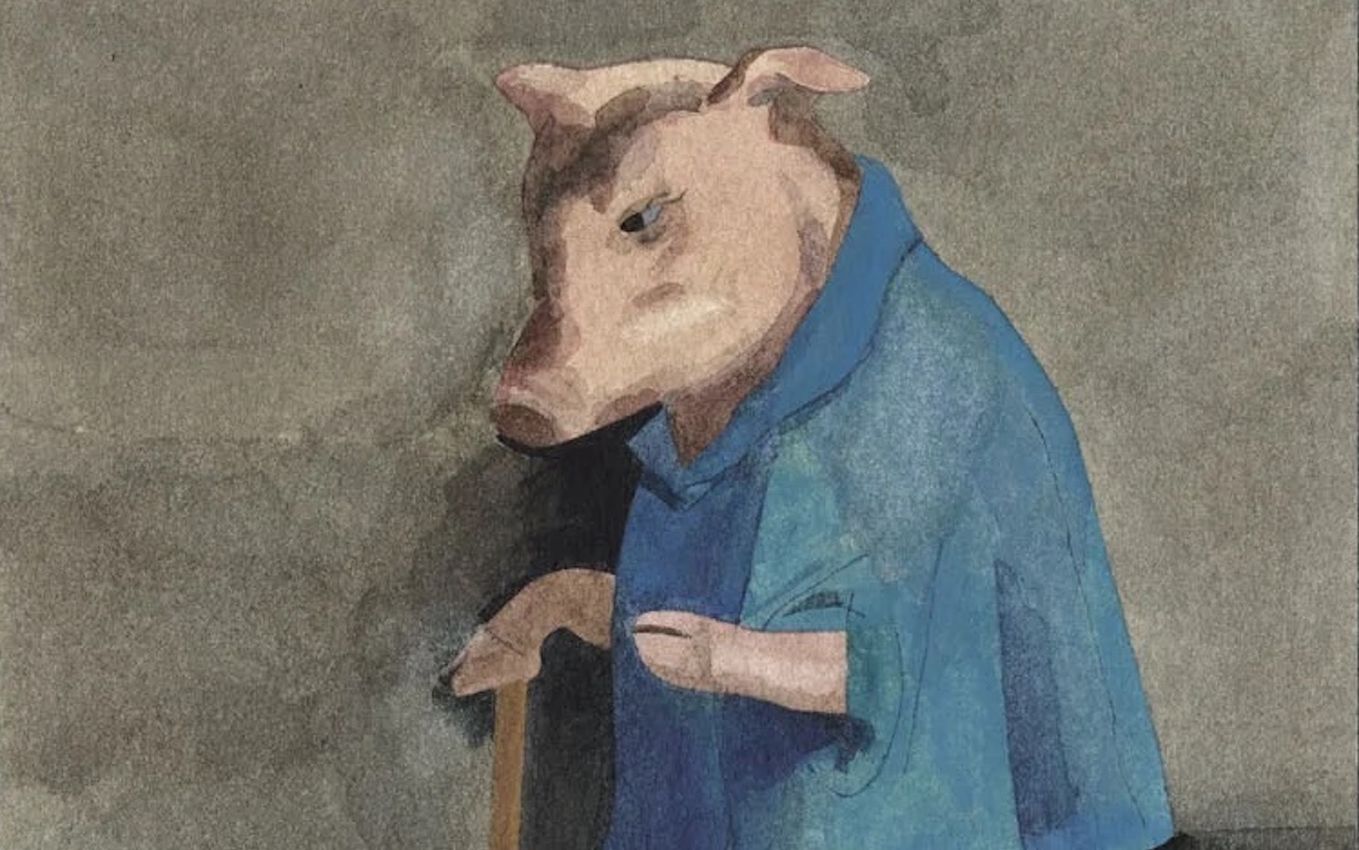
A series of over 170 watercolours, collages and drawings by Sir Peter Blake illustrating Dylan Thomas’s landmark 1953 ‘play for voices’, Under Milk Wood, is to be exhibited by Waddington Custot this summer, in a new, dedicated exhibition space opposite the main gallery at 22 Cork Street, London. The series has never before been shown outside of Wales, and this exhibition debuts a number of new works shown for the first time, as Blake has continued to work on the series. Under Milk Wood will open as Blake celebrates his 90th birthday.
Illustrating Under Milk Wood is a project that Blake has been working on for over 40 years. The artist first heard the play as a student at the Royal College of Art, when it was broadcast on the radio in 1954, but his idea to create a series of illustrations based on the piece was conceived a quarter of a century later in 1979, when he was given a recording to listen to in the studio as he worked. Blake returned to, and abandoned, the project multiple times until the 1990s, before embarking on the series in earnest: ‘As soon as I decided to illustrate Under Milk Wood, I researched it, read it and listened to it again and again. I still play it a couple of times a week and read it once a month. I’ve always treated it as a separate piece of work. I work on Under Milk Wood at home in the evening. It’s almost like a ‘separate me’ doing it.’
Under Milk Wood tells the surreal story of the dreams and innermost thoughts of the inhabitants of a mythical Welsh seaside town called Llareggub. All is ‘strangely simple and simply strange’ as dawn breaks and we are first introduced to characters such as Captain Cat, Nogood Boyo and Polly Garter through their visceral dreams, before following them around their interwoven lives in Llareggub over the course of one day. Following the sequence of the play, Blake divides his work into three distinct sections: brightly-coloured watercolours of the characters’ dreams, collages which capture scenes and snippets of text from the play and portraits of each character rendered in hard pencil. Later watercolours, added to the series after Blake imposed his ‘artificial deadline’ on the project in 2013, captures new scenes and moments from the play.
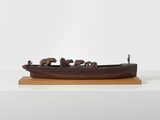
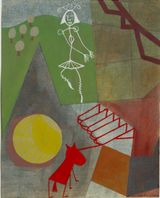
Blake began the project by first working on capturing the dreams that open the play, which are variably surreal, lusty, meandering and absurd, deeply rich in their imagery and transportative to the innermost thoughts of the characters: Captain Cat is visited by five drowned men who imagine life on land and the people they have left behind in Llareggub; Mr Utah Watkins imagines a sheep with the head of his wife, ‘smiling and knitting and bleating’ as they leap the fences on the hill; Mrs Willy Nilly dreams she is being spanked by her teacher for being late to school. The surrealism of the language encouraged Blake to depict the passages as literally as possible in these 26 works. Where Thomas writes ‘Mrs Rose Cottage’s eldest, Mae, peels off her pink and white skin, in a furnace, in a cave, in a waterfall in a wood and waits there’, Blake paints exactly that, carefully layering the imagery. Blake says, of Thomas: ‘When he wrote those sequences, I don’t imagine he ever thought of it visually, he would have thought of it as words. So I really enjoyed making something that was never intended to be visual, visual.’
The second section of the exhibition illustrates specific passages of the text through a variety of media including collage and photographs. Some passages, such as a long list of items that wash up onto a beach, took Blake years to depict as he painstakingly sourced the images that make up the collage. Much of the photography was taken by Blake himself in 1986 on a visit to Laugharne in Carmarthenshire, Wales, the town where Thomas lived during his final four years and which is generally regarded as the inspiration for Under Milk Wood. It was on this visit that Blake coincidentally met Dylan Thomas’s widow, on her first trip back to the town since the author’s death.
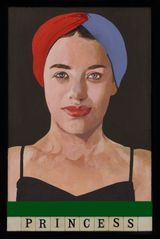
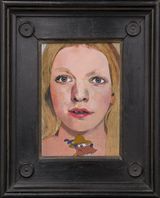
The third section of the exhibition displays 60 pencil-drawn portraits of each character mentioned in the text. Each portrait is a ‘drawn collage’ based on a real person, or people; Blake believes that a face cannot be invented. For example, Elizabeth Taylor appears as Rosie Probert, as she does in the 1972 BBC film adaptation of the text. Waldo’s wife uncannily resembles Terry Wogan with long hair, and Mrs Willy Nilly has a similarity to the author Margaret Atwood; others are composites of different features: Blake has given Captain Cat his own beard.
Under Milk Wood was first shown in 2013 at the National Museum of Wales in Cardiff, to celebrate the centenary of Dylan Thomas’ birth, and subsequently at the Glynn Vivian Art Gallery in Swansea. This will be the first time the series has been shown in almost a decade and the first time it comes to London.
Under Milk Wood is presented in a dedicated temporary exhibition space at 22 Cork Street, across the street from the main gallery and is the third address on the street occupied by Waddington Custot. The gallery has a long history on the street, opening its first space at 2 Cork Street in 1958 and having as many as five different galleries on the street by the end of the 1980s.
Sir Peter Blake (b. 1932, Dartford, Kent) is a British painter, sculptor, draughtsman and printmaker. He is known as one of the leading figures of British Pop art. Peter Blake studied at Gravesend School of Art before being accepted into the Royal College of Art, London, where he studied alongside other key British Pop artists, David Hockney, R.B. Kitaj, Joe Tilson, Allen Jones, Peter Phillips and Derek Boshier. After graduating from the Royal College of Art in 1956, Blake began to appropriate pop culture icons and advertising imagery to create homages to the likes of Marilyn Monroe, Brigitte Bardot, Elvis Presley and professional wrestlers. His iconic 1961 Self-portrait with Badges, in the Tate Collection, shows Blake holding an Elvis album, dressed in American jeans, Converse trainers, and baseball badges; here is the artist as a genuine fan. In other works, he composes assemblages of found objects with humorous allusions to art history and childhood fantasies. In 1967 he designed the iconic album cover for The Beatles’ Sgt. Pepper’s Lonely Hearts Club Band in his distinctive style of collage. Blake continues to be associated with the music world by designing album covers. In 1975 Blake co-founded the Brotherhood of Ruralists, a group of artists who moved to Somerset to paint nature.
Waddington Custot was formed through the partnership of French art dealer Stephane Custot and long-time London art dealer Leslie Waddington, in 2010. Located in Cork Street since 1958, formerly as Waddington Galleries, the gallery has a rich heritage and an international reputation for quality and expertise in works by modern and contemporary masters, with a particular focus on monumental sculpture.

A respected voice in contemporary art discourse.
Focusing on ambitious storytelling and insightful art-world commentary. Ocula Magazine publishes in-depth interviews, critical essays and timely analysis on the artists, exhibitions and ideas driving the global art world.
Learn more about Ocula Magazine
Showcasing the best of the art world.
Ocula partners with galleries from around the world to highlight their artists, artworks and exhibitions. Gallery membership is by application and invitation, with each member vetted by an independent panel.
Learn more about Ocula Membership

Specialises in the sale of major artworks.
Led by a team with deep ties to the world’s leading auction houses, galleries and collectors. Ocula’s advisory team offers bespoke services to high-net-worth clients from around the world who are looking to acquire the best of contemporary and modern art.
Learn more about our team and services