





ALLISON KATZ
b. 1980, CanadaAllison Katz is a Montreal-born, London-based contemporary artist whose work examines how images move between personal experience, popular culture, digital media, and art history. Her concept-led practice spans painting, posters, ceramics, installation, and exhibition design, and has been the focus of major institutional presentations, including the landmark UK solo project Artery at Nottingham Contemporary (2021) and Camden Art Centre, London (2022), as well as her participation in the 59th Venice Biennale (2022).
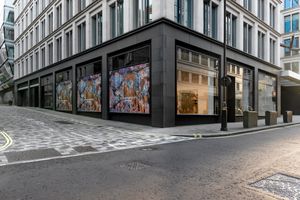
In 2026, Hauser & Wirth will present Outta the Bag (30 April—24 July 2026) at the gallery’s New York, Wooster Street space, a major solo exhibition that revisits Katz’s years living in the city and extends her ongoing exploration of how images, memories, and histories circulate through painting. Katz also has a forthcoming solo exhibition, Jeu d’esprit, at the Montreal Museum of Fine Arts, Montreal, Canada, opening in October 2026.
Background
Katz studied Fine Arts at Concordia University in Montreal and completed an MFA at Columbia University in New York before settling in London. She has presented solo and institutional exhibitions in Europe, North America, and Asia, and her work is included in major international surveys of contemporary painting.
Practice and Motifs
Katz practice is concept-led: she treats painting as a form of “voice” or conversation rather than a single fixed style. Since the early 2010s, she has built a constellation of motifs—cocks and roosters, cabbages, mouths, noses, monkeys, fairies, elevators, waterways, and versions of her own name—that recur across canvases, posters, and ceramics. These elements act like characters whose meaning changes through repetition, scale, and context, echoing how pictures circulate in advertising, social media, and museum culture. Text, signatures, and titles also play an active role, with puns and double meanings probing how language shapes identity and interpretation.
Framing and Exhibition-Making
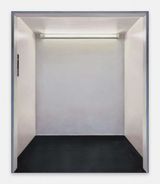
Katz’s interest in framing—as image, structure, and underlying idea—is central to her approach. She designs exhibitions with the viewer’s movement in mind, using angled walls, “rooms within rooms,” and painted copies of architectural features such as doorways or lift interiors. Paintings originally made to fit one location are later reinstalled elsewhere, producing new relationships and questioning site-specificity as something fixed. For her, the exhibition is not just a container but a form in its own right, one that energises the autonomy of each painting by placing it in changing contexts.
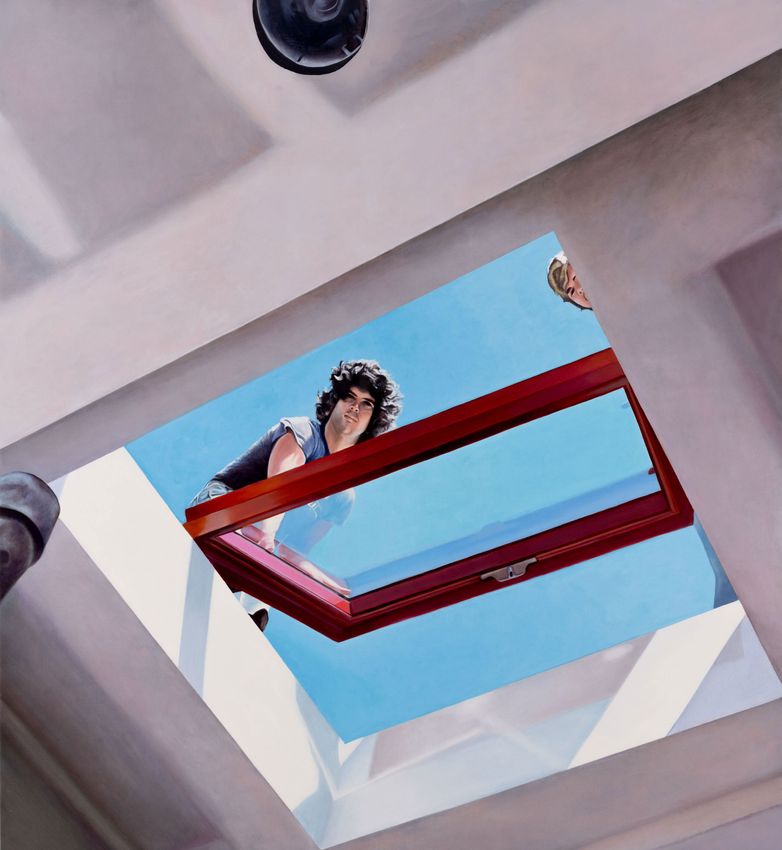
Windows and mouths, which appear throughout her work, mark thresholds between inside and outside, linking bodily sensation to acts of looking and reading. Her exhibition posters, printed with concrete dates and times, also operate as independent artworks that can extend or skew the duration of a show, continuing to circulate once the event has ended. In recent projects, framing devices double as both motif and structure: architectural apertures, bodily thresholds, and pictorial conventions highlight the conditions under which images are encountered.
Recent Works
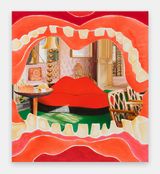
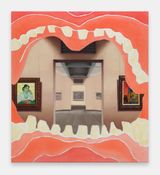
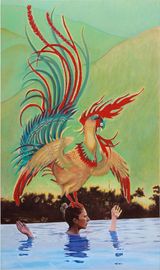
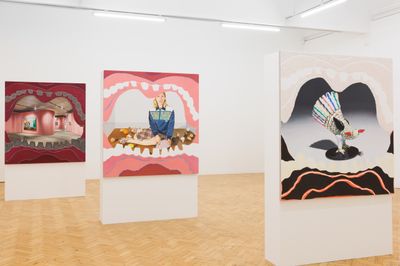
Individual works exemplify these concerns. In the painting Jaws (2026), Katz places an historical installation view of The Museum of Modern Art‘s inaugural 1929 exhibition inside an enlarged open mouth, a motif that threads through her wider practice. The composition sets the strict order of one-point perspective against the unruly outline of the mouth, suggesting that looking is simultaneously organised and visceral. In Burden (2026), a brightly coloured rooster stands on the head of a partially submerged figure in a pool, extending her long-running rooster motif into a hybrid self-image in which human and animal form a precarious pair.
Wordplay and AKgraph series
Wordplay, double entendre, and riddling structures run through Katz’s work, from painting titles to the construction of images. This extends to her use of her own signature as a visual device. In the AKgraph series, which draws on the Greek roots of “autograph” (autos, “self,” and graphos, “written”), she explores the overlap between everyday signatures and drawing, treating the written name as an image that both records and questions identity. These works build a likeness of her face from the letters of her name, setting cartoon-like forms against assumptions of stable authorship and gently undermining the idea of a single “signature style.” Instead, Katz proposes painting as an open, conversational field that can absorb and re-order the many images and narratives that shape contemporary life.
Exhibitions and Recognition
Katz’s institutional solo exhibitions include Diary w/o Dates at Oakville Galleries, Ontario, and MIT List Visual Arts Center, Cambridge (both 2018), and All Is On at Kunstverein Freiburg (2015). In the UK she gained wide attention with Artery, a travelling solo exhibition at Nottingham Contemporary (2021) and Camden Art Centre, London (2022), accompanied by an extensive publication. Recent gallery projects include Westward Ho! at Hauser & Wirth West Hollywood (2023–2024) and Outta the Bag at Hauser & Wirth New York (2026).
Her work has featured in major group shows such as The Milk of Dreams, 59th International Art Exhibition of La Biennale di Venezia (2022), Mixing It Up: Painting Today at the Hayward Gallery (2021), and The Imaginary Sea at Fondation Carmignac (2021). In 2023 she was awarded the Gershon Iskowitz Prize at the AGO, which recognises outstanding contributions to Canadian art and includes a solo presentation at the Art Gallery of Ontario.
Allison Katz FAQs
Who is Allison Katz?
Allison Katz is a contemporary visual artist from Montreal who lives and works in London. She is known for concept-led painting, posters, ceramics, and installations that use recurring motifs and wordplay to explore how images move between personal life, popular culture, and art history.
What themes does Allison Katz explore in her work?
Allison Katz’s work often deals with identity, subjectivity, communication, and how images circulate in today’s visual culture. She uses motifs like cabbages, cocks, mouths, noses, monkeys, elevators, and windows to question how meaning changes through context, repetition, and framing.
What is Allison Katz’s Artery exhibition about?
Artery is a major ongoing project that brings together paintings, ceramics, and posters to explore ideas of voice, selfhood, and circulation. Presented across institutions including Nottingham Contemporary, Camden Art Centre, and Canada House in London, it links the body’s arteries with the networks—urban, institutional, and informational—through which art and images travel.
Where has Allison Katz exhibited her work?
Allison Katz has presented solo exhibitions at institutions such as Nottingham Contemporary, Camden Art Centre, MIT List Visual Arts Center, Oakville Galleries, and Kunstverein Freiburg, as well as at commercial galleries in London, Milan, Shanghai, Los Angeles, and New York. She has also taken part in major international exhibitions, including the 59th Venice Biennale.
What is distinctive about Allison Katz’s style and approach to painting?
Allison paintings mix figurative and abstract elements, humour and unease, and often incorporate text, signatures, and poster-like formats. She treats exhibitions and wall layouts as integral to the work, using framing devices, architectural features, and site-specific display to challenge the idea of a single, fixed “signature style” and to keep interpretation open.
Ocula | 2026

Works at Gió Marconi

Works Elsewhere













Explore and Follow Artists Shaping Contemporary Art
A respected voice in contemporary art discourse.
Focusing on ambitious storytelling and insightful art-world commentary. Ocula Magazine publishes in-depth interviews, critical essays and timely analysis on the artists, exhibitions and ideas driving the global art world.
Learn more about Ocula Magazine
Showcasing the best of the art world.
Ocula partners with galleries from around the world to highlight their artists, artworks and exhibitions. Gallery membership is by application and invitation, with each member vetted by an independent panel.
Learn more about Ocula Membership
Specialises in the sale of major artworks.
Led by a team with deep ties to the world’s leading auction houses, galleries and collectors. Ocula’s advisory team offers bespoke services to high-net-worth clients from around the world who are looking to acquire the best of contemporary and modern art.
Learn more about our team and services