






JULIAN DASHPER
1960-2009, New ZealandJulian Dashper was a New Zealand contemporary artist from Auckland, known for wry conceptual paintings, drum-kit and record works, and projects like The Big Bang Theory, Future Call, and Midwestern Unlike You and Me that rethink modernist art from Aotearoa New Zealand’s vantage point.
Dashper developed a practice that is both intensely local and deeply attuned to the histories of abstraction, minimalism, and conceptual art associated with Europe and the United States. Curator Robert Leonard has described Dashper as a ’self-consciously art-historical’ artist whose works are always in dialogue with other artists and art history, whether through painting, drum kits, records, or exhibition ephemera.
What was Julian Dashper’s background?
Julian Dashper was born in Auckland in 1960 and studied at Elam School of Fine Arts, University of Auckland, graduating with a Bachelor of Fine Arts in 1982. He emerged in the 1980s with expressive abstract paintings before turning toward a more conceptual, art-historical practice that treated New Zealand’s reception of international modernism—largely via reproductions and catalogues—as a central theme.
Dashper lived and worked in Auckland while building a strongly international career, notably through a Senior Fulbright Scholarship and residency at the Chinati Foundation in Marfa, Texas, in 2001. This residency, alongside exhibitions and projects in Europe, Australia, and the United States, deepened his engagement with minimalism and conceptualism and provided crucial context for later works and the mid-career survey Midwestern Unlike You and Me: New Zealand’s Julian Dashper.
What kind of art did Julian Dashper make?
Julian Dashper made conceptually driven works across painting, sculpture, photography, sound, and printed matter, often using targets, drum kits, records, and installation photographs to probe where an artwork begins and ends. He consistently foregrounded the ‘infrastructure’ of art—galleries, catalogues, CVs, documentation, and even phone calls—as material, treating these supports not as secondary but as part of the work itself.
Drum kits, records, and ‘The Big Bang Theory’
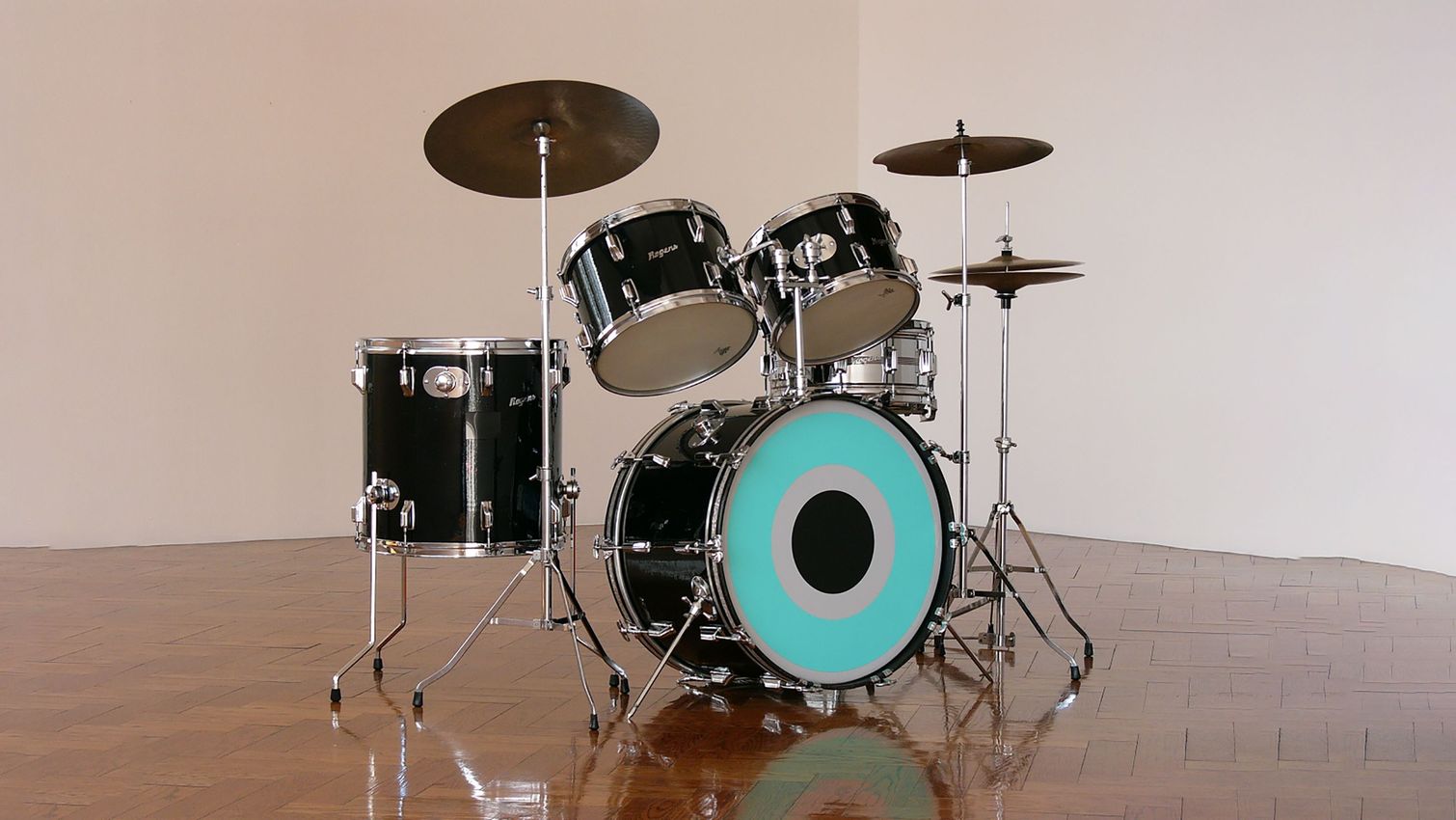
A defining strand of Dashper’s practice is his drum-kit and record works, which recast New Zealand’s painting canon as a band and the gallery as a stage. In The Big Bang Theory (1992—93), Dashper presented five full drum kits emblazoned with the names of painters Colin McCahon, Don Driver, Rita Angus, Ralph Hotere, and Toss Woollaston, transforming a line-up of revered artists into a sculptural ‘hit parade’ about influence, noise, and visibility.
Works such as The Colin McCahons (1992) isolate a single drum kit bearing McCahon’s name, shown both as a physical installation and as a series of photographs documenting its placement in different institutional settings. By re-presenting the kits as both objects and images, Dashper asks whether the work resides in the drum kit, the photograph, the exhibition story—or the entire network of associations around them.
Julian Dashper paintings and multiples
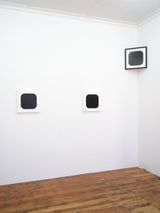
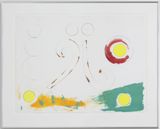
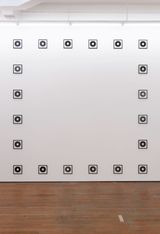
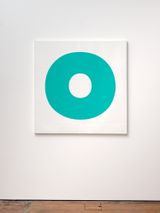
Dashper’s paintings often employ bold circular forms, targets, and restrained palettes that echo modernist abstraction while nodding to graphic design and branding. Works such as Untitled (1996) and related target-like canvases and prints distil the letter ‘O’ and circular logos into near-minimal compositions, playing on the overlap between records, drumheads, frames, and typographic forms. Smaller works, like Untitled (1996) made from vinyl on a drumhead, compress the larger drum-kit installations into single, wall-mounted objects that still carry the visual language of music equipment and logos. These works underline Dashper’s interest in how seemingly modest, circular motifs can be loaded with art-historical, musical, and institutional associations.
‘Future Call’ and the importance of context
Future Call (1994—2005) is one of Julian Dashper’s most influential conceptual works, consisting of scheduled telephone calls that the artist made to a gallery or exhibition space from another time zone. In exhibitions, a ringing phone would connect visitors to Dashper’s recorded or live voice from ‘the future’, turning a simple call into a time-shifted conversation about presence, anticipation, and the infrastructures that connect artists, galleries, and audiences.
Discussed in Ocula‘s spotlight ’Julian Dashper: Calling the future’, Future Call has been read as emblematic of Dashper’s belief that the words and networks surrounding an artwork—conversations, documentation, and collaborative relationships—are as important as the physical objects themselves. The work’s long time span and re-presentations in different venues underscore his interest in collaboration, friendship, and the ongoing ‘call and response’ that sustains artistic practice.
What is ‘Midwestern Unlike You and Me’?
Midwestern Unlike You and Me: New Zealand’s Julian Dashper is a mid-career survey and 25-year retrospective of Julian Dashper’s work, curated by Christopher Cook and David Raskin. Touring institutions in the American Midwest between 2005 and 2006, including the Sioux City Art Center, it was the first touring retrospective in the United States devoted to a resident New Zealand artist.
The catalogue for Midwestern Unlike You and Me draws parallels between New Zealand and the Midwest as regions that receive and re-stage narratives of modernism, positioning Dashper as an artist who works from and about such ‘peripheral’ locations. Bringing together paintings, drum-kit installations, photographic works, records, and projects like Future Call, the survey foregrounds Dashper’s contribution to contemporary art’s understanding of distance, documentation, and circulation.
How was ‘Midwestern Unlike You and Me’ re-staged in Auckland?
In 2026, Michael Lett in Auckland re-staged Midwestern Unlike You and Me, returning this landmark survey of Julian Dashper’s practice to the artist’s home city two decades after its original Midwest tour. Presented by the gallery that now represents Dashper’s estate, the re-staging renewed attention to his exploration of how modernist and conceptual art histories move between New Zealand, the American Midwest, and other art centres.
For Midwestern Unlike You and Me: New Zealand’s Julian Dashper, several works function as anchors that crystallise Julian Dashper’s key ideas about distance, documentation, and the circulation of modernism. The Big Bang Theory (1992—93), with its five full drum-kit installations emblazoned with the names of Colin McCahon, Don Driver, Rita Angus, Ralph Hotere, and Toss Woollaston, appears in the survey as a touchstone for Dashper’s interest in turning the New Zealand canon into a ‘band’, using music gear, staging, and photographs to ask how reputations are made and replayed. Works from The Colin McCahons series, shown as both drum-kit installations and official photographs, extend this inquiry by treating the institutional photograph as equal to the object, underscoring the exhibition’s wider concern with how artworks are remembered through images and archives.
Target and circle paintings and drumhead works from the 1990s, including Untitled (1996), bring his minimalist, logo-like circles into the survey as a visual counterpart to the drums and records, folding together abstraction, branding, and the material culture of music.
The inclusion of Future Call (1994–2005), with its scheduled telephone calls from another time zone, introduces a time-based, conversational dimension to the show, embodying Dashper’s fascination with networks, anticipation, and the idea that the work might be the relationship—artist to gallery, present to future—rather than a single object. Across these works, the survey frames Midwestern Unlike You and Me itself as a kind of meta-piece, showing how Dashper uses drums, circles, phone calls, and documents to think through what it means for an artist from New Zealand to inhabit and replay the histories of modern and contemporary art in the American Midwest and beyond.
What was the exhibition ‘Julian Dashper & Friends’ about?
Julian Dashper & Friends (City Gallery Wellington, 2015—16), curated by Robert Leonard, was conceived as a posthumous ‘conversation’ rather than a conventional retrospective, setting Julian Dashper’s works alongside those of artists who shaped, reflected, or extended his thinking. The exhibition brought together Dashper’s drum-kit piece The Colin McCahons and related Big Bang Theory material with works by New Zealand and international artists including Rita Angus, Billy Apple, Daniel Buren, Fiona Connor, Colin McCahon, Dane Mitchell, Milan Mrkusich, John Nixon, John Reynolds, Peter Robinson, Marie Shannon, Imants Tillers, Peter Tyndall, Jan van der Ploeg, and Gordon Walters.
Key juxtapositions in the exhibition included Nixon’s Blue Rider (1994) with Dashper’s Untitled (The Warriors) (1998), and the presentation of The Colin McCahons both as an original drum-kit installation and as the official photograph taken in Auckland Art Gallery’s auditorium, underscoring Dashper’s obsession with the slippage between artwork and documentation. By placing Dashper’s pieces amidst works by his peers, influences, and successors, Leonard framed Dashper as a ‘self-consciously art-historical” artist whose practice was always in dialogue—with New Zealand’s canon, with international abstraction and conceptualism, and with the friendships and collaborations that sustained his career.
For curator Robert Leonard, his art practice is important because it spanned a transitional period in New Zealand’s art history. Dashper brokered a shift from mid-century regionalist painters who were interested in nationalist artistic themes, to a group of younger artists who embraced different media and modalities but also pursued the discourses of a globalised art world.
Select awards and accolades
Julian Dashper received a Senior Fulbright Scholarship in 2001, undertaking an artist-in-residence position at the University of Nebraska and the Chinati Foundation in Marfa, Texas. His work has featured in major exhibitions such as Julian Dashper & Friends at City Gallery Wellington (2015) and Julian Dashper: Professional Practice at Gus Fisher Gallery, Auckland (2010).
Julian Dashper Exhibitions
Select solo exhibitions
- Midwestern Unlike You and Me: New Zealand’s Julian Dashper, touring the American Midwest, 2005–2006
- The Big Bang Theory, Artspace, Auckland, 1993
Select group exhibitions
- Headlands: Thinking Through New Zealand Art, Museum of Contemporary Art, Sydney, 1992
- After McCahon: Some Configurations in Recent Art, Auckland Art Gallery Toi o Tāmaki, 1989
Julian Dashper FAQs
Who is Julian Dashper?
Julian Dashper was an Auckland-born New Zealand contemporary artist whose conceptual artworks—spanning painting, drum-kit installations, records, photographs, and sound works—engage critically with the histories of abstraction, minimalism, and conceptual art. He is widely regarded as a pivotal figure in New Zealand’s transition from an inward-looking, medium-based art scene to a more globally networked, conceptually oriented practice.
What is Julian Dashper known for?
Julian Dashper is known for turning drum kits, records, targets, and exhibition ephemera into artworks that examine how art history is written, circulated, and branded in places like New Zealand and the American Midwest. Key projects include The Big Bang Theory, The Colin McCahons, the time-shifted telephone work Future Call, and the survey Midwestern Unlike You and Me: New Zealand’s Julian Dashper.
What is Future Call by Julian Dashper?
Future Call (1994—2005) is a conceptual work in which Julian Dashper arranged scheduled phone calls from an earlier time zone to a gallery or exhibition, so that visitors encountered his voice as a live or recorded call ‘from the future’. The work encapsulates Dashper’s interest in the words, conversations, and collaborative networks that surround artworks, treating communication itself as an artistic medium.
What was Julian Dashper’s exhibition ‘Midwestern Unlike You and Me about’?
Midwestern Unlike You and Me: New Zealand’s Julian Dashper was a mid-career survey and 25-year retrospective of Julian Dashper’s work, curated by Christopher Cook and David Raskin and touring museums in the American Midwest in 2005 and 2006. The exhibition and its catalogue emphasise how Dashper’s practice reflects parallels between New Zealand and the Midwest as regions that receive and reinterpret the narratives of modernist and conceptual art.
Where can I see work by Julian Dashper?
Work by Julian Dashper can be seen in major public collections, including Auckland Art Gallery Toi o Tāmaki, Museum of New Zealand Te Papa Tongarewa, Christchurch Art Gallery Te Puna o Waiwhetū, the Museum of Contemporary Art Australia in Sydney, the Ludwig Forum für Internationale Kunst in Aachen, and the Stedelijk Museum Amsterdam. Exhibitions of Julian Dashper’s work are also presented by galleries such as Michael Lett in Auckland and other contemporary art spaces in New Zealand and abroad.
How did Julian Dashper work and what materials did he use?
Julian Dashper worked with paint, canvas, drum kits, drumheads, records, photographs, slides, printed matter, and telephony, often using reproducible or mass-produced forms to question the status of the unique artwork. He regularly drew attention to the physical and administrative supports of art—frames, CVs, catalogues, business cards, and phone lines—treating them as extensions of the work rather than mere documentation.
Where did Julian Dashper live and work, and when did he die?
Julian Dashper lived and worked in Auckland, New Zealand, for most of his life, while travelling regularly for exhibitions, residencies, and teaching engagements in Australia, Europe, and North America. He died in Auckland on 30 July 2009, aged forty-nine, leaving a substantial body of work that continues to be exhibited and written about internationally.
Where can I buy Julian Dashper’s work?
Julian Dashper’s work is handled by leading contemporary art galleries, including Michael Lett in Auckland and Hamish McKay Gallery in Wellington, and appears on the secondary market through auction houses and online platforms. Collectors and institutions typically acquire his work by working directly with these galleries or with specialist contemporary art advisory services familiar with Dashper’s estate.
Ocula | 2026



View Julian Dashper's Artworks



























Explore and Follow Artists Shaping Contemporary Art
A respected voice in contemporary art discourse.
Focusing on ambitious storytelling and insightful art-world commentary. Ocula Magazine publishes in-depth interviews, critical essays and timely analysis on the artists, exhibitions and ideas driving the global art world.
Learn more about Ocula Magazine
Showcasing the best of the art world.
Ocula partners with galleries from around the world to highlight their artists, artworks and exhibitions. Gallery membership is by application and invitation, with each member vetted by an independent panel.
Learn more about Ocula Membership
Specialises in the sale of major artworks.
Led by a team with deep ties to the world’s leading auction houses, galleries and collectors. Ocula’s advisory team offers bespoke services to high-net-worth clients from around the world who are looking to acquire the best of contemporary and modern art.
Learn more about our team and services