






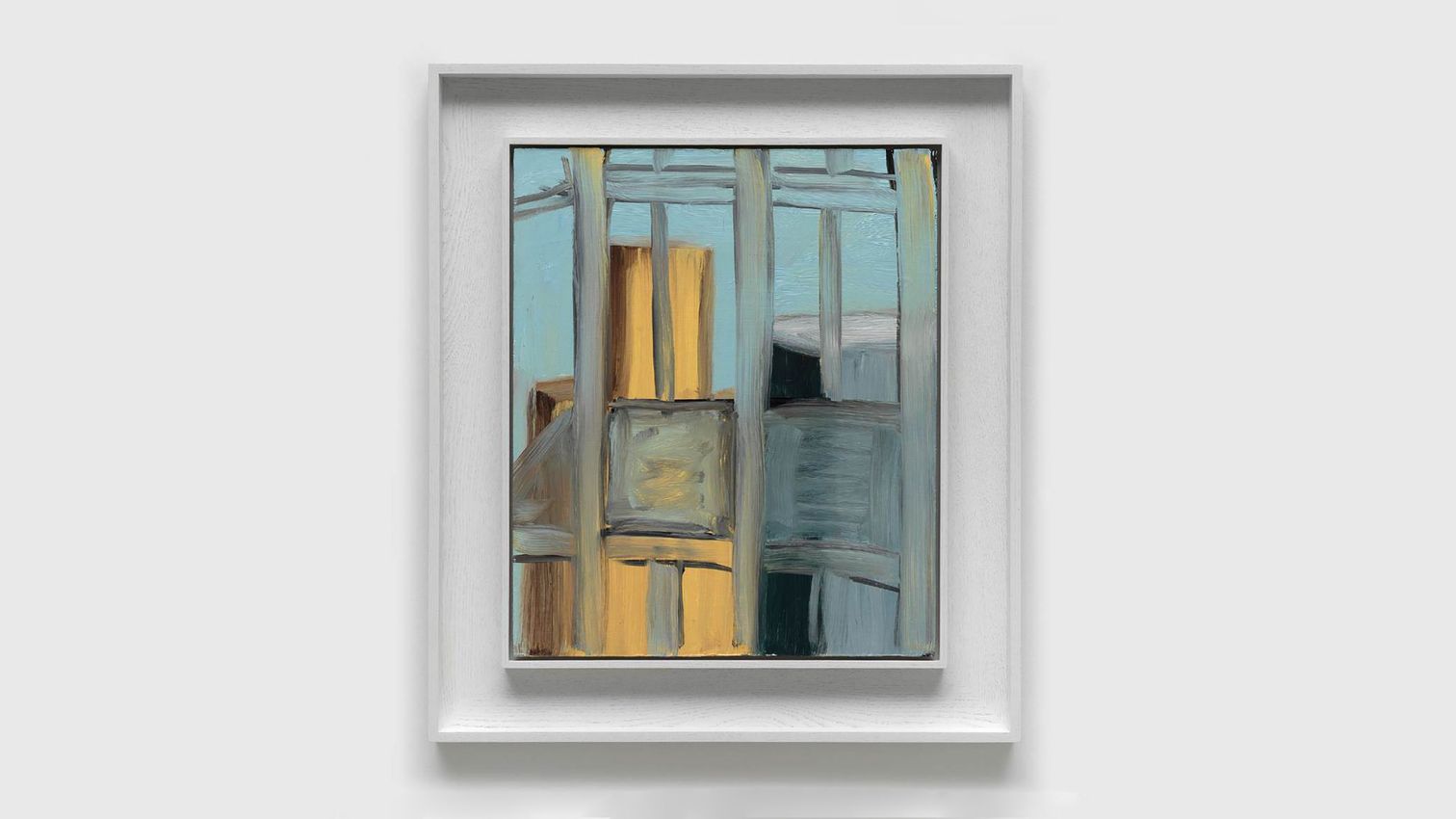
MARTHA DIAMOND
1944-2023, United StatesMartha Diamond (1944–2023) was an American painter best known for her abstracted cityscapes of New York, in which skyscrapers and streets appear at once monumental and elusive. Working primarily in painting, as well as drawing and printmaking, she developed a distinctive vocabulary of thick, wet-into-wet brushwork, luminous colour, and compositions that hover between abstraction and representation. Her work, shaped by the experimental energy of postwar New York, is held in major collections including the Whitney Museum of American Art, the Museum of Modern Art, New York, the Art Institute of Chicago, and the National Gallery of Australia.
In 2026, Thaddaeus Ropac announced a collaboration with the Martha Diamond Trust, joining David Kordansky Gallery in representing the artist’s estate. The first major museum exhibition dedicated to Diamond’s work in Europe will open in September 2026 at the Sara Hildén Art Museum in Tampere, Finland, followed by the gallery’s first presentation of her work at Thaddaeus Ropac Paris in 2027.
Early life and Career
Martha Bonnie Diamond was born on 1 May 1944 in Manhattan and grew up in Queens, taking in the New York skyline on regular drives into the city. She studied art at Carleton College in Minnesota (BA, 1964), where she became close to the artist Donna Dennis and the poet and critic Peter Schjeldahl. In the mid-1960s she spent time in Paris, studying at the Alliance Française de Paris (diploma with honours, 1965), and by 1966 she was working in the film department at the Museum of Modern Art in New York. She completed an MA in art and art education at New York University in 1969 and soon after moved into a Bowery loft in downtown Manhattan, where she lived and worked for more than five decades, participating in the Lower Manhattan art and poetry scenes around figures such as Schjeldahl, Alex Katz, Ted Berrigan, and Anne Waldman, and drawing inspiration from New York School painters including Jackson Pollock, Franz Kline, Joan Mitchell, Fairfield Porter, and Katz.
In 1970, Joan Mitchell visited Diamond’s studio and urged her to move her canvases off the floor and onto the wall, a shift that helped consolidate her mature practice. Diamond began exhibiting in the 1970s, held her first solo show at Brooke Alexander Gallery in 1976, and gained wider recognition in the 1980s. She showed with Brooke Alexander until 1985 and with the Robert Miller Gallery—home to artists such as Louise Bourgeois, Lee Krasner, Robert Mapplethorpe, and Mitchell—from 1985 to 1994. Though firmly rooted in New York, she forged lasting ties with institutions in Maine, spending summers there and exhibiting at Bowdoin College Museum of Art and the Portland Museum of Art. Over six decades she maintained a focused engagement with the city’s architecture and atmosphere, even as her paintings moved toward greater abstraction.
In later years Diamond led printmaking workshops in New York City public schools through the Solomon R. Guggenheim Museum‘s Learning Through Art program and taught at Harvard, Yale, the Goddard Riverside Community Center in New York, and the Skowhegan School of Painting & Sculpture in Madison, Maine, where she also served on the board of governors for 36 years.
Works, Series and Methods
Diamond’s best-known paintings depict New York’s office towers, bridges, and industrial buildings as looming, often vertiginous forms that fragment or tilt within the picture plane. Working wet-into-wet on large canvases, she built up layered, tactile strokes and a reduced palette of saturated tones to create images that Peter Schjeldahl, writing in The New Yorker, described as ‘giddily celebratory and drunk on daylight’, capturing the city’s light and energy more than its topographical detail. From the late 1970s, works such as her early single-picture images and 1980s skyscraper canvases established her signature approach: architectural volumes rendered as rhythmic, sometimes spectral stacks of colour that seem to oscillate between solidity and dissolution. Although right-handed, she painted with her left.
Alongside these partially abstract cityscapes, Diamond developed bodies of work that move further into non-representational painting. Later canvases and works on paper often retain vertical scaffolds or gridded structures reminiscent of buildings, but the imagery dissolves into luminous, all-over fields, suggesting time, memory, and the persistence of vision rather than specific locations. Across media, she remained committed to painting from perception rather than from narrative or symbolic programs, aligning her with, yet distinct from, contemporaries associated with Neo-Expressionism.
Themes and Context
Diamond’s work is grounded in the experience of looking at New York’s built environment and translating that experience into painterly form. Her canvases explore how skyscrapers, streets, and industrial structures shape a viewer’s sense of scale, vertigo, and immersion, often heightening these sensations through exaggerated perspectives, cropping, and atmospheric colour. While critics have linked her to the New York School, her emphasis on perception and optical memory—rather than on gestural self-expression—sets her apart from classic Abstract Expressionism and from the market-driven Neo-Expressionist currents of the 1980s; David Salle likened her brushwork to ‘a thrown knife or a karate chop’.
Time is another key concern. Diamond spoke of thinking about ‘deep time’, and recent surveys have framed her paintings as spanning religious, historical, and personal temporalities through recurring architectural motifs that resonate across centuries. Her urban images converse with earlier traditions of capriccio and city painting yet remain firmly rooted in the contemporary downtown New York she observed from her Bowery studio over more than 50 years.
Exhibitions, Collections and Recognition
Diamond’s work entered major museum collections from the 1980s, and her paintings are now held by institutions including the Whitney Museum of American Art, the Museum of Modern Art in New York, the Solomon R. Guggenheim Museum, the Art Institute of Chicago, the Brooklyn Museum, and the National Gallery of Australia. She received National Endowment for the Arts fellowships in 1980 and 1983, an Arts and Letters Award in Art from the American Academy of Arts and Letters in 2001 and was elected a National Academician in 2018. Diamond took part in the Whitney’s 1984 exhibition MetaManhattan and the 1989 Whitney Biennial, where her paintings were described as ‘spectral abstractions of the city, looming in a charged atmosphere enlivened by her free color sense’.
Important solo exhibitions have included Martha Diamond: Paintings at Bowdoin College Museum of Art and Martha Diamond: Prints at the Portland Museum of Art (both 1988), Martha Diamond: Cityscapes at Galerie Eva Presenhuber, New York (2018), and Martha Diamond: 1980–1989 at Magenta Plains, New York (2021). She was the subject of a three-decade survey at the New York Studio School in 2004 and has featured in recent group shows such as Looking Back/The 14th White Columns Annual at White Columns and Beautiful, Vivid, Self-contained at the Hill Art Foundation, both in New York. Posthumously, the survey Martha Diamond: Deep Time at Colby College Museum of Art and The Aldrich Contemporary Art Museum (2024–25) has further consolidated her institutional presence, while representation by David Kordansky Gallery and Thaddaeus Ropac has extended her visibility within the international gallery landscape.
The Martha Diamond Trust and catalogue raisonné
Established by the artist in 2020, the Martha Diamond Trust maintains an archive of materials related to her life and work and is preparing a catalogue raisonné of all known paintings, prints, and drawings. The Trust is actively gathering images and data on works in both private and public collections, supporting ongoing research and future exhibitions.
Martha Diamond FAQs
Who was Martha Diamond and what is she best known for?
Martha Diamond was an American painter born in New York City in 1944 and based for most of her life in a Bowery studio in downtown Manhattan. She is best known for her abstracted cityscapes of New York, in which skyscrapers and streets are rendered as luminous, vertiginous structures that blur the line between representation and abstraction.
How did Martha Diamond’s style relate to the New York School and Neo-Expressionism?
Martha Diamond acknowledged the influence of the New York School but rejected the Neo-Expressionist label, emphasising that she painted perceptions and “vision” rather than emotion-driven gesture. Critics have positioned her work as a distinctive bridge between expressionistic urban landscape and abstraction, marked by thick, wet-into-wet brushwork and a strong sense of structure.
Where can I see Martha Diamond’s work?
Paintings by Martha Diamond are held in major museum collections including the Whitney Museum of American Art, the Museum of Modern Art in New York, the Art Institute of Chicago, and the National Gallery of Australia. Recent and upcoming exhibitions, such as Martha Diamond: Deep Time at Colby College Museum of Art and The Aldrich Contemporary Art Museum, and shows with David Kordansky Gallery and Thaddaeus Ropac, offer broader surveys of her work.
When did Martha Diamond die?
Martha Diamond died on 30 December 2023 in New York City at the age of 79. Her death prompted renewed critical attention to her six-decade career as a painter of New York’s skyline and built environment.
Ocula | 2026







Explore and Follow Artists Shaping Contemporary Art
A respected voice in contemporary art discourse.
Focusing on ambitious storytelling and insightful art-world commentary. Ocula Magazine publishes in-depth interviews, critical essays and timely analysis on the artists, exhibitions and ideas driving the global art world.
Learn more about Ocula Magazine
Showcasing the best of the art world.
Ocula partners with galleries from around the world to highlight their artists, artworks and exhibitions. Gallery membership is by application and invitation, with each member vetted by an independent panel.
Learn more about Ocula Membership
Specialises in the sale of major artworks.
Led by a team with deep ties to the world’s leading auction houses, galleries and collectors. Ocula’s advisory team offers bespoke services to high-net-worth clients from around the world who are looking to acquire the best of contemporary and modern art.
Learn more about our team and services