





RONNIE VAN HOUT
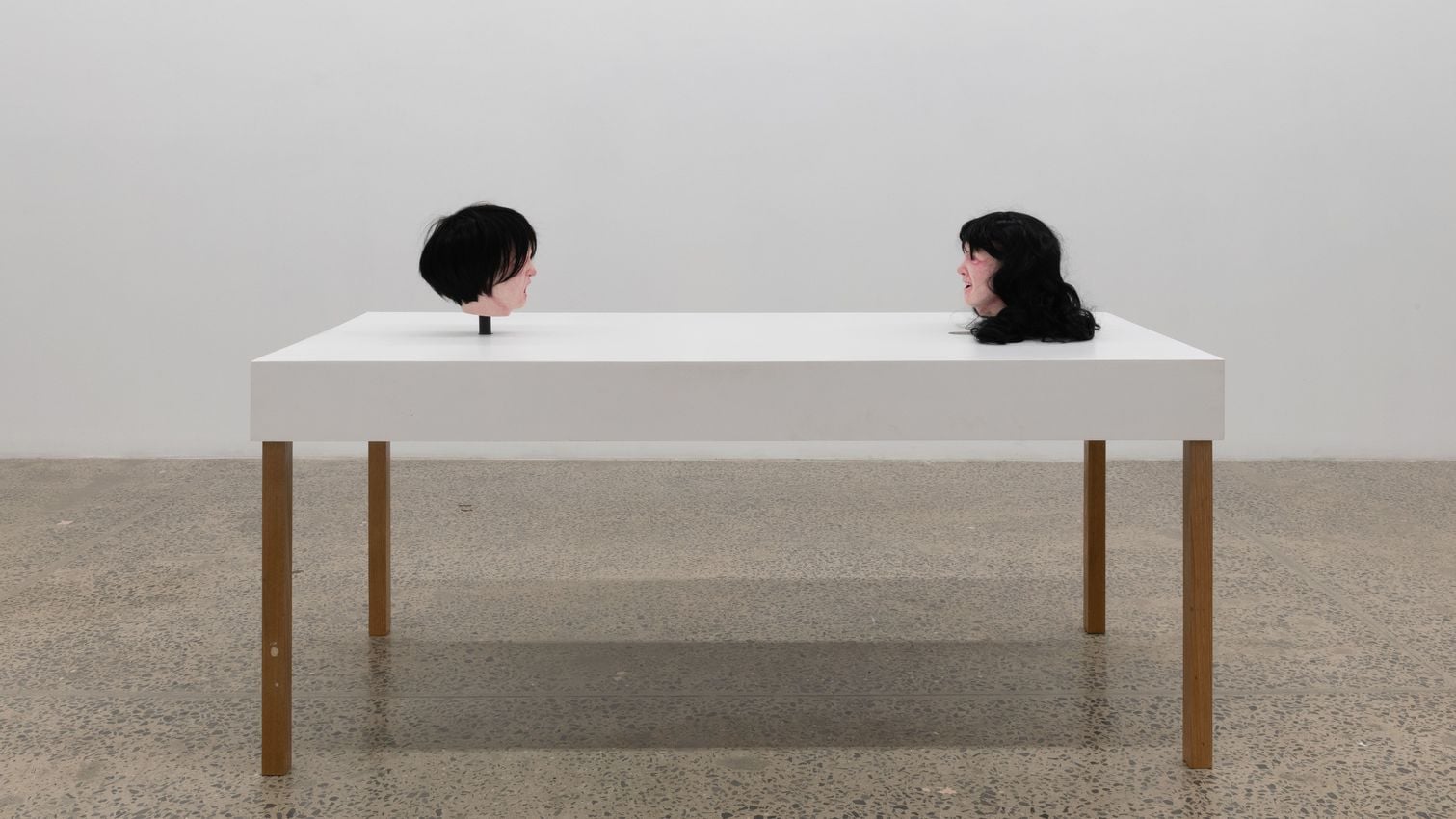
b. 1962, New ZealandRonnie van Hout is a New Zealand-born, Melbourne-based multimedia artist whose work explores themes of identity, anxiety, and the uncanny through sculpture, video, installation, embroidery, and photography. Working in what has been described as ‘existential absurdism’, van Hout is best known for creating unsettling yet humorous doppelgangers of himself using body casts and resin, including the viral public sculpture Quasi (2016), a five-metre hand with the artist’s face on its palm that perched atop Christchurch Art Gallery. His work has been presented at major institutions including the National Gallery of Victoria, Museum of Contemporary Art Sydney, Buxton Contemporary, and Christchurch Art Gallery Te Puna o Waiwhetū, and is held in collections at Te Papa Tongarewa, the National Gallery of Australia, and the Art Gallery of New South Wales.
Early Life and Career
Born on 22 January 1962 in Christchurch, New Zealand, van Hout studied film at the School of Fine Arts, University of Canterbury, from 1980 to 1982. He relocated to Melbourne in the late 1990s, completing a Master of Fine Arts at RMIT University in 1999. This geographic shift marked a significant turning point in his practice, allowing him to develop his distinctive approach to self-portraiture and the exploration of outsider identities.
Van Hout’s work gained early recognition in New Zealand through solo exhibitions including I’m OK at Govett-Brewster Art Gallery (1996) and his participation in the survey exhibition Toi Toi Toi: Three Generations of Artists from New Zealand at Museum Fridericianum, Kassel, Germany (1999). In 2003, his retrospective I’ve Abandoned Me toured Dunedin Public Art Gallery, establishing him as one of Australasia’s most provocative contemporary artists. He was nominated for the Walters Prize in 2004 and named a Laureate Artist by the Arts Foundation of New Zealand in 2005.
Works, Series and Methods
Throughout his career, van Hout has treated his own body as both subject and object, using moulds and scans to create warped renditions of himself. These resin and plastic sculptures function as doppelgangers that enable the artist to explore fragmentation, doubling, and the constructed nature of identity while avoiding conventional self-portraiture or narcissism.
One of his most recognisable recurring figures is Monkey Madness, an alter ego that first appeared in a 1998 video work. Works such as Sick Chimp (2002), now in Te Papa Tongarewa’s collection, depict a downcast simian figure in human clothing. This character embodies themes of failure, discomfort, and the artist-as-outsider, allowing van Hout to address difficult subjects through dark comedy.
Van Hout’s large-scale public sculptures have brought his practice to wider audiences. Fallen Robot (2012), a 7.2-metre stainless steel sculpture of a prone robot, was installed outside The Dowse Art Museum in Lower Hutt. Quasi (2016-2019) became an iconic landmark in post-earthquake Christchurch, combining a scan of the artist’s face with his left hand to create a surreal hybrid figure that referenced both horror film tropes and Victor Hugo’s Quasimodo. The rudely pink sculpture moved to City Gallery Wellington’s roof in 2019 before returning to Australia in 2024. More recently, Boy Walking (2018), a 5.6-metre cast aluminium figure based on scans of the artist’s son, was commissioned by Auckland Council for Potters Park, capturing a giant child mid-stride in contemplative motion.
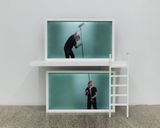
His installations and video works often stage absurd scenarios that explore family dynamics and the artistic life. In Bad Fathers (2018), presented at Buxton Contemporary, van Hout examined paternal roles through uncanny sculptural tableaux. The 2024 exhibition The Giants at Station Gallery featured two figurative sculptures of ‘uncanny children’ inspired by Francisco Goya‘s The Colossus, accompanied by a video showing the artist’s teenage child Vi destroying a printer with a tree limb.
Themes and Context
Van Hout’s practice centres on the uncanny experience of the self and the awkwardness of embodied existence. His work creates what he describes as ‘constructed worlds that are simultaneously humorous, unsettling and nostalgic’, drawing viewers into spaces where comedy and horror, the familiar and the strange, collapse into one another. By multiplying himself through casts, doubles, and surrogates, van Hout investigates how identity is performed, fragmented, and mediated.
His art belongs to a lineage of post-conceptual practice that treats the artist’s persona as material. He references diverse sources including pop culture, cinema, art history, and family life, often impersonating cultural figures such as Norman Bates, Charles Manson, and New Zealand painter Colin McCahon. These performances allow van Hout to explore social stereotypes and marginal identities—the thief, the vagabond, the failed artist—while maintaining a position of simultaneous presence and absence that he describes as being ‘irresponsible’.
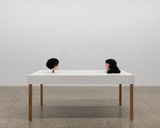
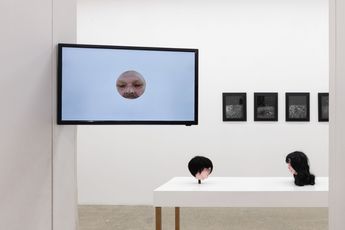
Emerging from a generation for whom artistic success seemed both undesirable and unattainable, van Hout celebrates the persona of the artist-as-outsider. His work often reverses the traditional gallery gaze, creating situations where the audience becomes aware of being watched by his sculptural proxies. This strategy of doubling extends to his titles, such as I’ve Abandoned Me and No One Is Watching You, which suggest a slippery relationship between the artist and his representations.
Exhibitions, Collections and Recognition
Van Hout has presented solo exhibitions at major institutions including No One Is Watching You at Buxton Contemporary, Melbourne (2018), the artist’s first major solo exhibition in a public institution; I’ve Seen Things at The Dowse Art Museum, Lower Hutt (2012); Who Goes There at Christchurch Art Gallery Te Puna o Waiwhetū (2009); and the touring retrospective I’ve Abandoned Me presented by Dunedin Public Art Gallery (2003-2005). More recent exhibitions include The Giants at STATION Gallery, Melbourne (2024), and Dummies & Doppelgängers at Christchurch Art Gallery (2023).
He has participated in significant group exhibitions including The National 4: New Australian Art at Museum of Contemporary Art Sydney (2017), where his work Punk on a Bed addressed memory and personality; Melbourne Now at the National Gallery of Victoria (2013), a major survey of Melbourne’s contemporary art scene; and Toi Toi Toi: Three Generations of Artists from New Zealand at Museum Fridericianum, Kassel (1999) and Auckland City Art Gallery. In 2007, van Hout undertook an Antarctic Artist Residency, and in 2004-2005 he was Artist in Residence at the International Studio Programme, Kunstlerhaus Bethanien, Berlin.
His work is held in major public collections including the Museum of Contemporary Art, Los Angeles; National Gallery of Australia, Canberra; National Gallery of Victoria, Melbourne; Art Gallery of New South Wales, Sydney; Art Gallery of Western Australia, Perth; Museum of New Zealand Te Papa Tongarewa, Wellington; and Auckland Art Gallery. He was a finalist for the McClelland National Small Sculpture Awards (2020) and received commissions including Surrender for Bendigo Art Gallery (2018).
Ronnie Van Hout FAQs
What is Ronnie van Hout best known for?
Ronnie van Hout is best known for his uncanny sculptures that use casts and scans of his own body to create unsettling doppelgangers. His most famous work is Quasi (2016), a five-metre pink sculpture combining the artist’s hand and face that became an icon of post-earthquake Christchurch when installed on the roof of Christchurch Art Gallery. Van Hout’s practice, described as ‘existential absurdism’, explores themes of identity, anxiety, failure, and the artist-as-outsider through sculpture, video, and installation.
What themes does Ronnie van Hout explore in his work?
Van Hout’s work explores the uncanny nature of selfhood, the fragmentation of identity, and the anxiety of existence. He examines the artist-as-outsider, social stereotypes, family dynamics, and the tension between success and failure. His sculptures and videos create constructed worlds that are simultaneously humorous, unsettling, and nostalgic, often reversing the gallery gaze so viewers become aware of being watched. The artist treats his body as both subject and object, using doubles and proxies to maintain what he calls ‘simultaneous presence and absence’.
Why did Ronnie van Hout create Quasi?
Van Hout created Quasi as a partial self-portrait for his hometown of Christchurch following the 2011 earthquake. The sculpture combines scans of his face and left hand to create what he describes as ‘a surrealist artwork’ that references multiple cultural sources including the crawling disembodied hands from comedy-horror films and Victor Hugo’s lonely outcast Quasimodo on the roof of Notre Dame. The work plays with the idea of ‘the artist’s hand made giant’, elevating the traditional notion of the artist’s hand as the source of genius to monumental and absurd status in the regenerating city.
Where can I see Ronnie van Hout’s work?
Van Hout’s work is held in major public collections including Te Papa Tongarewa in Wellington, the National Gallery of Australia in Canberra, the National Gallery of Victoria in Melbourne, the Art Gallery of New South Wales in Sydney, and the Museum of Contemporary Art in Los Angeles. His public sculptures include Boy Walking (2018) at Potters Park in Auckland, New Zealand, and Fallen Robot (2012) at The Dowse Art Museum in Lower Hutt. He is represented by Darren Knight Gallery in Sydney and STATION Gallery in Melbourne.
What is ‘Boy Walking’ about?
Boy Walking (2018) is a 5.6-metre cast aluminium sculpture commissioned by Auckland Council for Potters Park in Auckland’s Balmoral neighbourhood. Based on 3D scans of the artist’s son captured mid-stride, the giant figure appears lost in thought, evoking both change and optimism. Van Hout describes the work as exploring how scale and proportion shift as we grow, noting that ‘the sculpture is only large in relation to other human bodies.’ The contemplative figure acts as a towering landmark that addresses themes of childhood, growth, and the uncanny experience of familiar forms made monumental.
Ocula | 2026











Explore Ronnie Van Hout's Exhibitions







Explore and Follow Artists Shaping Contemporary Art
A respected voice in contemporary art discourse.
Focusing on ambitious storytelling and insightful art-world commentary. Ocula Magazine publishes in-depth interviews, critical essays and timely analysis on the artists, exhibitions and ideas driving the global art world.
Learn more about Ocula Magazine
Showcasing the best of the art world.
Ocula partners with galleries from around the world to highlight their artists, artworks and exhibitions. Gallery membership is by application and invitation, with each member vetted by an independent panel.
Learn more about Ocula Membership
Specialises in the sale of major artworks.
Led by a team with deep ties to the world’s leading auction houses, galleries and collectors. Ocula’s advisory team offers bespoke services to high-net-worth clients from around the world who are looking to acquire the best of contemporary and modern art.
Learn more about our team and services