






SAKARIN KRUE-ON
b. 1965, ThailandSakarin Krue-On is a leading Thai contemporary artist and art educator. He is known around the world for his provocative installations and conceptual projects that draw from the history and traditions of Thailand, where he was an early figure of conceptual art.
Born in Mae Hong Son, Thailand, Sakarin Krue-On attended Silpakorn University, Bangkok, graduating in 1989. He would later return to the university as head of the Art Department. Through his art, the artist has sought to bring elements of Thai history and culture—that is, religious and mythological traditions, and material attitudes—into a dialogue with contemporary society. Sakarin Krue-On was one of the first artists in Thailand to be recognised for taking this conceptual approach. He did so through various avenues, including painting, print, and sculpture. Some of his most significant works, however, have been site-specific installations. One of his earliest was Lotus Pods (1998–2015), a work that is also representative of the natural imagery that became a recurring motif throughout his practice.
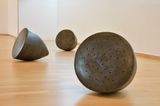
In Lotus Pods (1998), the artist created a form that amalgamated the symbolic motif of the lotus flower with the shape of a bullet. A commentary on the inherent contradiction in Thailand’s professed values as a peaceful Buddhist society with its history of internal violence, the work became site-specific by being installed in a way that responds to the context of each location.
Sakarin Krue-On’s Terraced Rice Fields (2007) is one of his largest site-specific projects. It was presented at documenta 12. The artist attempted to turn the area in front of Schloss Wilhelmshöhe—a Neoclassical palace in Kassel—into a terraced rice field. Individuals worked together using traditional rice-cultivating techniques to create the field.
Although Terraced Rice Fields did not produce any rice, the project brought people from all walks of life together and set up a conceptual culture clash between the German castle and the rice field. As a very visceral, hands-on project, Terraced Rice Fields contrasts with Sakarin Krue-On’s more media-based installations, such as the single-screen video projection Circle of Hope (2003), which presents images of a traditional Thai goddess rotating and pulsating against a black background.
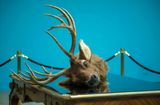
Another Sakrin Krue-On installation, Monument of Awakening Era (2012) opens a more sombre dialogue between tradition and rapid development in Thai society. In the work, white antlers emerge from a blackish liquid on the floor in a dark room. The antlers—fragile creations made from porcelain—appear like ghosts. They represent the extinct Schomburgk’s Deer, who roamed the central plains of Thailand until they were completely wiped out in the 1930s.
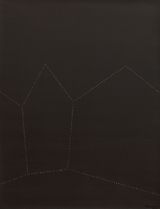
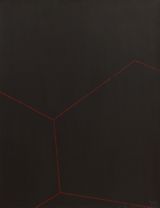
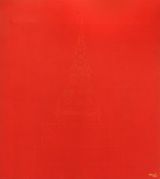
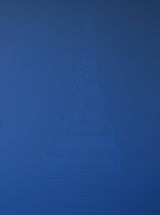
On a smaller scale, Sakarin Krue-On has produced prints that combine traditional Buddhist motifs with contemporary imagery, such as Flying Lesson (2010). The artist also creates paintings executed overall in a modern, minimalist style but featuring a pattern of dots that outline a traditional Buddhist motif, such as in Blue Chedi (2008).
Sakarin Krue-On’s art has been exhibited across the globe in gallery and institutional shows. The artist has also represented Thailand at several major international art events, including the Venice Biennale, Busan Biennale, and Singapore Biennale, and he was the first Thai artist to present work at Documenta. In 2016, Krue-On received the Prudential Eye Lifetime Achievement Award in recognition of his contributions to Asian art.
Sakarin Krue-On Solo Exhibitions include:
A Talebearer’s Tale, Tang Contemporary Art, Bangkok (2017); Manorah and Best Friends of The Snake, 100 Tonson Gallery, Bangkok (2010); Ripe Project: Village and Harvest Time, ARDEL Gallery of Modern Art, Bangkok (2008); Horizon, Museum of Mind, Bangkok (2008); Nang Kwak: Equal Opportunity, The Art Center, Chulalongkorn University, Bangkok (2006); Nang Kwak: The 2005 Crisis, Playground, Bangkok (2005); Temple, About Café-Studio, Bangkok (2000).
Sakarin Krue-On Group Exhibitions include:
Slippages, Pearl Lam Galleries, Shanghai (2017); Afterwork, Para Site, Hong Kong (2016); Green Acres: Artists Farming Fields, Greenhouses and Abandoned Lots, Cincinnati Contemporary Arts Center (2012); Panorama: Recent Art from Contemporary Asia, Singapore Art Museum (2012); Return Ticket: Thailand–Germany, Bangkok Art & Culture Centre (2010); MURALS, Fundació Joan Miró, Barcelona (2010); The World in Painting, Heide Museum of Modern Art, Melbourne (2008).
Michael Irwin | Ocula | 2021










Explore Sakarin Krue-On's Exhibitions






Explore and Follow Artists Shaping Contemporary Art
A respected voice in contemporary art discourse.
Focusing on ambitious storytelling and insightful art-world commentary. Ocula Magazine publishes in-depth interviews, critical essays and timely analysis on the artists, exhibitions and ideas driving the global art world.
Learn more about Ocula Magazine
Showcasing the best of the art world.
Ocula partners with galleries from around the world to highlight their artists, artworks and exhibitions. Gallery membership is by application and invitation, with each member vetted by an independent panel.
Learn more about Ocula Membership
Specialises in the sale of major artworks.
Led by a team with deep ties to the world’s leading auction houses, galleries and collectors. Ocula’s advisory team offers bespoke services to high-net-worth clients from around the world who are looking to acquire the best of contemporary and modern art.
Learn more about our team and services