





SOICHIRO TOMIOKA
1922-1994, JapanSoichiro Tomioka was a Japanese artist who primarily painted snowy landscapes. Taking his artistic cues from Japan’s winter landscapes, Tomioka’s paintings variously depict fissures among naked tree branches, fog cloaking the peaks of mountains, and a river between snow-capped banks. He also painted sprays of fireworks in mid-burst.
Life
Soichiro Tomioka was born in Takada, Niigata Prefecture, Japan. Captivated by the white of snow, Tomioka sought to capture what he termed the ‘white world’, in reverence of the winter palette he encountered during his pilgrimage to the snowy regions of Japan in 1972. To anchor his artistic approach, Tomioka developed his own non-discolouring and non-cracking white oil paint called Tomioka White, which he applied with an extra-long painting knife custom-made for him by a blacksmith.
Tomioka moved to New York in 1965 after being invited by the Rockefeller Foundation to work and live as an international student. Seven years later, he returned to Japan and began painting the snowscapes of Kyoto and Tango. He painted white worlds throughout his career, and his Tomioka White paint is said to never yellow or peel. To house his vast collection of paintings, Tomioka founded the Tomioka White Museum of Art in Muikamachitown (now Minamiuonuma City), Niigata in 1990.
Soichiro Tomioka’s Winter Trees
Soichiro Tomioka’s experimental phase saw the creation of Untitled in 1963, an abstract of trees composing of small pins queueing across horizontal lines. When he moved to New York, his winter trees reflected the leafless branches he saw in the city. New York Central Park, Treetop in Early Spring (1979) is an ink drawing that shows the bald trees Tomioka saw canopied over him in Central Park, depicting the natural bends of their bare branches.
Shinano River
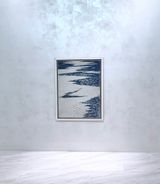
In addition to Soichiro Tomioka’s winter trees, the Japanese artist had sketched and photographed the Shinano river while flying overhead, noting that the snake-like form of the water surrounded by deep snow could not be seen from the ground. In Shinano river / Unoki A (1984), the Japanese artist uses black to stress the curve where the water flows, dresses the banks in his Tomioka White, and flecks the northern part of the canvas with dots of black to create the illusion of winter trees.
Fireworks in Nagaoka and Katakai
While Tomioka’s trees were in black and white ink, the Japanese artist also dabbled in other colours. These appeared in Fireworks / Katakai (1989), a close-up painting of a fireworks display the Japanese artist had witnessed in Katakai. For him, the fireworks in Nagaoka and Katakai were the world’s best, and brought him an essential turning point in his practice. Rather than using the paint of his white world, Tomioka began to use colours, such as red, to depict the phenomenon of white light. In Fireworks / Katakai, Tomioka dragged his knife from the centre in all directions, spreading the light red paint outwards to resemble fireworks.
Awards and Accolades
Soichiro Tomioka’s awards include the 17th Shinseisaku Exhibition Initial selection in 1953, the 25th Shinseisaku Art Association Award and the Museum of Modern Art Award at the Sao Paulo Biennale Exhibition (both 1962), and the Togo Seiji Art Gallery Award in 1984.
Exhibitions
Soichiro Tomioka’s exhibitions include √K Contemporary Collection Summer 2021, √K Contemporary, Tokyo (2021); Modern Landscape/New Art Exhibition, Museum of Modern Art, Paris (1968); and The New Japanese Painting and Sculpture: An Exhibition, Museum of Modern Art, New York (1966). Throughout his life, Tomioka regularly exhibited his work at Ginza Wako.
Gallery
On Ocula, Soichiro Tomioka is represented by √K Contemporary.
Matthew Burgos | Ocula | 2021






Explore and Follow Artists Shaping Contemporary Art
A respected voice in contemporary art discourse.
Focusing on ambitious storytelling and insightful art-world commentary. Ocula Magazine publishes in-depth interviews, critical essays and timely analysis on the artists, exhibitions and ideas driving the global art world.
Learn more about Ocula Magazine
Showcasing the best of the art world.
Ocula partners with galleries from around the world to highlight their artists, artworks and exhibitions. Gallery membership is by application and invitation, with each member vetted by an independent panel.
Learn more about Ocula Membership
Specialises in the sale of major artworks.
Led by a team with deep ties to the world’s leading auction houses, galleries and collectors. Ocula’s advisory team offers bespoke services to high-net-worth clients from around the world who are looking to acquire the best of contemporary and modern art.
Learn more about our team and services