





The Brick (LAXART)
Los Angeles Learn more about what's on at The Brick (LAXART) and the artists shaping its programme.The Brick: Experimental Platform for Contemporary Art and Ideas
Overview
The Brick, in Los Angeles, United States, is a nonprofit visual art space that promotes developments in contemporary culture through exhibitions, publications, and public programmes. Formerly known as LAXART, it operates outside the traditional museum model, foregrounding artists’ projects, research-driven exhibitions, and collaborations that use contemporary art to explore ‘key issues of our time’ and their inherent contradictions. Free and open to the public, The Brick serves as an accessible hub where contemporary art is framed within broader social and art-historical contexts.
Founded as LAXART in 2005 by curator and art historian Lauri Firstenberg, the organisation began as a platform for emerging and under-recognised artists in Los Angeles. It has since realised more than 400 projects in its gallery and public spaces, with a strong emphasis on newly commissioned works and solo presentations. Its programme spans exhibitions, public art, performances, and publications, often developed with major institutions including the Getty and the Hammer Museum. These collaborations have supported city-wide initiatives such as the Pacific Standard Time Performance and Public Art Festival (2012), co-produced with the Getty; Video Art in Latin America (2017), organised with the Getty Research Institute as part of Pacific Standard Time: LA/LA; and the inaugural Made in L.A. biennial (2012), co-organised with the Hammer Museum.
Art and Exhibitions
The Brick’s curatorial programme treats contemporary art as a tool for understanding ‘key issues of our time’, privileging open questions over fixed conclusions. This approach underpins projects such as Life on Earth: Art & Ecofeminism (2024), a Getty-supported Pacific Standard Time exhibition surveying ecofeminist art and visual culture, which features international artists and collectives and is accompanied by a publication and a travelling presentation at West Den Haag. It also shapes MONUMENTS (23 October 2025–3 May 2026), co-organised and co-presented with the Museum of Contemporary Art (MOCA), which brings decommissioned Confederate and other U.S. monuments into dialogue with new and existing contemporary artworks to consider post–Civil War histories and the ongoing legacies of white supremacy.
New commissions and artist-centred projects remain central to The Brick’s identity, with exhibitions and public programmes that situate contemporary art within social, political, and historical frameworks while remaining free to visit. This ethos extends into discursive initiatives such as LIVE ON EARTH! Ecofeminism & Art: A Planetary Symposium, a 24-hour programme hosted with ArtCenter College of Design that convenes artists, scholars, and activists across Seoul, The Hague, and Los Angeles to address ecofeminism, art, and environmental questions. Through these exhibitions, symposia, and publications, The Brick functions as both an exhibition venue and a platform for research-driven, collaborative projects that link experimental artistic practice to wider cultural and political debates.
Visiting Information
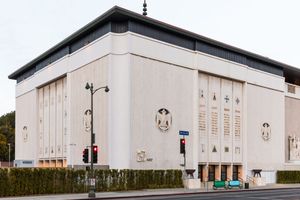
The Brick’s exhibitions and public programmes are free and open to all audiences, from local visitors to international art professionals. Programming and opening hours vary by season and project, so visitors should consult The Brick’s official channels for current exhibition listings, opening times, and event schedules. Located in a 5,000-square-foot former furniture showroom at 518 N. Western Avenue, within an emerging gallery corridor in East Hollywood, The Brick is a key destination within Los Angeles’s contemporary art scene.
The Brick (LAXART) FAQs
What is The Brick?
The Brick is a nonprofit contemporary art space in Los Angeles that presents exhibitions, public art projects, publications, and public programmes. It uses contemporary art to explore pressing cultural and political questions, and all programmes are free and open to the public.
Why is The Brick significant?
Since 2005, The Brick has produced more than 400 projects, many of them newly commissioned works and solo exhibitions that have shaped contemporary art discourse in Southern California. Collaborations with the Getty and the Hammer Museum—such as the Pacific Standard Time Performance and Public Art Festival (2012), Video Art in Latin America (2017), and Made in L.A. 2012—highlight its role in the region’s cultural infrastructure.
What kind of art can I see at The Brick?
Visitors encounter contemporary art in a wide range of media, including installation, video, performance, and research-driven projects. Recent and current exhibitions such as Life on Earth: Art & Ecofeminism and MONUMENTS address topics from ecofeminism and environmental justice to contested monuments and public memory.
Has The Brick hosted controversial or widely discussed exhibitions?
Yes. The Brick has co-organised exhibitions that have attracted significant public debate, notably MONUMENTS (23 October 2025–3 May 2026), which recontextualises removed Confederate and Jim Crow–era monuments alongside contemporary artworks to examine race, history, and public memory in the United States. Widely covered by local and international media, the exhibition has provoked strong responses while remaining aligned with The Brick’s mission to address key issues of the present through contemporary art.
How does The Brick handle sensitive or politically charged topics?
The Brick approaches politically charged subjects through exhibitions and public programmes that foreground critical inquiry, historical context, and open discussion. Rather than offering definitive positions, its curatorial framework emphasises art’s capacity to raise questions about contested symbols, narratives, and forms of public memory.
Who is Lauri Firstenberg?
Lauri Firstenberg is a Los Angeles–based curator and art historian who founded LAXART in 2005, creating the independent nonprofit space that later became The Brick. She holds a PhD in the History of Art and Architecture from Harvard University and has held curatorial roles at institutions including Artists Space in New York and the MAK Center for Art and Architecture at the Schindler House in Los Angeles. As founding Executive Director and Chief Curator, she helped develop experimental exhibitions, public art projects, and collaborations—including the Pacific Standard Time Performance and Public Art Festival and Made in L.A. 2012—that laid the groundwork for The Brick’s current programme.
When and why did LAXART change its name to The Brick?
LAXART was renamed The Brick in 2024, when the organisation moved into its new 5,000-square-foot home at 518 N. Western Avenue, which opened to the public in June 2024. The name references both the building’s exposed red brick interior and the idea of a “building block” within a larger cultural structure, marking a new chapter for the organisation while preserving its core mission.
How is The Brick funded?
The Brick (formerly LAXART) is a non-profit 501(c)(3) art space whose primary income comes from contributions and grants rather than ticket sales or commercial activity. Support includes funding from organisations such as the Andy Warhol Foundation for the Visual Arts, the Mike Kelley Foundation for the Arts, and the Pasadena Art Alliance, as well as major individual donations, including a 1 million USD gift from Jarl and Pamela Mohn toward its new building and programme.projects.
Who are Jarl and Pamela Mohn?
Jarl and Pamela Mohn are Los Angeles–based art collectors and philanthropists whose giving has significantly shaped the city’s contemporary art landscape. In addition to a major joint gift of their MAC3 collection and an acquisition endowment to the Hammer Museum, LACMA, and MOCA, they have supported organisations across Southern California, including a 1 million USD donation that helped fund The Brick’s new facility and programme.
How much does it cost to visit The Brick?
Admission to The Brick’s exhibitions and public programmes is free. Free access is fundamental to its mission to make contemporary art and critical discourse available to as wide an audience as possible.
Does The Brick offer public programmes or events?
Yes. The Brick regularly organises talks, screenings, performances, concerts, and other public programmes in conjunction with its exhibitions. These events are designed to place artworks in social and historical context and to provide accessible entry points into contemporary art and current debates.













A respected voice in contemporary art discourse.
Focusing on ambitious storytelling and insightful art-world commentary. Ocula Magazine publishes in-depth interviews, critical essays and timely analysis on the artists, exhibitions and ideas driving the global art world.
Learn more about Ocula Magazine
Showcasing the best of the art world.
Ocula partners with galleries from around the world to highlight their artists, artworks and exhibitions. Gallery membership is by application and invitation, with each member vetted by an independent panel.
Learn more about Ocula Membership
Specialises in the sale of major artworks.
Led by a team with deep ties to the world’s leading auction houses, galleries and collectors. Ocula’s advisory team offers bespoke services to high-net-worth clients from around the world who are looking to acquire the best of contemporary and modern art.
Learn more about our team and services