






Julie Mehretu: Something New, Something Else
Julie Mehretu talks to Jennifer Higgie about the radical uses of abstraction, the importance of music, and her interest in the art of the past. Save to My Ocula
Julie Mehretu‘s is an art of accumulation. Since the early 1990s, the Ethiopian-born American artist has been exploring a visual language that is as informed by architecture, Renaissance art, Chinese ink painting, Japanese manga, cartography, jazz, Black abstraction, and the civil rights movement as it is by the global crises of the present moment. She often begins a painting or a print by digitally obscuring the original source images—which have variously documented the devastation of war, racial injustice, and environmental destruction—and then working into the surface.
Characterised by their calligraphic, often frenzied, mark-marking and luminous, shape-shifting surfaces, Mehretu’s paintings have segued in scale from the intimate to the monumental. Her 28-metres-wide Mural (2009), for example, graces the lobby of the Goldman Sachs building in Manhattan, while the seven-metres-high diptych HOWL, eon (I, II) (2017) was commissioned by the San Francisco Museum of Modern Art to flank the two sides of the main entrance hall.
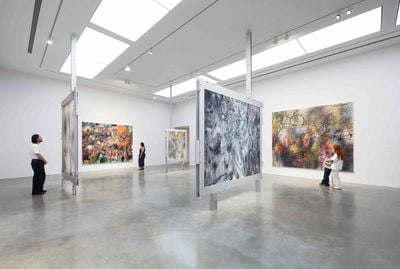
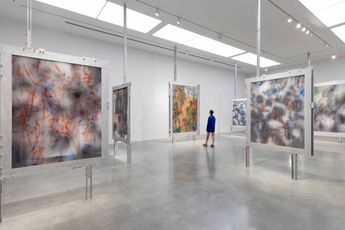
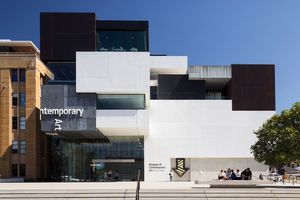
Presented as part of the Sydney International Art Series 2024–2025, Julie Mehretu: A Transcore of the Radical Imaginatory at the Museum of Contemporary Art Australia (MCA) is the first major exhibition dedicated to the artist in the Southern Hemisphere. Curated by Suzanne Cotter, MCA Australia Director, with Jane Devery, MCA Australia Senior Curator Exhibitions, it includes more than 80 works: 36 paintings, completed between 2018 and 2024, and around 50 etchings, drawings, and works on paper, from the mid-1990s to the present.
Jennifer Higgie met with the artist at MCA. The interview has been edited for clarity and concision, and is the outcome of an editorial collaboration between Ocula and the National Gallery of Australia, Canberra. Jennifer Higgie is a valued Ocula contributor and the editor of The Annual, published by the National Gallery each year.
JH: This is your first major show in the Southern Hemisphere. What does that mean to you?
JM: It’s amazing. Although it’s not exactly a homecoming, it feels significant because [my ex-wife, the Australian artist] Jessica [Rankin] is here, too, and our children have Australian passports. We have a collaborative work hanging downstairs in the MCA galleries [Struggling With Words That Count, 2014–2016].
“I am interested in images, their differences, and what they can do. It’s a way for me to respond to some of the hauntingness I’m feeling . . .”
JH: Many of your paintings are built up over architectural plans or photographs sourced from news outlets, which then become obscured, dissolved beneath translucent layers. How important is it for your audience to identify the original material?
JM: It’s not necessary to know the references to experience the work; you don’t even need to know the title, although perhaps it lends another layer. But, if you’re really curious, you could look up what the title might refer to, which can then uncover other stuff. It’s like experiencing a really great song: you can look at the liner notes if you want to, but to feel the song you don’t need to know everything. I hope that the paintings have something in them that activates a visceral and emotional response.
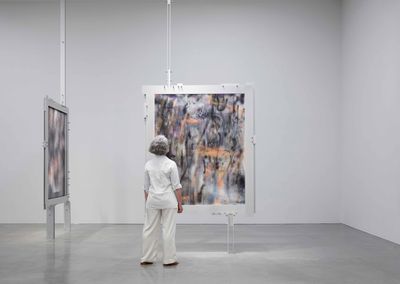
JH: Why do you so often choose to start a work with distressing source material which is then obscured?
JM: I am interested in images, their differences, and what they can do. It’s a way for me to respond to some of the hauntingness I’m feeling—a kind of constant haunting presence that we’re all negotiating in terms of the new realities that we’re going into. This indeterminate, haunted space is blurred, reflecting the confusion of everything.
It’s one of the reasons blurs are important for me right now in my work—they’re like points of entry. But I’m not thinking about the source photograph when I enter the work. I’m responding to what’s happening in the painted blur, and what point of entry I can pull out of that.
JH: Do all the works in this show have a point of entry that was a photographic source?
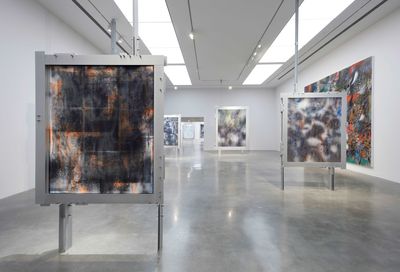
JM: Almost all, but not the ‘Black Paintings’. [‘Femenine in nine’, 2023–2024, is a cycle of nine paintings titled after a 1974 composition by Julius Eastman. Mehretu refers to the series as the ‘Black Paintings’.]
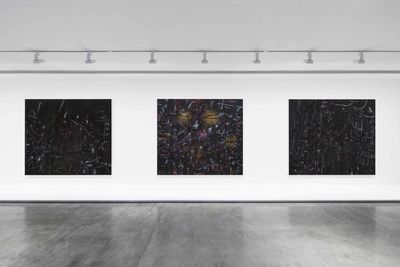

JH: How did the ‘Black Paintings’ evolve?
JM: I’d visited a small 16th-century church, Agia Dynamis, in central Athens that has religious paintings which, over the centuries, have turned black; almost every detail, except for the golden halos of saintly figures, has been lost. They stuck with me.
Another significant experience was a hike I took with my kids and Jessica in Utah, where we came across what looked like white drawings or spray paint on rocks, but it’s just the natural geology. Both of these experiences were points of departure.
Then, when I started working on the canvases, I accidentally used a weird silver interference spray paint that changed everything because, when I applied it, it wasn’t silver, it was violet. And I was like, ‘Oh my god, it’s changed colour!’ So, I called it the magic ink. I thought it was just one bottle and maybe something had gone wrong with it.
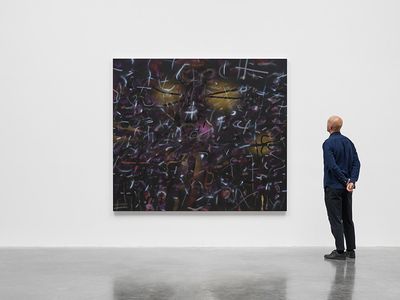
JH: So, the iridescent marks on the surface of the paintings are the result of a beautiful accident?
JM: Yes! And then, I looked at the spray can with my glasses on—which I rarely wear in the studio because I think I don’t need them all the time, but I really do—and I realised it was an interference colour, called silver violet. After that, one of my assistants developed a range of interference colours for me to play with.
“I realised my perspective was one of being immersed in contradictions.”
JH: It’s one of the mesmerising aspects of ‘Femenine in nine’ that, as you move around the works, the colours shift in the light. Did you do a lot of preparatory drawings for this series?
JM: No, it was a very, very intuitive process. Towards the end, I was working on two or three canvases at a time; it was really liberating and, within just a few months, I had finished them. Then, I started moving them around and a rhythm between them started to happen.

JH: Generally speaking, how much preparation do you do before beginning a work?
JM: I don’t do any preparation for the gestural drawings as the language is constantly evolving. The architectural and the blurred photographs both work as a kind of ‘social ground’, as my friend [the artist] Glenn Ligon88 calls it. And I feel that’s really true. It’s a way to find an entry point into the work.
JH: Abstraction is, of course, a complicated word—it means many different things to different people. In the conversation you did with Suzanne Cotter for the media preview of your exhibition, you referred to abstraction as a radical new way of being in the world. Could you elaborate on what you mean?
JM: When I was younger, I kept almost unknowingly pulling away from representation. It wasn’t until later that I started to really try and understand why. When I was in graduate school, it became really clear to me that part of the reason I resisted it was I didn’t want to have to define who I was or to represent myself. This was in the 1990s: I’d seen the 1993 Whitney Biennial and identity politics was really coming into the fore. I felt caught between different realities—being Ethiopian and living in the U.S. In interrogating that, I realised my perspective was one of being immersed in contradictions.
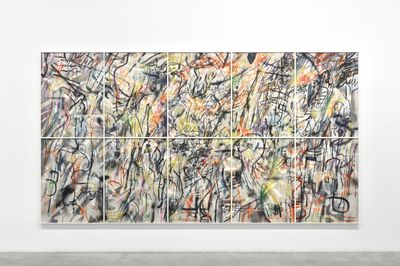
Later, I was thinking about [the late Martinican writer, poet, philosopher, and literary critic] Édouard Glissant’s idea [from Caribbean Discourse, 1981] of the right to opacity, the right to be able to invent and create. And I started really going into abstraction, inspired by amazing painters who were also civil rights activists, like the late Jack Whitten, and the relationship between jazz and the Black radical tradition.
[The late American Jazz saxophonist and composer] John Coltrane would talk about universality, about music as a way of rigorously inventing something new from a knowledge of the past. It was an insistence on a kind of humanity, an insistence by these artists who knew their worth. Despite Jim Crow, despite every institutional effort to deny their humanity, these people had a deep knowledge of their value.
It’s so moving to think about that history. And it made me understand that one of my reasons for not wanting to describe something is not wanting to mimic anyone. Of course, I think there’s some incredible representational painting too, but I’m more interested in the space of what is possible. In that sense, working on the ‘Black Paintings’ was so liberating. There’s a joy in that, a kind of explosion of something new, of something else.
“My paintings occupy an indeterminate space of transition, transcendence, reorganising, and re-morphing.”
JH: Do you listen to music when you make your work?
JM: Yeah, I listen to everything—music, podcasts, news, books, history classes. I was listening to Julius Eastman’s ‘Femenine’, which is so great, as I was making the ‘Black Paintings’. There are so many moments in that piece that are intense and the title refers to the feminine: he was pushing that. But, despite the fact that he was this radical composer, he was kind of shunned by his contemporaries, such as John Cage. Eastman was also very open about being gay in a world that wasn’t very accepting. He lived radically.
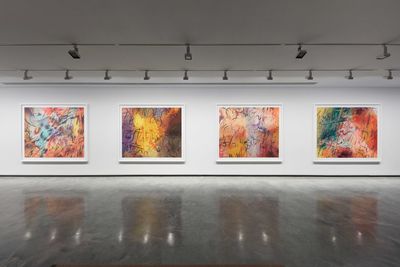
JH: The title of your MCA show, A Transcore of the Radical Imaginatory, is enigmatic and allusive. How did it come about?
JM: When I met with Suzanne to discuss the show, she was interested in the things I was talking about regarding radical imagination, the Black radical tradition, and the possibilities of that space.
My paintings occupy an indeterminate space of transition, transcendence, reorganising, and re-morphing. I also love the idea of a musical score—I’d been thinking about musicality and how you can use it to move through space—so I came up with the neologism ‘transcore’. I like my titles to add another layer of complexity to the work.
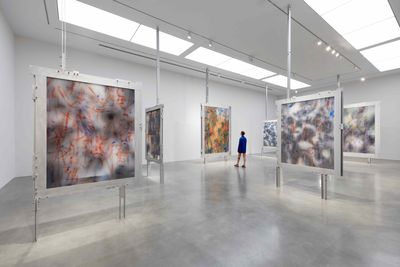
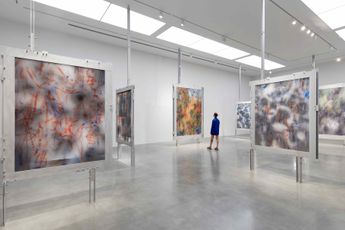
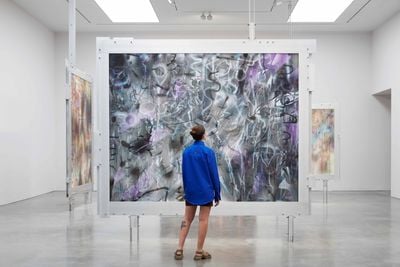
JH: The series ‘TRANSpaintings’ [2023–2024]—comprising seven freestanding, semi-translucent canvases—is central to the exhibition. Will you expand on these works?
JM: I have some more paintings in the studio that I’m working on, and I think when they’re finished it might be over, but we’ll see.
JH: You have a rich dialogue with the Berlin-based artist Nairy Baghramian, who designed Upright Brackets [2023–2024], the freestanding aluminium supports for the ‘TRANSpaintings’. Will you keep collaborating with her?
JM: Sure, if she’d like to! We have an agreement that we’ve made 26 works together, and if that feels finished, it feels finished. But something happened when I was making the biggest painting of the series that I’d really like to push, so I might want to make some new ones.
JH: Which artists are you currently interested in?
JM: There are so many paintings that move me. I love looking at art in different places; it started when I first visited Rome as a young person. Caravaggio has been very influential. I titled my painting The Seven Acts of Mercy [2004] after his altarpiece of the same name [c.1607]; it’s such an exhilarating work. One of my favourite experiences of coming across something I didn’t know about was in Palazzo Abatellis in Palermo. It’s a 15th-century fresco called The Triumph of Death, by an unknown artist.
JH: What was it that grabbed you?
JM: It’s just beautiful and so moving. Also, it’s huge: there are so many parts to it. In the centre is a horse, painted as part skeleton, being ridden by a human skeleton. They’re surrounded by people who are watching and praying, knowing that this will happen to all of us in the end. It was such a discovery—like a jolt.
Another painting that had an impact on me is Titian’s Pièta [c.1576] in the Gallerie dell’Accademia in Venice. It’s his last painting and it shows Christ’s chest seemingly falling apart, disintegrating into paint. It’s very moving.
JH: Could you sum up what it is that excites you about a work of art?
JM: I think it’s the desire to manifest the forces that we intuitively feel but don’t always understand, that insist on our fragility and humanity and the desire to express that. It’s the same with landscape painters who tried to describe the sublime, to inspire some kind of awe. I’m interested in why something moves me. That’s always been a question of mine. Some of the younger artists I’ve spoken with don’t feel comfortable going to museums with complicated histories that directly or indirectly intersect with colonialism, and I understand that. But you’ve got to go look at this amazing stuff. There’s a reason it can move you. —[O]
Julie Mehretu: A Transcore of the Radical Imaginatory is on view at MCA, Sydney, Australia from 29 November 2024 to 27 April 2025.
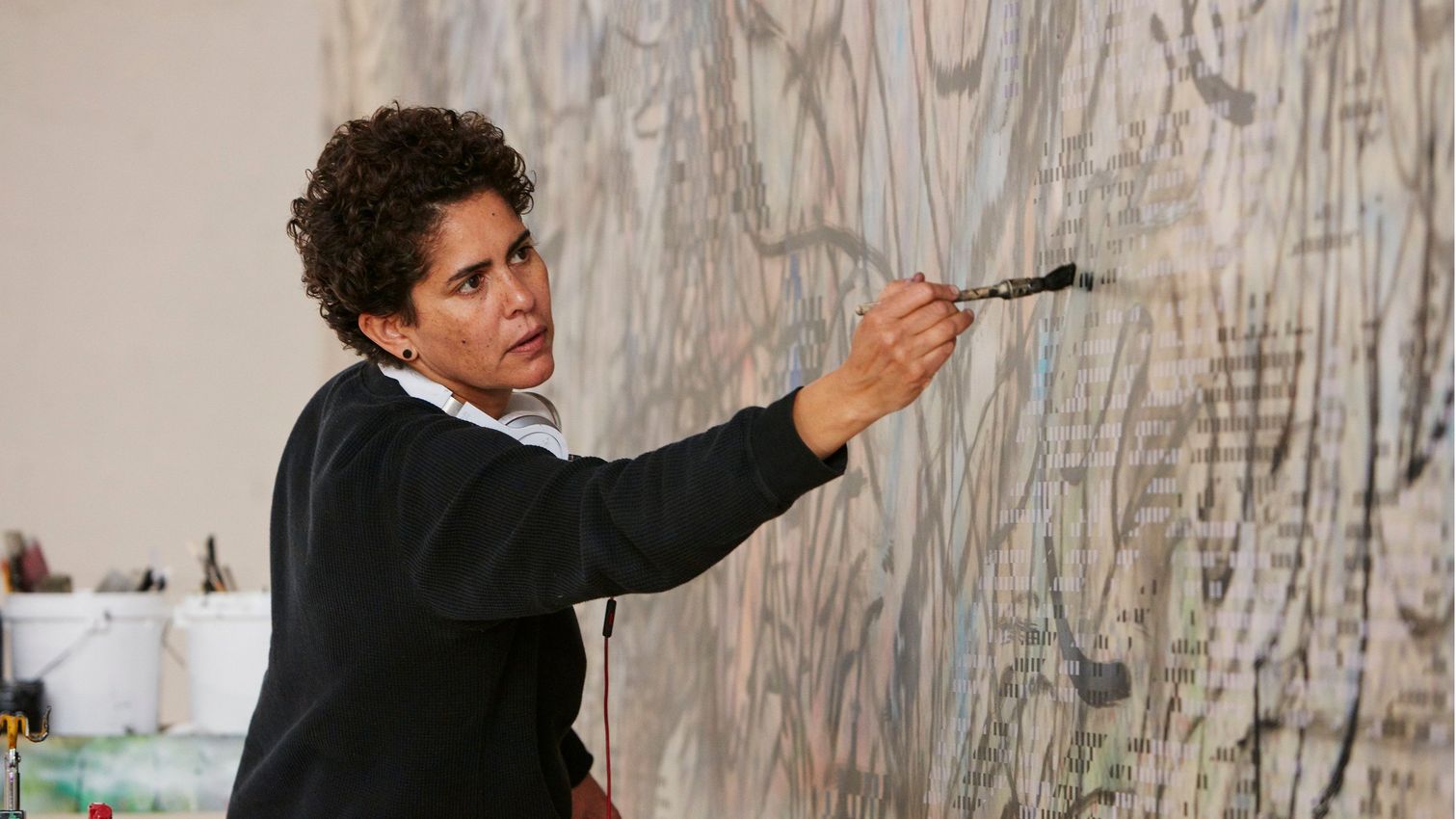
Main image: Julie Mehretu working on HOWL, eon (I, II) (2017). Commissioned by the San Francisco Museum of Modern Art. Courtesy © Julie Mehretu. Photo: Tom Powel Imaging.






A respected voice in contemporary art discourse.
Focusing on ambitious storytelling and insightful art-world commentary. Ocula Magazine publishes in-depth interviews, critical essays and timely analysis on the artists, exhibitions and ideas driving the global art world.
Learn more about Ocula Magazine
Showcasing the best of the art world.
Ocula partners with galleries from around the world to highlight their artists, artworks and exhibitions. Gallery membership is by application and invitation, with each member vetted by an independent panel.
Learn more about Ocula Membership
Specialises in the sale of major artworks.
Led by a team with deep ties to the world’s leading auction houses, galleries and collectors. Ocula’s advisory team offers bespoke services to high-net-worth clients from around the world who are looking to acquire the best of contemporary and modern art.
Learn more about our team and services