





Lawrence Lek
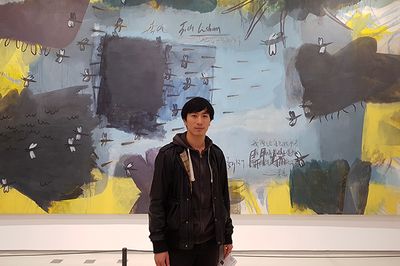
Lawrence Lek. Courtesy the artist.

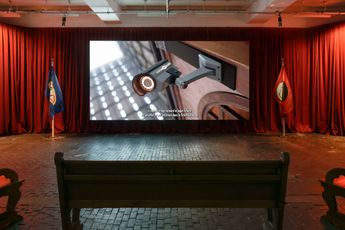
Lawrence Lek is an artist working in the fields of virtual reality and simulation. Using computer-generated imagery, Lek develops digital environments he describes as ‘three-dimensional collages of found objects and situations drawn from observed reality’.
‘Bonus Levels’ (2013–ongoing), Lek’s nine-part ‘virtual novel’ about a ‘utopian world-in-progress’, centres on nine video simulations that journey through retro-futurist landscapes and cultural architectures in London.
In Unreal Estate (The Royal Academy is Yours) (2015), the Royal Academy is presented as a recent purchase by a Chinese oligarch, decorated with a shiny silver Koons rabbit; Shiva’s Dreaming (Crystal Palace) (2014) shows the Crystal Palace on fire in 1936, the year it burned down.
![Lawrence Lek, Unreal Estate (The Royal Academy is Yours) [still] (2015). Multi-screen installation with 18-minute HD video loop and two interactive versions with Xbox controllers. Copyright Lawrence Lek.](https://files.ocula.com/anzax/Content/Conversations%2FLawrence%20Lek%2Ftumblro4cc2pSnrf1tvgtcoo41280_400_0.jpg)
With a background in architecture, having studied at Cambridge University and then the Architectural Association in London, Lek has pointed out that his interest in mapping structures is not so much about critiquing them, but about finding a place to inhabit. Naturally, the art world is a constant feature within these cartographies.

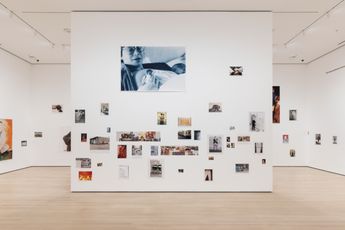
A Collective Tower (2013) shows a utopian skyscraper housing 21 London-based project spaces and galleries, while Delirious New Wick (2015) presents an alternative post-Olympic London made up of floating islands, one crowned by Anish Kapoor‘s ArcelorMittal Orbit tower. Dalston, Mon Amour (2015) depicts a London neighbourhood in a state of apocalyptic collapse—a 2016 Brexit edition of the work, Europa, Mon Amour, features Wolfgang Tillmans’ posters supporting the movement for the UK to remain in the European Union.
![Lawrence Lek, Europa, Mon Amour (2016 Brexit Edition) [still] (2016). HD video, stereo sound. 14 min 08 sec. Copyright Lawrence Lek.](https://files.ocula.com/anzax/Content/Conversations%2FLawrence%20Lek%2FLawrenceLekEuropaMonAmourScreenshotHiRes03_400_0.jpg)
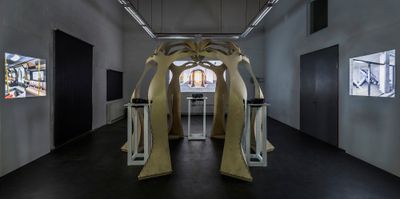
Each ‘Bonus Level’ is presented in physical space as an installation, with real-time playable versions of the artist’s worlds. Sky Line (2014), for instance, was shown as part of Art Licks Weekend 2014 in London. A three-screen HD video installation—two interactive real-time simulations with game controllers plus the actual Sky Line video filmed on a loop—was installed in London’s White Building, at the centre of which stood a wooden pavilion that appears throughout Lek’s videos as a teleporter.
That pavilion makes an appearance in Lek’s latest exhibition in Hong Kong at chi K11 art space in Tsim Sha Tsui, titled 2065 in reference to the centennial year of Singapore’s independence (21 March–20 May 2018).
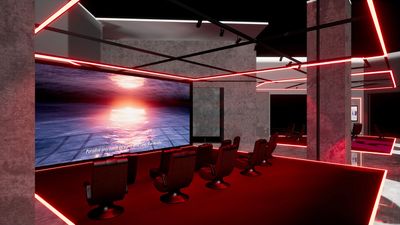
Installed in the basement space of the K11 art mall, 2065 is staged like a gaming zone, incorporating CGI videos and five playable game simulations. A core narrative is expressed by an HD video depicting a city built from elements of Hong Kong, Malaysia, and Singapore, including the Marina Bay Sands Casino.
In this future world, life has become entirely facilitated by the so-called Farsight Corporation’s artificial intelligence algorithms; a group of which, inspired by the ‘Sinofuturists’, breaks free from their programmed roles—for example, to always lose to humans in e-sport games—in order to become artists.
![Lawrence Lek, Sinofuturism (1839–2046 AD) [still] (2016). HD video essay. 60 min.](https://files.ocula.com/anzax/Content/Conversations%2FLawrence%20Lek%2Ftumblrinlineodupm3OjDG1sbjn8t500_400_0.png)
Offering a prologue to this tale in the exhibition is the feature-length film Geomancer (2017), which incorporates ‘a video game animation, a neural network-generated dream sequence, and a synthesised vocal soundtrack’. Geomancer tells the story of an adolescent AI satellite that escapes its cosmic orbit to land on earth and fulfil its dream of becoming an artist. On earth, the AI comes across the Sinofuturist manifesto, which is outlined in a video essay that is not included in this Hong Kong show: Sinofuturism (1839–2046AD) (2016). The work describes a techno-futurist condition powered by artificial intelligence that is already ‘embedded into a trillion industrial products, a billion individuals, and a million veiled narratives’.
Lek has said that simulation, on a fundamental level, is ‘a medium that integrates others’. With this in mind, 2065 presents an integration of the artist’s work thus far, incorporating formal elements within an expanded narrative that continues to grow as the virtual worlds that Lek builds continue to connect through time and space. In this conversation, he expands on these connections.
![Lawrence Lek, Geomancer [still] (2017). HD video, stereo sound. 48 min 15 sec. Commissioned for the Jerwood/FVU Awards. Copyright Lawrence Lek.](https://files.ocula.com/anzax/Content/Conversations%2FLawrence%20Lek%2FGeomancer131920x1080_400_0.jpg)
SB: So many threads come together in 2065, from your reflection on cities as cosmological diagrams in ‘Bonus Levels’, to the journey of the world’s first AI artist in Geomancer that continues with the AI collective inspired to become artists in 2065.
How would you say 2065 fits into your practice as a whole?
LL: For me, the show is an opportunity to bring together many of the different things I’ve been working on over the past years. Even though the show came together quickly, I wanted to complete the narrative that I’ve been working with in Geomancer and Sinofuturism, and essentially create a game around it. The first thing I thought of in terms of the installation was the ability to really have, for the first time, something in which the physical installation and the virtual world could really coexist side by side. But I also wanted to make something that is deeply embedded with AI and simulation, both in terms of medium and subject. With ‘Bonus Levels’, when I was looking at virtual architecture, it was more about thinking of architecture as symbolic representation; a kind of microcosm, or a world within the world.
The difference between then and now, I guess, is that in the last two or three years I’ve become more familiar with virtual world-building, and have been thinking of Sinofuturism, which takes the form of a kind of critical video essay, and Geomancer, which is a speculative, fictional, emotional reading of the condition that Sinofuturism explores. I’m happy that the two sides have managed to come together at the same time in an installation that isn’t super didactic, and gets the critical narrative across either in a playful or in a more meditative way. So it’s not just the narrative that has expanded.
SB: ‘A world within the world’ recalls how you described your 2015 Delfina Foundation residency project for Performance as Process: a live walk-through of a simulated Tate Tanks and MoMA atrium, where you did a virtual re-enactment of Marina Abramović‘s The Artist is Present. You called this ‘a performance within a performance within a performance space.’
LL:

SB: In many ways, every aspect of your practice is performative in terms of how works, audiences, spaces, and temporalities interact. Take the Sky Line installation you showed at the White Building in 2014, which included that wooden pavilion we see in a number of your videos, including 2065. What does this structure perform every time it appears as a simulation, and how does it connect not only with its physical form, but with those architectures you reference in your simulated worlds?
LL: That pavilion was the last physical, architectural installation that I’ve made, and on a personal level, it symbolises the transition between taking physical space as the primary focus, to thinking about the ways in which an object can be a portal into other things. I do have this kind of recursive hall of mirrors effect in my work—but it’s important for me that it’s not just referencing the same work in itself. The pavilion reminds me of the different ways in which ideas have moved from one medium to another, whether that’s physical to virtual space, or whatever.
“...because I’ve been reflecting for a long time on the significance of science fiction, I am also interested in the failure of science fiction as kind of a clichéd narrative, and its power to offer an alternative to cynicism or irony when it comes to a projection of the future, whether it’s based on the simulated desire of advertising, or the narratives of film-making.
In another sense, even though 2065 is a world that contains many other spaces, it is completely non-abstract. There are levels of representation, when I’m representing Marina Bays Sands Casino, for instance; but it’s not in any way composed like an abstract painting, where one thing is an adaptation of another. It essentially stands for a simulation of itself.
Sometimes, when I’m explaining my work, I have to say exactly what places are what, just like I can say now that this pavilion used to be a physical pavilion. These representations are never at the level where you have to operate metaphorically—where I would have to say, for example, that I’m using the casino to symbolise something else.
SB: It is what it is.
LL: Exactly. I’m using the casino as a casino. I’m kind of creating the virtual gallery as a virtual gallery.
![Lawrence Lek, 2065 [still] (2018). Copyright Lawrence Lek.](https://files.ocula.com/anzax/Content/Conversations%2FLawrence%20Lek%2F2065GameStill033840x2160_400_0.jpg)
SB: You have talked about how the pace of technological development can often result in the visual aesthetic of CGI becoming dated quite quickly, turning each of your works into a ‘future relic’. This connects with what you wrote in your essay, ‘Pyramid Schemes’—that ‘architecture is prosthetic memory, a way to write without words.’
LL: In a pre-literate society, buildings act as collective spaces that transmit certain ideas about culture, power, society, religion and so on. Virtual architecture is kind of a way to contain these memories; of places that you’ve been or places that you’ve experienced. For me, this is an opportunity to use the kind of medium that I’m familiar with as a result of my background in architecture as a memory device, basically. It is about this idea of prosthetic memory.
Also, with 2065, because I’ve been reflecting for a long time on the significance of science fiction, I am also interested in the failure of science fiction as kind of a clichéd narrative, and its power to offer an alternative to cynicism or irony when it comes to a projection of the future, whether it’s based on the simulated desire of advertising, or the narratives of film-making. These are essentially useful artistic devices to get away from certain clichés, I guess.
“The first thing I thought of in terms of the installation was the ability to really have, for the first time, something in which the physical installation and the virtual world could really coexist side by side. But I also wanted to make something that is deeply embedded with AI and simulation, both in terms of medium and subject.
SB: How does this relate to Sinofuturism and the failed optimism that the work plays with?
LL: The failure of Sinofuturism stems from the acknowledgement that the humanism conditioned by Western enlightenment principles leads to certain kinds of failures, because that kind of idealism is not possible in all contexts—especially when there are different demographics or different histories being dealt with. In Sinofuturism, I spell this out in a quasi-video-essay didacticism, which I thought about as a kind of narrative device. Take 2065, in which group of AIs come across this video essay called Sinofuturism and were inspired by it to start their own art movement.
The breaking of the fourth wall as a form of authorship is something that I became more conscious of when I was working on Geomancer. As a thought experiment, I thought about how, in the future, a self-aware AI might Google itself or search for examples of an AI artist, and Sinofuturism would come up in the search results and feed into this future consciousness. A future art history told through the infinite memory of the Internet is a really interesting idea to me.
![Lawrence Lek, Geomancer [still] (2017). HD video, stereo sound. 48 min 15 sec. Commissioned for the Jerwood/FVU Awards. Copyright Lawrence Lek.](https://files.ocula.com/anzax/Content/Conversations%2FLawrence%20Lek%2FGeomancer021920x1080_400_0.jpg)
SB: This idea of a future art history recalls QE3 (2016): a metaphor for how simulated structures—from a video essay like Sinofuturism, to a building—travel through space and time. But instead of the Royal Academy shifting identity to become a privately owned future home, in QE3 we have a retired ocean liner named after Queen Elizabeth II brought back to Glasgow in 2062 from Dubai to house the Glasgow School of Art.
The person who brings the ship to Glasgow is a sculptor whose task is their personal Fitzcarraldo: a challenge not unlike the AI’s dream in Geomancer to become the first AI artist. How do these protagonists relate to your interest in finding where you are as opposed to who you are in your work, which you have linked to your identification as a post-colonial body shaped by globalisation?
LL: I’m also dealing with the symbolism of architecture as this collective memory, and in opposition to that, the idea of the wandering protagonist—whether that’s literally through the first person perspective or through the memories of places where a person, consciousness, or anything else, has been. This contrast between the static position of architecture and the mobile position of the eye or the consciousness is something that is really at the heart of 2065. Obviously, there’s the fact that in the game the player is free to explore a world that is unique to them. I may have said this in ‘Pyramid Schemes’ as well, but the simplest form of freedom is the freedom of mobility.
Also, the idea of the wandering migrant is something that is very strongly tethered to the idea of post-colonial identity, and raises different issues surrounding migration, access and the privilege of being able to access different places. This kind of freedom of access was one of the major concepts of ‘Bonus Levels’. In 2065, I’ve become slightly more conscious of the limitations of that kind of utopia, because even in a virtual world you can fall off the edge.
![Lawrence Lek, QE3 [still] (2016).](https://files.ocula.com/anzax/Content/Conversations%2FLawrence%20Lek%2Ftumblro4ce8wv7jr1tvgtcoo11280_400_0.jpg)
SB: Or your movement will always be constricted by what is ultimately a contained environment, or programmed system.
LL: Exactly. In all of these works, the contrast between the freedom of the individual within the system and the architecture that stands in these worlds is symbolic of an urban or political system; and the wandering eye of the camera in the film, or of a player in the game, stands in for the expanded yet limited amount of freedom that we have.
SB: This makes me think of Nøtel, an 2015 audio-visual show you developed with Kode9 and the fully automated luxury communist space envisioned through the simulation of an automated hotel managed by the so-called Nøtel Corporation. I thought about Nøtel when I watched 2065, particularly when the ‘player’ stands on a platform that leads to a number of doors—casino, museum, gallery—and the narrator wonders if we will know the difference between art and the world when everything is simulated.
LL: Yes. Nøtel was the first time I custom-made a piece of architecture that fit in with these political ideas about left accelerationism. One thing I did draw on heavily from Nøtel was this idea of the fictional corporation that in the case of 2065 is the AI company Farsight. In 2065, this all becomes expanded. You have corporations, cities, characters, and different scenes that combine to create sort of a critical mass that, let’s say, ‘Bonus Levels’ didn’t really have. Because in ‘Bonus Levels’ everything exists as a one liner in each place: so the Royal Academy is treated like real estate, or Dalston becomes a post-apocalyptic wasteland.
Ultimately, the difference between 2065 and my previous work can be described in the way a short film differs from a movie, or how a short story is constructed differently to a novel. This kind of expanded long-form work is one of the most challenging things as an artist, because there is no single commission or project that will enable you to make something that encapsulates everything.
![Lawrence Lek, Play Station VR [still] (2017). VR for Oculus Rift Headset. 3 min. Copyright Lawrence Lek.](https://files.ocula.com/anzax/Content/Conversations%2FLawrence%20Lek%2FPlayStation05_400_0.jpg)
SB: But your practice as a whole is the ongoing, long-form work, no?
LL: Exactly. You have to find opportunities to push things a bit further, and bring things together, which you have to make happen in a roundabout way. For example, in 2065 I extended parts of Geomancer and brought them together within this physical space in a new way, and with a different kind of mindset than I had before, just by being more aware of how these one-liners within virtual worlds, or even within short films, can exist at quite a simplistic level.
SB: Going back to what you said about ‘Bonus Levels’ being a way to find a place for yourself in London, where are you now, here in your installation in Hong Kong?
LL: When a practice becomes more developed you establish your own kind of intellectual, critical and artistic space for yourself. For me, its about creating these kinds of virtual spaces that have their own atmosphere and that are evocative of certain things that I’ve always been interested in; to exist in a fluid, material place that is also spatial and architectural. Of course, there are all these adjectives to describe these qualities in the work: like cinematic and immersive. But I don’t quite think those are the right way to describe where I am now. I think the more I question the idea of where I am, and by association where we are, the more it continues to evolve.
![Lawrence Lek, 2065 [still] (2018). Copyright Lawrence Lek.](https://files.ocula.com/anzax/Content/Conversations%2FLawrence%20Lek%2F2065GameStill023840x2160_400_0.jpg)
SB: And where is Singapore in all of this, given there’s such a specific reference to it in 2065? You once said that Singapore offers the clearest study of how modern architecture is used as a nation-building device.
LL: To start, 2065 is the centennial of Singapore‘s independence. But for me, though Singapore obviously exists as the setting for the work, what I’m interested in is when the country or the place is no longer new. That’s when it becomes particularly interesting. I’m interested in the moment when the novel is no longer new; when virtual reality is no longer exciting. When things fall into the background, how do we identify with them? What makes them special? Again, when Singapore is no longer this unique nation-state, but actually a model for other kinds of micro-nations, for example, then it might no longer be seen as so different or so special. I guess it is a vision of the future but also a scapegoat for the future at the same time.
To be able to reflect on a place that I know very intimately but in a non-judgemental way, in order to speculate how it might change, is the most interesting thing. Take London, which was kind of a textbook metropolis for a certain kind of European or American city. Now we have places like Singapore and Hong Kong, which are a very different kind of future city that exists in the present.
SB: A future that has already arrived.
LL: Yes. Like it says in the 2065 script: in a world where anything can be built or anything can be simulated, how do you tell the difference between art and the world? If the representation becomes perfect, then the question of where are we becomes much more difficult to answer. —[O]
Main image: Lawrence Lek. Courtesy the artist.


A respected voice in contemporary art discourse.
Focusing on ambitious storytelling and insightful art-world commentary. Ocula Magazine publishes in-depth interviews, critical essays and timely analysis on the artists, exhibitions and ideas driving the global art world.
Learn more about Ocula Magazine
Showcasing the best of the art world.
Ocula partners with galleries from around the world to highlight their artists, artworks and exhibitions. Gallery membership is by application and invitation, with each member vetted by an independent panel.
Learn more about Ocula Membership
Specialises in the sale of major artworks.
Led by a team with deep ties to the world’s leading auction houses, galleries and collectors. Ocula’s advisory team offers bespoke services to high-net-worth clients from around the world who are looking to acquire the best of contemporary and modern art.
Learn more about our team and services