





Neo Rauch: Fairytale Motifs
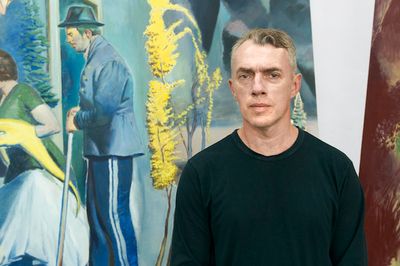
Neo Rauch. Photo: © Uwe Walter. Courtesy David Zwirner, New York/London

Born in 1960 in Leipzig, then part of East Germany, Neo Rauch belongs to a generation of artists who came of age in a divided, war‑scarred nation. He studied figurative painting at the Hochschule für Grafik und Buchkunst in Leipzig and, after the fall of the Berlin Wall, continued with representational painting even as many peers abandoned it, deeming it tainted by its proximity to state‑sanctioned Socialist Realism. In 1999, Galerie Eigen + Art presented his work at The Armory Show in New York to strong critical attention, leading to New York exhibitions with David Zwirner and a succession of gallery and museum shows across Europe. A first major museum survey followed in 2010, shared by the Museum der bildenden Künste in Leipzig and the Pinakothek der Moderne in Munich, with subsequent presentations in Warsaw and Brussels.
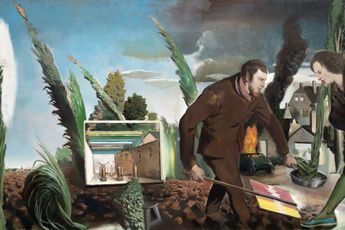
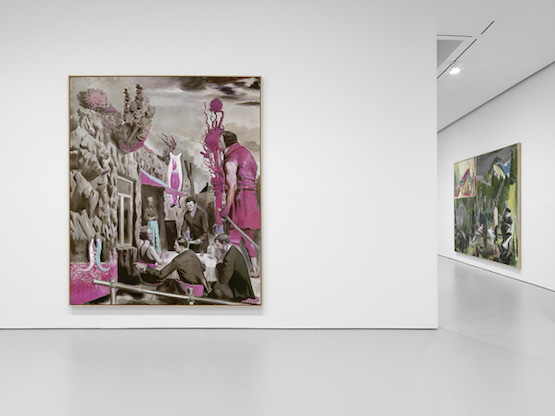
Rauch’s paintings are often discussed in relation to both realism and surrealism. His canvases teem with figures engaged in seemingly ordinary tasks—a man riding a scooter with a child, a woman sculpting, a fisherman gutting a fish—yet the narratives resist resolution, unfolding instead like scenes from an unsettled dream. Scale and perspective are routinely skewed, storylines spliced, protagonists dressed in theatrical costumes that hint at obscure rituals, and all are set against barren landscapes or oddly generic village and industrial backdrops, assembled with a collage‑like logic. Abstraction enters less through subject than through colour, which he deploys structurally, sometimes limiting himself to distinct chromatic schemes. In Der Felsenwirt (2014), for instance, a woman and three men in evening dress dine outdoors beside a rocky structure, watched by an innkeeper‑like figure, apparently oblivious to the giant striding behind them or the lizard‑like creatures entwined nearby. The scene is painted almost entirely in neutrals, punctuated by patches of pink and aqua—the chairs, the towering figure—and small flashes of purple.
In the following interview, conducted with Anna Dickie in Hong Kong, Neo Rauch discusses his use of colour, his attraction to costume and theatricality, and the role that fairytales play in the construction of his painted worlds.
AD: You were born in Leipzig, which is in the eastern part of Germany in 1960 and spent your youth in the German Democratic Republic where you completed your art studies at the Hochschule für Grafik und Buchkunst in Leipzig – Academy of Visual Arts, Leipzig. What motivated you to study art?
NR: For me anything but art was out of question. Drawing enabled me to continue to play so I carried it over to adulthood in order to professionalise it.
AD: In an Artforum article “Last Painting”, which was published in 1981 the critic Thomas Lawson argues that painting can be used as an instrument for subversion. To what extent does this statement relate to your work?
NR: If this statement refers to inner painterly processes I can agree: The act of painting seen as a corrector and driving power in the sense of an evolutionary conversion of painterly customs and conventionalities within painting itself. Relating to society, I find painting entirely unsuitable. I would even go as far as to say that it is virtually worthy of protection for and against a utilization of political programmatic.



AD: In a 2002 article, Roberta Smith wrote an article on your works: “Mr. Rauch is developing a distinctive Pop-Surrealist-Social Realist style. Warhol, Léger and Magritte could number among his current interests.
Or he may be trying to rectify Georg Baselitz‘s early hero paintings with Sigmar Polke and Martin Kippenberger‘s sense of the absurd, as well as his own more academic background.” To what extent was she correct in drawing connections to the artists she referenced?
NR: One gets closer to the core of the matter when crossing out Warhol from the list.
AD: Before you begin to paint, do you have a definite vision of the final outcome you wish to achieve?
NR: Provided that a vision can ever be concrete it is the most favourable and fortunate starting situation when a phantom of a painting appears before me that I then must re-enact however conscious that I will only get approximate hold of it. It could be a whisper that seeks out to me via conceptions or terminology; it could be a coloristic triad that beams at me from my floor on which I blend my colours; but it could also be a nearly complete, figurative and scenic arrangement that grows out of dark depths and arises before me.
AD: In a previous interview you said that you wanted people to linger before your paintings, and to be rewarded—“if people devote time to the picture than they must be rewarded”. What do you hope a viewer takes from your work?
NR: The viewer should absolutely get the feeling that his time is not measured with a ruler but with a scale. Meaning an enrichment of substances in the time through a conveyance of sensations that can gradually be turned into meaning through ones mind. The paintings should appeal to the viewers mind irrespective of their narrative first impression with the creatural implicitness and unintentionality of plants.
AD: In the recent work shown at David Zwirner for At the Well, you used colour schemes for some of the paintings, for example in Der Felsenwirt [The Mighty Rock’s Innkeeper] (2014), we see neutrals and hot pinks used predominantly (there is a touch of purple and aqua too). Can you please outline your interest in using colour schemes and why you made this shift?
NR: From time to time I love incorporating applied art of earlier decades into my painting. The charming misprints of pristine comics for example, which are based on a few printing processes and occasionally suppose an absence of an entire colour have always fascinated me. On that account, I occasionally tend to orchestrate triads that are of dissonant nature and rise to the challenge of legitimising the discordance or rather to make it consumable by means of intense painterly devotion, to domesticate it.
AD: The figures in your paintings often appear as though they were in costumes. Are you able to outline the connection (if any) between your work and theatre?
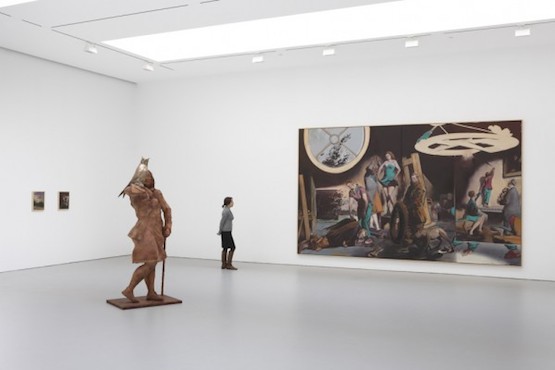
NR: Of course, the large formats, which I favor already open up a stage area in which I can boss around personnel that is almost lifesize. So as long as it stays limited to a two-dimensionality, a self-understanding as stage director is not too digressive. However, what remains oddly strange to me is performing and directing in a room.
AD: A catalogue was published to accompany your recent exhibition at David Zwirner in New York, At the Well. The catalogue features an essay by the art historian and curator Sir Norman Rosenthal, who presents a careful reading of your new work. In particular, he discusses the relationship between your work and fairy tales. How would you define the relationship between your work and fairy tales?
NR: Fairy tales for me are a profound romantic phenomenon, which I feel strongly connected to in terms of understanding romanticism as re-enchantment of the world with painterly mediums. According to that, the arc ranges from dark spheres of the pre-enlightenment into a post-modern confusion of a yet unsorted post-enlightenment.
AD: You are a recognised accomplished painter, where does the challenge in painting reside for you today?
NR: Who sees me that way and what exactly is meant by ‘recognised accomplished painter’? Gottfried Benn says, if something is completed it has to be accomplished. And if I were to apply the term ‘completion’ to myself I feel scared. It would mean that the prespecified extent of discovery and adventures in painting would be exhausted. This would be a truly tragic result that I hold against with my unabated curiosity for the possibilities of the medium. For me, each blank canvas is a fog bank that I enter equally anxious and excited safe in the knowledge that I will come across things that I have never seen before. —[O]
Main image: Neo Rauch. Photo: © Uwe Walter. Courtesy David Zwirner, New York/London


A respected voice in contemporary art discourse.
Focusing on ambitious storytelling and insightful art-world commentary. Ocula Magazine publishes in-depth interviews, critical essays and timely analysis on the artists, exhibitions and ideas driving the global art world.
Learn more about Ocula Magazine
Showcasing the best of the art world.
Ocula partners with galleries from around the world to highlight their artists, artworks and exhibitions. Gallery membership is by application and invitation, with each member vetted by an independent panel.
Learn more about Ocula Membership
Specialises in the sale of major artworks.
Led by a team with deep ties to the world’s leading auction houses, galleries and collectors. Ocula’s advisory team offers bespoke services to high-net-worth clients from around the world who are looking to acquire the best of contemporary and modern art.
Learn more about our team and services