






Fair Enough

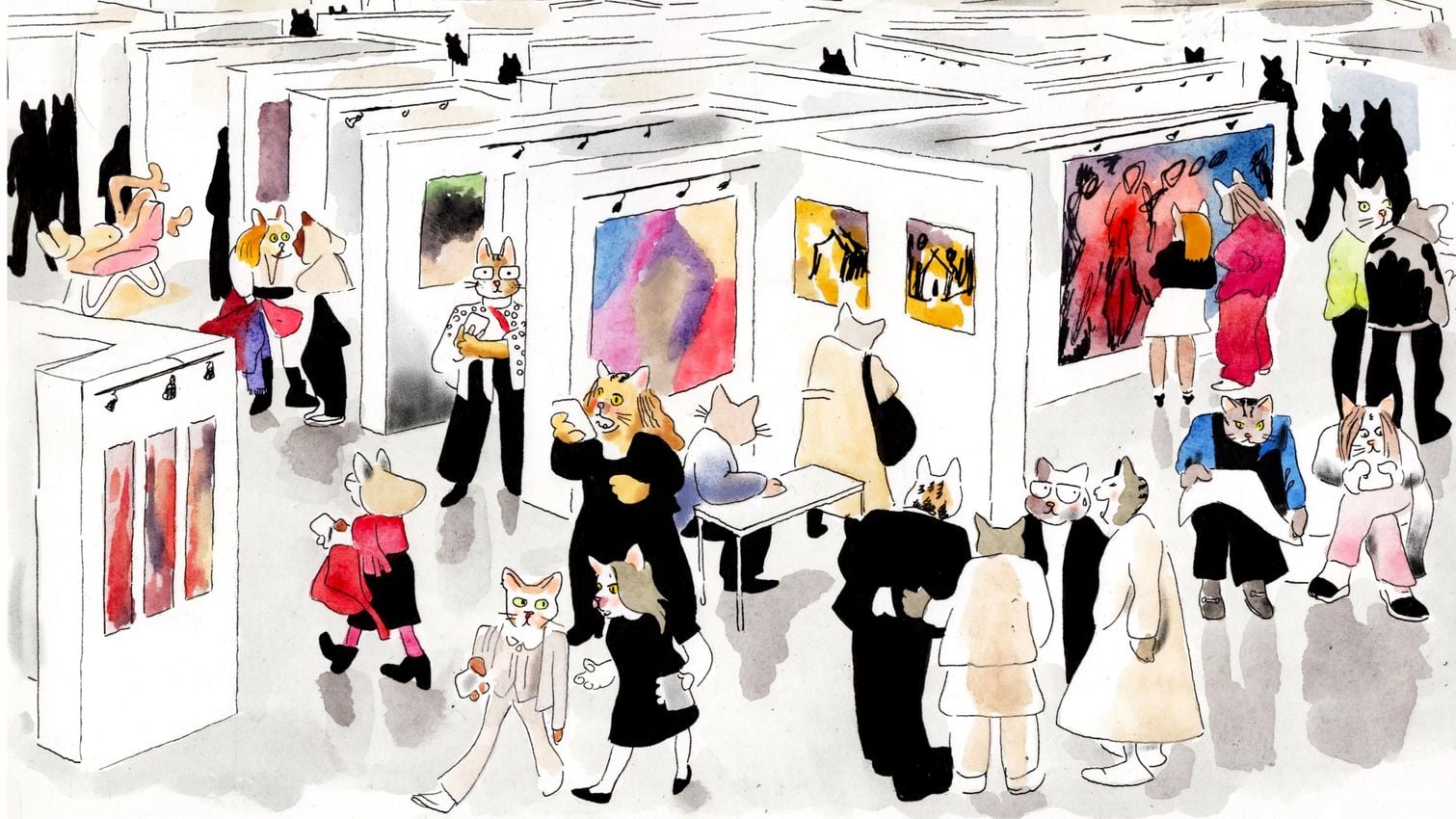
In September 1967, the German art dealers Rudolf Zwirner and Hein Stünke opened the world’s first contemporary art fair. Kunstmarkt Köln was met with bewilderment: “Paintings and sculptures are being traded like refrigerators and sewing machines in a household fair,” wrote one critic. “Can one do that—put art on the market like any old household article?”
Six decades later, the answer is a resounding yes, one can. According to The 2026 Art Basel and UBS Art Market Report, fairs accounted for 36 percent of sales by mid-sized dealers, who had a turnover of between $1 million and $10 million USD in 2025. Frieze and Art Basel’s forays into the pre-war Persian Gulf this year marked a shift in the function of the art fair on the global stage. In February, the inaugural Art Basel Qatar was held in partnership with government-backed Qatar Sports Investments.
In aligning itself with the country during what many see as Qatar’s campaign of manufacturing consent by way of cultural investments, the Art Basel fair gained significance beyond the art market, as an instrument of soft power. In an acerbic essay about Art Basel Qatar for &&&, the Iranian philosopher Reza Negarestani described the fair as “a (golden) visa for reputations”. When Art Basel announced on April Fool’s Day this year that it would host an event on the Moon, the joke’s subtext was clear: nowhere is safe from the expansionary march of the art fair.
“ Complaining about fairs remains a beloved art world hobby”
The fairification of the art market is certainly accelerating. Whether that’s for better or for worse is another question. Historically, fairs have served an important purpose, providing hordes of international collectors with a zero-friction environment in which to discover hundreds of galleries within a day. For galleries, they are a way of reaching far beyond local markets and testing new territories without the commitment of opening a space. “It’s like speed dating,” the writer and artist Kenny Schachter, who has attended more than his fair share of fairs, tells me.
But complaining about fairs remains a beloved art-world hobby. Unpredictable and time-consuming for galleries, brazenly bad for the environment and increasingly inaccessible to the public (the cheapest non-concession ticket to Frieze London last year cost £48), they’re an easy target. They’re also hugely expensive. In 2025, according to the Art Basel and UBS report, fairs accounted for 15 percent of dealers’ operational costs. (The report placed gallery rent at 20 percent and “support for artists” at 4 percent.)
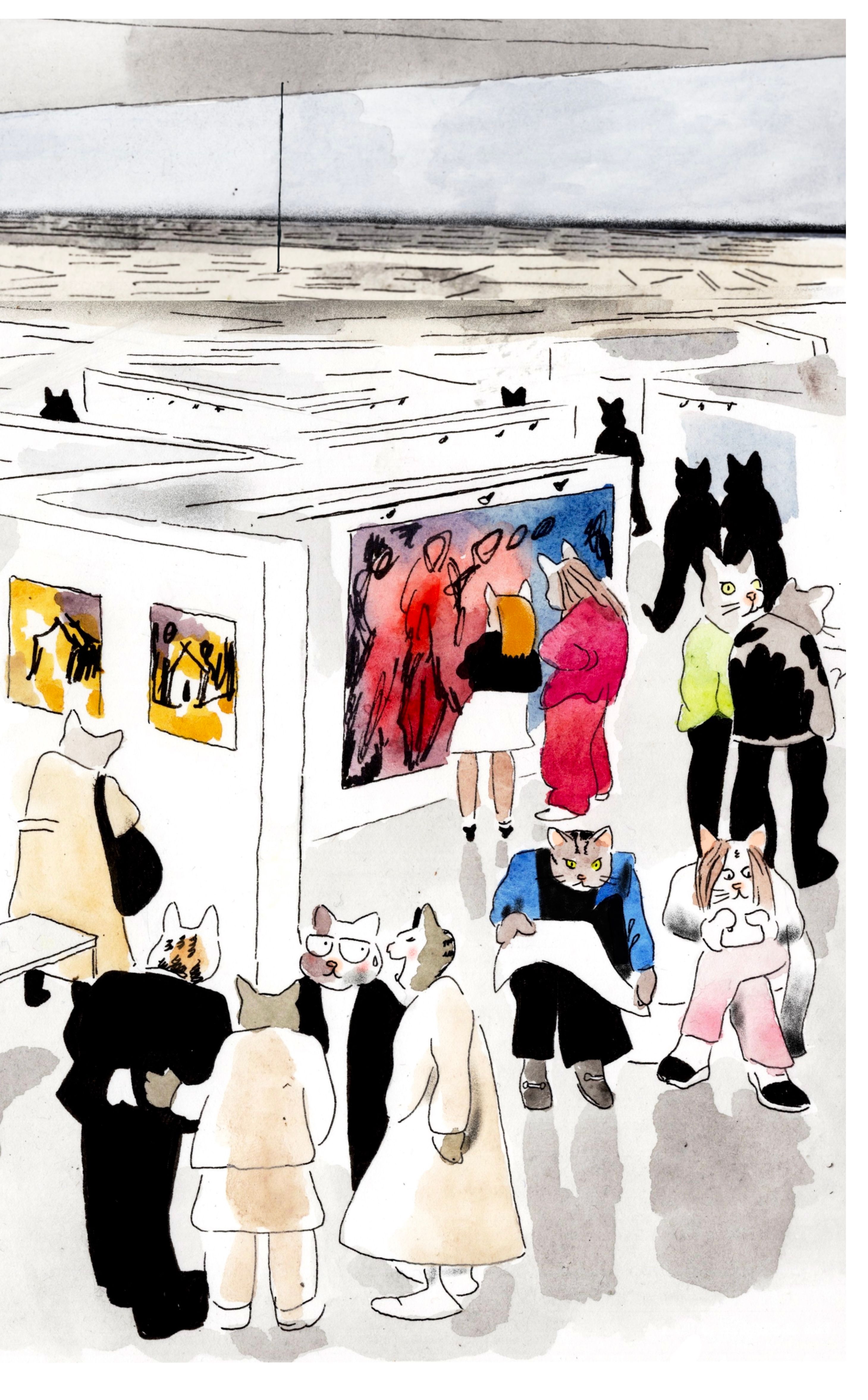
In 2021, during the height of the Covid-19 pandemic, the art market columnist Melanie Gerlis wrote a book titled The Art Fair Story, reflecting on the meteoric rise and uncertain future of the format. It had crossed her mind the art world’s lockdown reset might spell the end of the art fair. “There was a slight sense that maybe that was it: we’d got to a stage where people were already a bit fed up with fairs,” she tells me. The art market had existed before them. “Maybe we can exist in a world without them.”
Following the pandemic, dreams of a post-fair world were quickly dashed as dealers climbed back on to the hamster wheel. The year after Gerlis’ book was published, Frieze expanded to Seoul and Art Basel to Paris. Now, most commentators are fatalistic: “Art fairs will carry on in perpetuity unless there is a monumental, seismic schism,” Schachter says.
The most common criticism is that the tasting-menu format of fairs comes at the expense of the sustained, year-round success of local art scenes. If you’ll see a gallery at fairs in London, Basel, Hong Kong and Paris, the logic goes, then why bother visiting their space at another point in the year?
“If you’ll see a gallery at fairs, the logic goes, then why bother visiting their space at another point in the year?”
“You get one week when everyone’s obsessed with art and that’s it,” explains Gerlis. “That can be problematic because it’s not a city developing its own ecosystem; it’s a city adopting an international version of art.” This problem has been exacerbated, Schachter notes, by our “algorithmically contorted and controlled attention spans”. The Los Angeles-based gallerist Chris Sharp has recalibrated his programming to reflect this reality, bringing more commercial work to fairs, where he’s more likely to meet potential buyers than in his gallery. “You take risks at the gallery because you’re probably not going to sell,” he tells me. “Galleries are no longer really a marketplace.”
Almost everyone I spoke with agreed that the current art fair cycle is unsustainable. Two years ago, Sharp was offered a booth at Frieze Los Angeles for $35,000 USD. “I was like: ‘You have to be fucking kidding me,’” he says. He found an Art Deco former post office building in Santa Monica, which he could rent during Frieze week for $70,000 USD, and started his own fair. Now in its second year, the wryly titled Post-Fair charges its exhibitors around 10 percent of Frieze LA’s prices. “Doing an art fair should not bankrupt your gallery,” says Sharp. A spokesperson for Frieze said that they “appreciate that galleries present in varying contexts depending on their programme and priorities across venues” and “support that flexibility as part of a thriving and diverse ecosystem.”

Sharp follows in the footsteps of other frustrated gallerists. In fact, challenger fairs have existed since the very beginning, when Demonstrative 67 was set up by Heiner Friedrich, a rejectee of the inaugural Kunstmarkt Köln. And during this year’s Frieze LA, the collector R Parmar hosted ENZO, which was free for both exhibitors and visitors, in his own roughly 465 square-metre exhibition space. Earlier this month, Neighbors opened as a low-cost, boutique alternative to Expo Chicago, a fair that was acquired by Frieze in 2023.
Though smaller in scale and collegiate in spirit, many challengers end up resembling the fairs to which they are created as a response. “I’m part of a cyclical process,” Sharp admits, describing the periodical emergence of alternatives to Art Basel and Frieze.
If the art world is held captive by fairs, it also appears to have developed Stockholm syndrome, positing more fairs as the only viable solution. Under such circumstances, it’s difficult to imagine a post-fair world. In fact, a troubling inversion of that dream may be more likely: a post-gallery world. “Fair organisers would say what isn’t sustainable is the gallery,” says Gerlis; “that their biggest problem is the bricks and mortar.” Gerlis notes that, beginning with September’s Frieze Seoul, the fair will no longer require participants to have a physical space.
“If the art world is held captive by fairs, it also appears to have developed Stockholm syndrome”
What’s a gallerist to do in the face of the increasing hegemony of the art fair? A good start may simply be to take a step back. “Fairs can be a burden,” says George Vamvakidis, founder of Athens-based gallery The Breeder, “but it’s really a game of restriction.” He started his gallery in 2002, the year before Frieze’s first edition in London and long before collectors were using social media to find and buy art. “Our aim was always to export ideas… to communicate ideas that had been born in Athens,” he tells me. “So we did the fair, and it proved a game-changer for us.” But during the past 15 years, he has drastically reduced the number of fairs in which The Breeder participates. “You’re not going to rule the world,” he says, “so don’t try.” He advises young gallerists considering participation in fairs to “choose a market that could be friendly to what you show them”.
As Frieze and Art Basel grow by way of expansion, acquisition and new formats, the people who run their own bricks-and-mortar spaces are faced with a choice: be bled dry by a relentless cycle of participation or try saying “no”, FOMO be damned. Vamvakidis seems to have carved himself a comfortable path doing the latter: “I enjoy being philosophical about it,” he tells me. “I don’t enjoy being on a rat wheel.” —[O]









A respected voice in contemporary art discourse.
Focusing on ambitious storytelling and insightful art-world commentary. Ocula Magazine publishes in-depth interviews, critical essays and timely analysis on the artists, exhibitions and ideas driving the global art world.
Learn more about Ocula Magazine
Showcasing the best of the art world.
Ocula partners with galleries from around the world to highlight their artists, artworks and exhibitions. Gallery membership is by application and invitation, with each member vetted by an independent panel.
Learn more about Ocula Membership
Specialises in the sale of major artworks.
Led by a team with deep ties to the world’s leading auction houses, galleries and collectors. Ocula’s advisory team offers bespoke services to high-net-worth clients from around the world who are looking to acquire the best of contemporary and modern art.
Learn more about our team and services