





A Stitch in Time: Hand-Made, Textile, Contemplation, Imperfection, and Chance
Save to My Ocula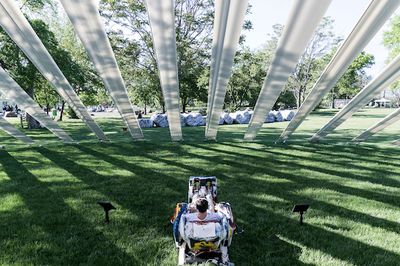
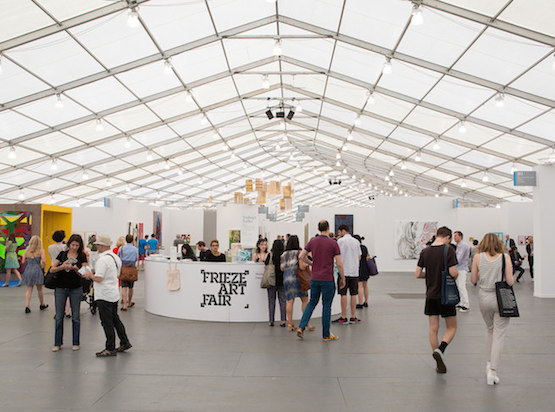
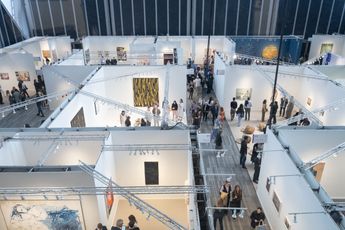
Frieze New York 2015 Photo: © Charles Roussel & Ocula
To scan an art fair for trends, or to claim a neat summation of what was on view, is to take on a task designed for failure. A writer who strides in to announce the emergence of a new movement or the dominance of a particular medium can only ever speak from a partial view: a path taken through the aisles, a handful of chance conversations, the last thing read still ringing in the ears. Taste, prejudice, fatigue, passing obsessions, even unacknowledged conflicts all shape what rises to the surface and what slips from view.
With that in mind—and fully accepting a likely failure to “sum it all up”—this is one account of Frieze New York 2015, which brought more than 190 contemporary galleries to a custom‑built tent on Randall’s Island from 14 to 17 May. Seen through this particular lens, after the initial sprint and a more measured second circuit, certain threads began to stand out against the expected fields of abstraction and sculpture: a pronounced turn toward textiles and the hand‑made, a renewed concern with slowing down the viewing experience, and a quiet but insistent fascination with chance as both method and medium.
Perhaps this sensitivity to cloth and touch was primed elsewhere. My fair week began uptown at the Metropolitan Museum of Art, with Grayson Perry talking through his shift from ceramics to monumental tapestries; it unfolded online amid the red web of Chiharu Shiota’s string installation at the Venice Biennale; and it ran up against the hard‑edged abstraction and monumental Minimalism on view in Chelsea—Ellsworth Kelly at Matthew Marks, Mary Corse at Lehmann Maupin, Lee Ufan at Pace, Michael Heizer at Gagosian, Richard Serra at David Zwirner. Whatever the cause, once the dust from the first lap had settled, it was the works that used embroidery or textile—or borrowed their logic—that began to glow against the fair’s usual dominance of painting.
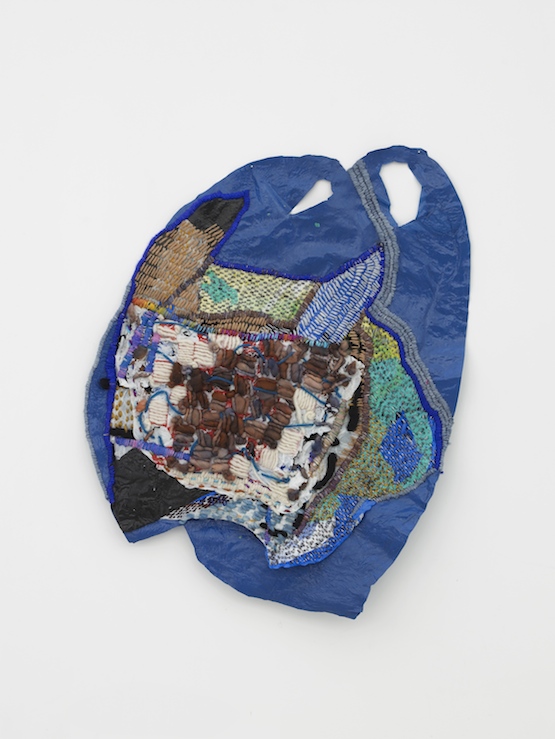
At Kate MacGarry’s booth, an entire wall was punctuated by Josh Blackwell’s Neveruses—discarded plastic bags transformed into delicate, jewel‑like objects through dense embroidery in wool, silk and paper. The bags, their handles collapsed and bellied out, suggested tribal masks, aerial maps, circuit boards; their former disposability was all but erased. For an artist still relatively emerging on a fair like Frieze, the prices—roughly USD 4,500 to 6,500—seemed modest, and all but one of the works sold within hours of the opening. Buyers were perhaps buoyed by Christie’s record-breaking sales earlier in the week (with Pablo Picasso’s The Women of Algiers (Version ‘O’) selling for just over $179 million).
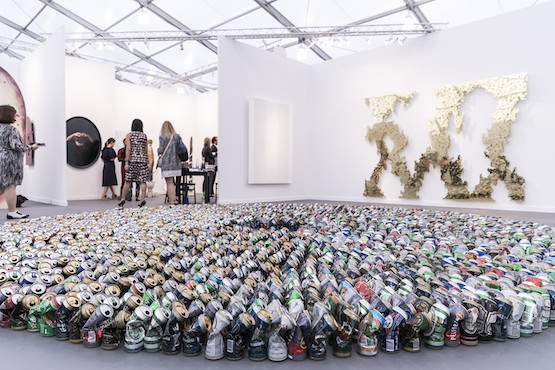
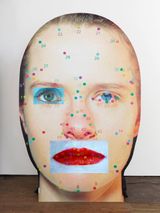
Lehmann Maupin’s presentation paired Tony Oursler, a known quantity for the gallery, with a new addition to its roster, Nicholas Hlobo. Hlobo’s work—a floating jellyfish form, head bulbous, tendrils ribboned and stitched—was assembled from sewn pastel ribbons. The creature’s genderless body pointed toward a now well‑established art‑historical trajectory of artists who have adopted techniques associated with “feminine” craft—sewing, embroidery, knitting—to probe gender hierarchies and the politics of labour: from Judy Chicago and Louise Bourgeois to Rosemarie Trockel, Ghada Amer and Tracey Emin, who had an embroidered work at White Cube’s booth.
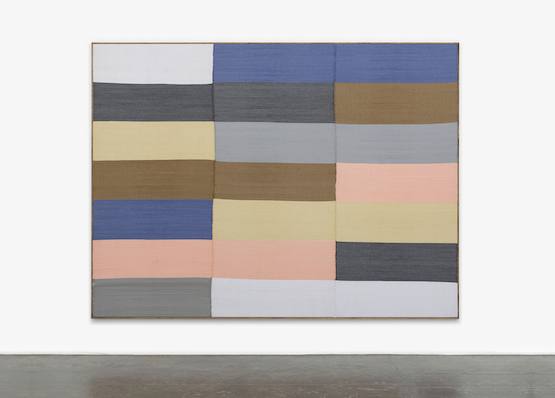
If Trockel herself was not in evidence, her knitted canvases echoed in the work of Brent Wadden, represented at the fair by Peres Projects, and in a concurrent exhibition at Mitchell‑Innes & Nash in Chelsea. Wadden, like Trockel, borrows the formal language of 20th‑century abstract painting and rephrases it in textile. Unlike Trockel, who has often used machine‑knitted wool since the 1980s, Wadden relies on a self‑taught, labour‑intensive weaving process, interlacing wool, cotton and acrylic into bands of colour that he then stitches together and mounts on raw canvas.
The lineage here runs not only through Trockel but back to the Bauhaus weaving workshop and figures such as Anni Albers and Gunta Stölzl, whose textiles quietly unsettled the hierarchy between “fine” and “applied” arts. Wadden’s insistence on the hand‑made similarly troubles modernist divisions between disciplines, while his refusal of manufactured perfection—visible joins, slight misalignments, irregular tensions—pushes against contemporary obsessions with seamlessness and speed. Fittingly, the series from which his Frieze work was drawn is titled About Time, and the waiting lists for his work are reportedly long.
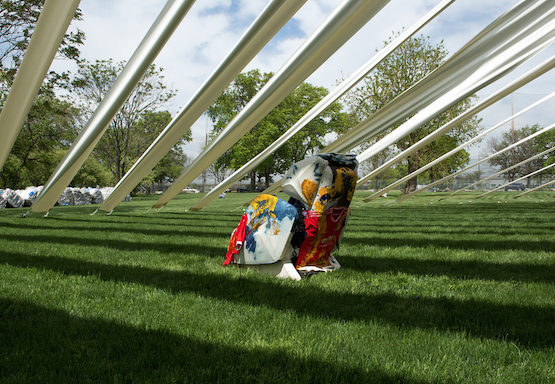
If the woven and embroidered works pointed toward a renewed interest in time‑bound making, several projects across the fair took “taking time” as their subject outright. For Frieze Projects 2015, Korakrit Arunanondchai installed a constellation of high‑tech massage chairs throughout the tent: islands of sanctioned repose upholstered in his trademark bleached and painted denim, accompanied by a hypnotic soundtrack developed with his twin brother and collaborators. Visitors could sink back into the padded forms and, for a few minutes, experience the fair as sound and vibration rather than as a visual onslaught—an almost comically literal invitation to relax into the work.
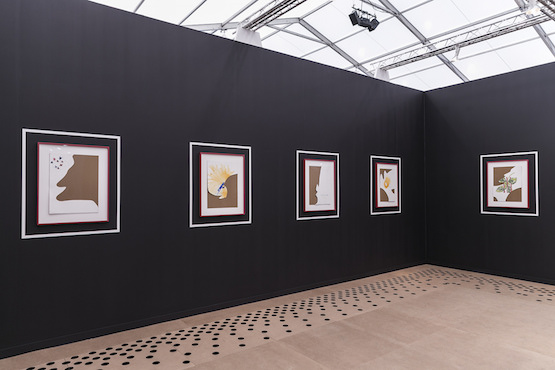
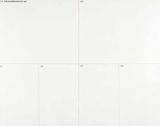
Richard Tuttle, at Pace Gallery, took a quieter route to contemplation. His series of new drawings, Aspects, was presented in a booth conceived as an immersive viewing device. Each drawing—a cut page from an artist’s pad marked with spare painted, drawn and cut gestures and mounted on cardboard—was framed in red and then optically framed again by a thin white line painted directly onto the booth’s black walls. The floor had been covered in hardboard and painted with a border of black dots that tracked the booth’s perimeter. The effect was to choreograph the body as much as the eye: you found yourself standing at an ideal distance, held just long enough for the work’s slightness to register as intention rather than as throwaway gesture.
A similar modulation of tempo operated at Galerie Gisela Capitain, where a curtain of black plastic strips by Monika Sosnowska partially occluded three paintings beyond, including a taut black‑and‑white canvas by Tobias Pils. Passing through the slats, one was momentarily blind, the rustle of plastic in the ears; the paintings arrived as an after‑image, something earned.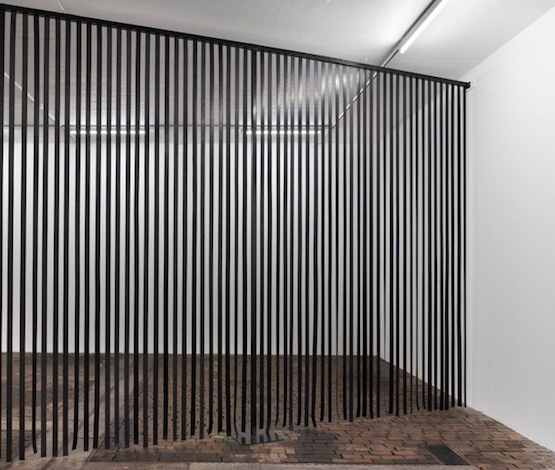
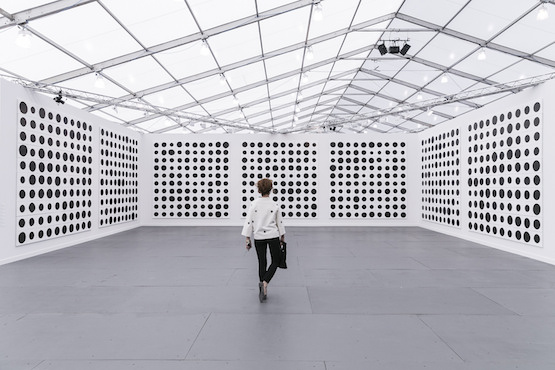
Directly opposite, at Gavin Brown’s Enterprise, contemplation gave way to participatory absurdity. Jonathan Horowitz’s 700 Dots invited visitors to paint a “perfect” solid black dot on a small square of paper in exchange for USD 20, paid by the artist. As each dot was completed, it was adhered to the booth walls, until very soon all 700 dots covered the entire three walls in a monochromatic grid formation. It was an alternative ‘sticking on of dots’ to that taking place outside the fair at one of David Zwirner’s two spaces, 519 and 525 West 19th Street, where Yayoi Kusama’s Give Me Love exhibition saw visitors invited to pepper a pristine domestic interior with brightly coloured dot stickers.
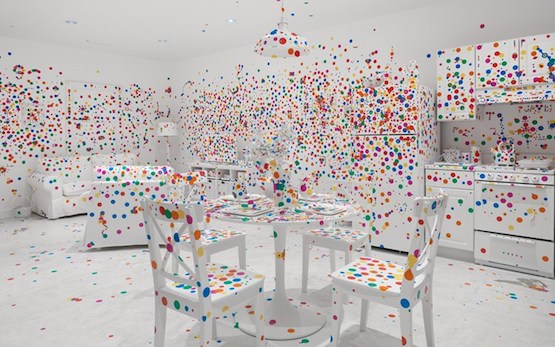
Compared with Kusama’s polychrome obliteration, Horowitz’s dots were larger, singular and, taken en masse, relentlessly monochrome. The format recalled the mythic Picasso exercise of asking young artists to draw a perfect circle to reveal their limitations and, by extension, their individuality. Horowitz has said of the piece, “A perfectly painted dot would render the hand invisible. And there’s a further amplification of the hand through the multiplicity of hands involved. Every dot is different.” Like Wadden, who treats slips in his weaving as vital to the work rather than as flaws, Horowitz accepts and even leans into the accidental imperfections of each dot. Picasso again comes to mind: “The accidental reveals man.”

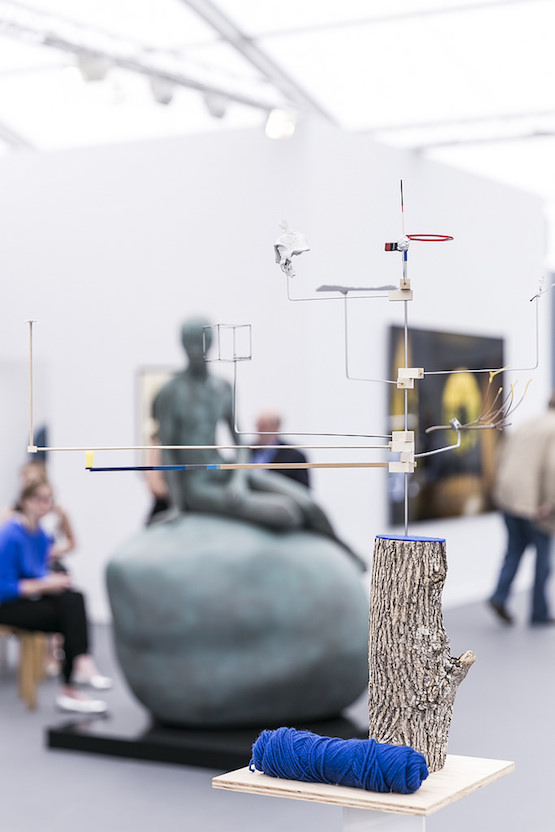
Closely related to the idea of accident, is the idea of chance, another theme that was noted at the fair in various states. Sarah Sze, who had two beautifully composed, intricate and model-like sculptures showing at Victoria Miro Gallery (forming part of her first body of work since she represented the United States at the 55th Venice Biennale in 2013), has described her work as representing experiments that explore time, space, mass and volume, but equally she has also acknowledged that the final composition is very much the result of chance.
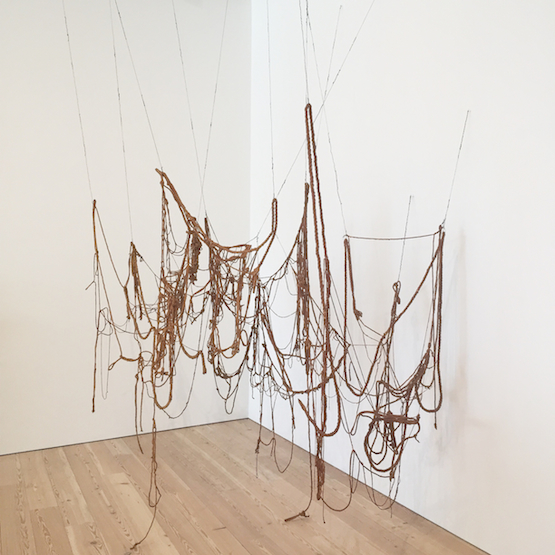
Looking at Sze’s interlaced structures, it was hard not to think of Eva Hesse’s untitled rope piece in America Is Hard to See, the inaugural exhibition at the new Whitney Museum, which had opened just days before Frieze. To make that work, Hesse dipped knotted lengths of rope into latex and left them hanging to dry. The viscous material clung or dripped according to its own logic, creating snarls and loops that preserved the contingencies of their making. In notes for a preparatory drawing she wrote of wanting the work “to determine more of the way it completes itself,” and indeed the sculpture is configured differently each time it is installed.
The use of mutability and chance as artistic process was also reflected in a very different work at Frieze: a work by the artist Ian Cheng which comprised a gigantic cinema sized LED screen showing an animation installed by Standard (Oslo) gallery at the entrance to the fair.
A young artist, Cheng’s animation Emissary in the Squat of Gods (2015) is based on a 1976 book by the psychologist Julian Jaynes that argues prehistoric humans possessed a different type of consciousness from our own. The work is a computer program that provides for a continual and mutating telling of the narrative. This continual churning of random possibilities for the work is apparently one of the reasons why a number of institutions had indicated interest in the work, attracted by the numerous experiences it offered an audience.
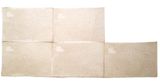
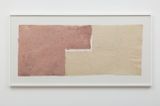
Elsewhere, Brazilian artist Rivane Neuenschwander, at Stephen Friedman Gallery, offered a quieter negotiation with chance. Known for an ephemeral practice that draws on the history of Latin American conceptualism and frequently incorporates everyday materials and participatory systems, Neuenschwander recently had a major survey at the São Paulo Museum of Modern Art. The pieces at Frieze belonged to a series developed for that show and were inspired by John Cage’s method of dripping string into paint and dropping it onto paper, then tracing the resulting, arbitrarily formed outlines. Neuenschwander dropped string onto fabric napkins, then embroidered the contours left by the fallen thread. The process also nodded toward Marcel Duchamp’s 3 Standard Stoppages (1913), in which the artist dropped three one‑metre threads and preserved their chance‑determined curves.
![Rivane Neuenschwander, (a)casos eroticos [Erotic Cases] 2, 2014. Silk thread on fabric, NEUEN 345. 62.5 x 62.5cm (24 5/8 x 24 5/8in).](https://files.ocula.com/anzax/9a/9a5e6947-cb98-459b-b3e5-f8cd712fe61a.jpg)
Cage and Duchamp are inevitable reference points for Fluxus, a movement that shadowed the fair in more direct ways. With Yoko Ono: One Woman Show, 1960–1971 on view at the Museum of Modern Art, it was perhaps unsurprising that Ono—who studied with Cage and was intermittently aligned with Fluxus—appeared at Galerie Lelong with two works. In the fair itself, Cecilia Alemani, curator of Frieze Projects, commissioned a tribute to the Flux‑Labyrinth, the obstacle course of small rooms and sensory traps initially designed in the 1970s by George Maciunas and his collaborators.
Another Frieze Projects commission, by Aki Sasamoto, played Fluxus’s interest in instruction and play against the fair’s grid. The New York–based Japanese artist constructed a maze‑like environment threaded through several booths, creating a three‑dimensional personality test. Visitors moved from room to room by choosing between pairs of objects or situations; each decision determined the next door, and, eventually, their “result”. The walls were low enough that you could see other people moving through the structure, parallel lives glimpsed in a lightly absurd game.
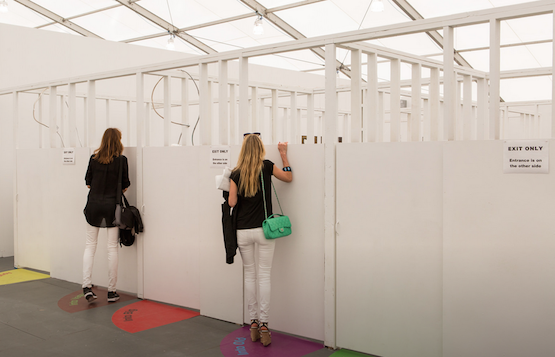
Sasamoto’s piece mirrored the fair’s own conditions: a dense, semi‑public space where a thousand small choices—turn left rather than right, stop for a coffee, answer a text—shape what you see and what you miss. Like Cheng’s software, the fair is built on branching paths and unrealised possibilities; any visit is one version among many. For this writer, the version that emerged at Frieze New York 2015 was one in which threads, in every sense, kept surfacing: an emphasis on textiles and the hand‑made, a desire to slow the pace of looking, and an ongoing curiosity about chance as process and, increasingly, as medium. —[O]
Main image: Frieze New York 2015 Photo: © Charles Roussel & Ocula











A respected voice in contemporary art discourse.
Focusing on ambitious storytelling and insightful art-world commentary. Ocula Magazine publishes in-depth interviews, critical essays and timely analysis on the artists, exhibitions and ideas driving the global art world.
Learn more about Ocula Magazine
Showcasing the best of the art world.
Ocula partners with galleries from around the world to highlight their artists, artworks and exhibitions. Gallery membership is by application and invitation, with each member vetted by an independent panel.
Learn more about Ocula Membership
Specialises in the sale of major artworks.
Led by a team with deep ties to the world’s leading auction houses, galleries and collectors. Ocula’s advisory team offers bespoke services to high-net-worth clients from around the world who are looking to acquire the best of contemporary and modern art.
Learn more about our team and services