The art world in focus
Subscribe to our newsletter for news and insights on artists, galleries and exhibitions.
Frank Gerritz. Courtesy Bartha Contemporary, London.
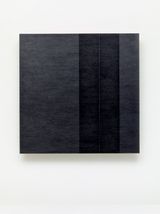
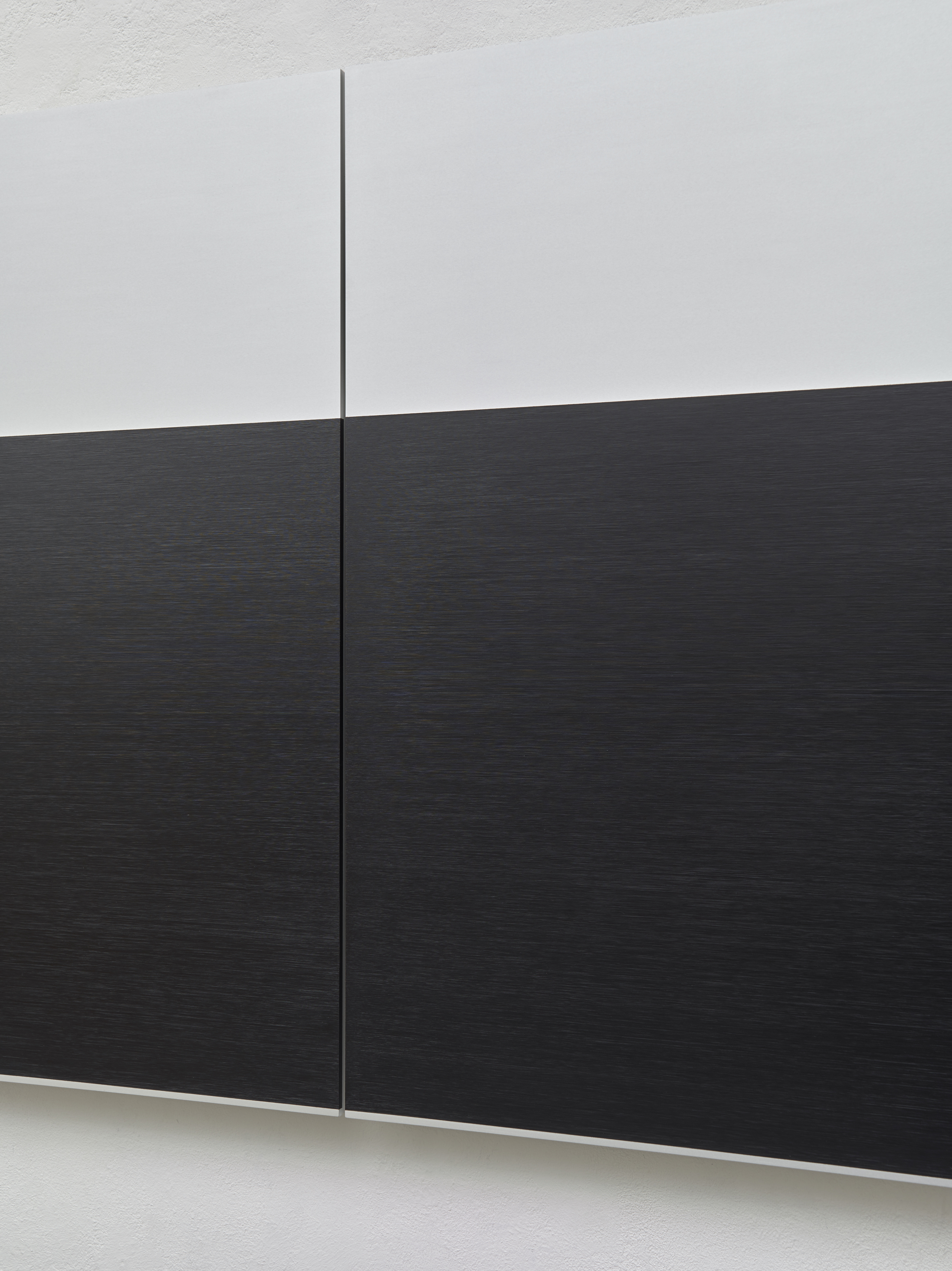
A concurrent exhibition at Sleeper in Edinburgh (13 May–2 July 2016) presents a single wall-based work in four parts, executed in oil paint-stick on anodised aluminium. In both venues, Gerritz restricts himself to black, white and grey, arranging squares and rectangles in a crisp, serial vocabulary that seems, at first glance, more invested in the picture plane than in volume. It is not hard to see why the American critic Donald Kuspit once described him as the “last abstract hardliner.”
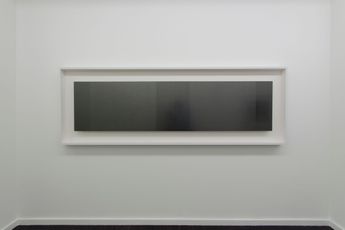
Gerritz began as a maker of cast-iron sculpture, but in the late 1980s he turned to drawing, attempting to create works on paper that embodied what he calls “compressed space” and carried the same presence—the same visual weight—as his heavy iron forms. That concern runs through both the London and Edinburgh exhibitions. In London, the MDF works are built up from innumerable layers of graphite applied with a Faber-Castell 9B pencil, so that the surface modulates and reflects light and the drawing takes on the palpable density of an object. As light shifts across these planes, and as viewers move, the works appear to recalibrate themselves in relation to their surroundings, insisting on their three-dimensionality even as they remain resolutely flat.

I started the pencil drawings on paper in 1989. Back then, these were part of my larger sculpture installations. The drawings depicted the front, sides or top of geometric solid cast iron sculptures.
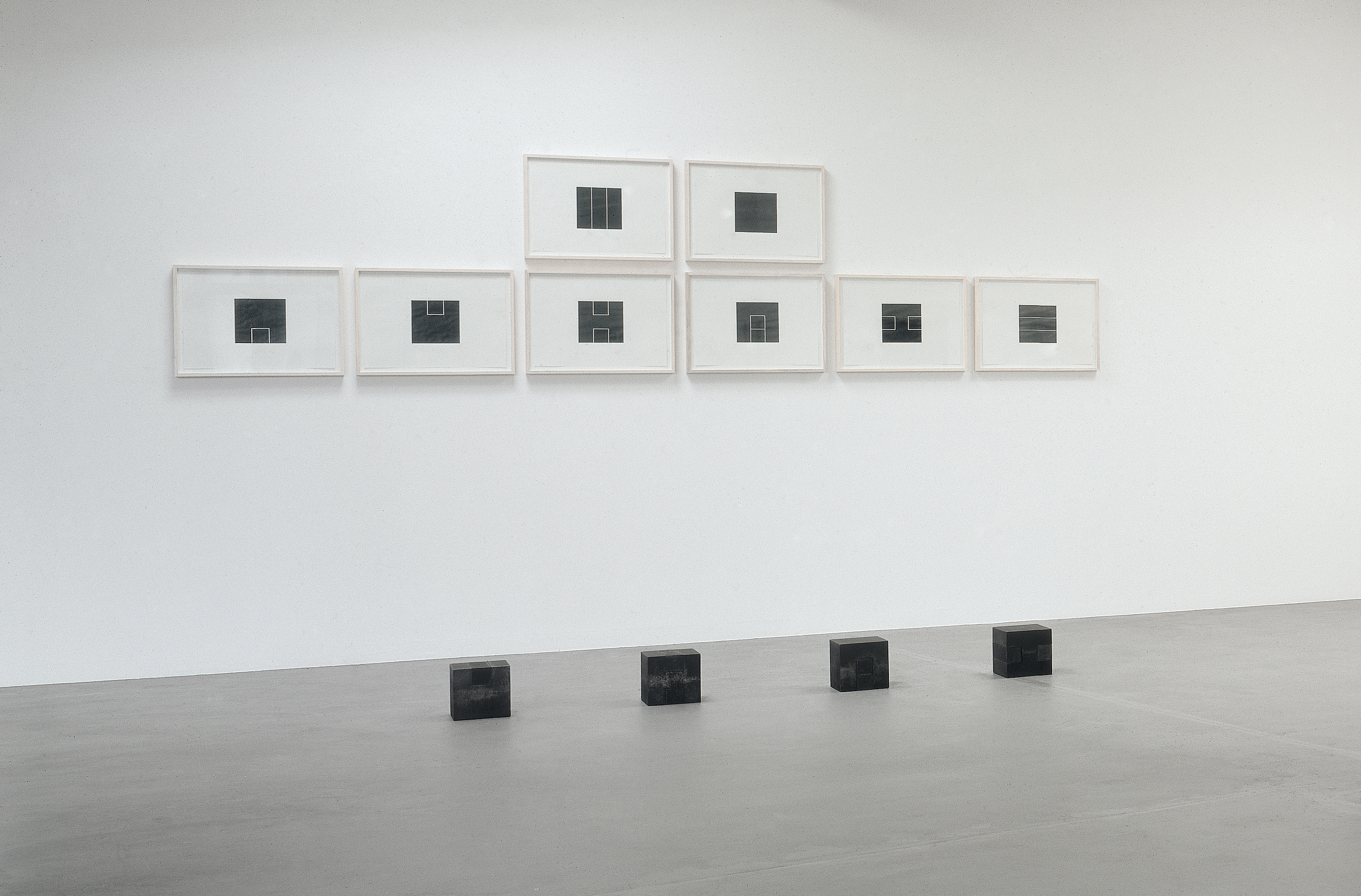
Back in the late 80s I was interested in creating drawings that embodied a compressed space. My intention was for these works to have the same presence, indeed the same visual weight as my heavy cast-iron sculptures; they are a means of transferring a physically compressed volume into an independent form of drawing. Always installed at head height they achieved a process in which the weight of the sculptures on the ground is elevated to your eye level.
The drawings from the very beginning were part of an installation featuring sculptures, using the same visual vocabulary they then referred to my interests concerning space, volume, the site specific and architecture. These works should always be viewed in a broader three-dimensional context.

Light is a very important element in my work. When I work with pencil on paper, MDF or directly onto the wall, or when I apply black paint-stick (oil and wax based bars of colour) on paper or anodised aluminium. My interest is not the darkness of these materials, but their unique abilities to showcase the shifting quality of light as it moves across the surfaces that I am creating. It is at these moments that my works spring to life. At the core, I am interested in creating means of depicting light within the picture-plane.
Donald Kuspit wrote several essays on my work. You could say he is somewhat of an expert on my work and has an integral knowledge of all aspects of my practice.
The essay Donald Kuspit wrote and titled ‘the last abstract hardliner,’ was first published in the catalogue accompanying my mid-career retrospective at the [Weserburg] Museum of Modern Art in Bremen.
It was an essay primarily about my aluminium wall sculptures. One of the largest pieces in this show is entitled ‘Hardliner’, [the work is part of the Lafrenz Collection, on loan at the Hamburger Kunsthalle]. He referred to this specific piece to describe the complexity of this entire body of work; Kuspit described in great detail the side and front views of my pieces and how at these points my works evolve from the two dimensional into the three dimensional.
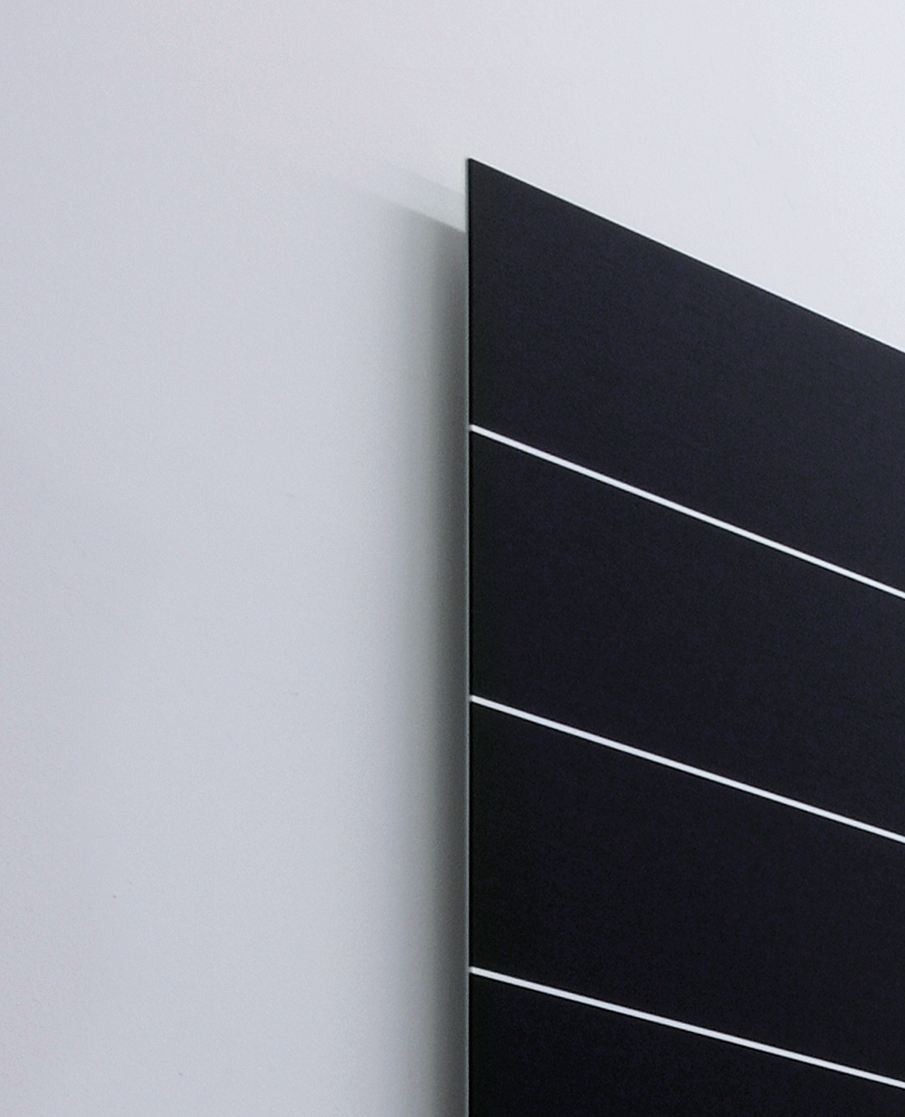
I began making pencil drawings on MDF panels in 1994, after working mainly on paper or directly onto walls. I was looking for a stable, flat and strong material, which could give me a harder surface to work on than paper. This was primarily in response to the fact that large format sheets of paper are very fragile, difficult to handle and required frames as support.
At the same time, I was looking for an everyday, humble and industrial material. Something that wasn’t common in the art-world or used by many artists. I wanted something that was known as a craftsmen’s material, used for building shelves or furniture.
To be able to handle these works without having to touch their fragile surfaces I designed a special handling-frame system as well as custom crates. The panels had a very interesting three-dimensional body to them and an intriguing almost object like character. I like the fact that these panels are distinctly removed from a ‘classic’ idea of a drawing.
The delicately drawn pencil surfaces on the face of the panel lend the works an appearance that tether on the edge of drawing, wall sculpture, and object. I want them to encompass all three of these almost contradictory qualities collectively.
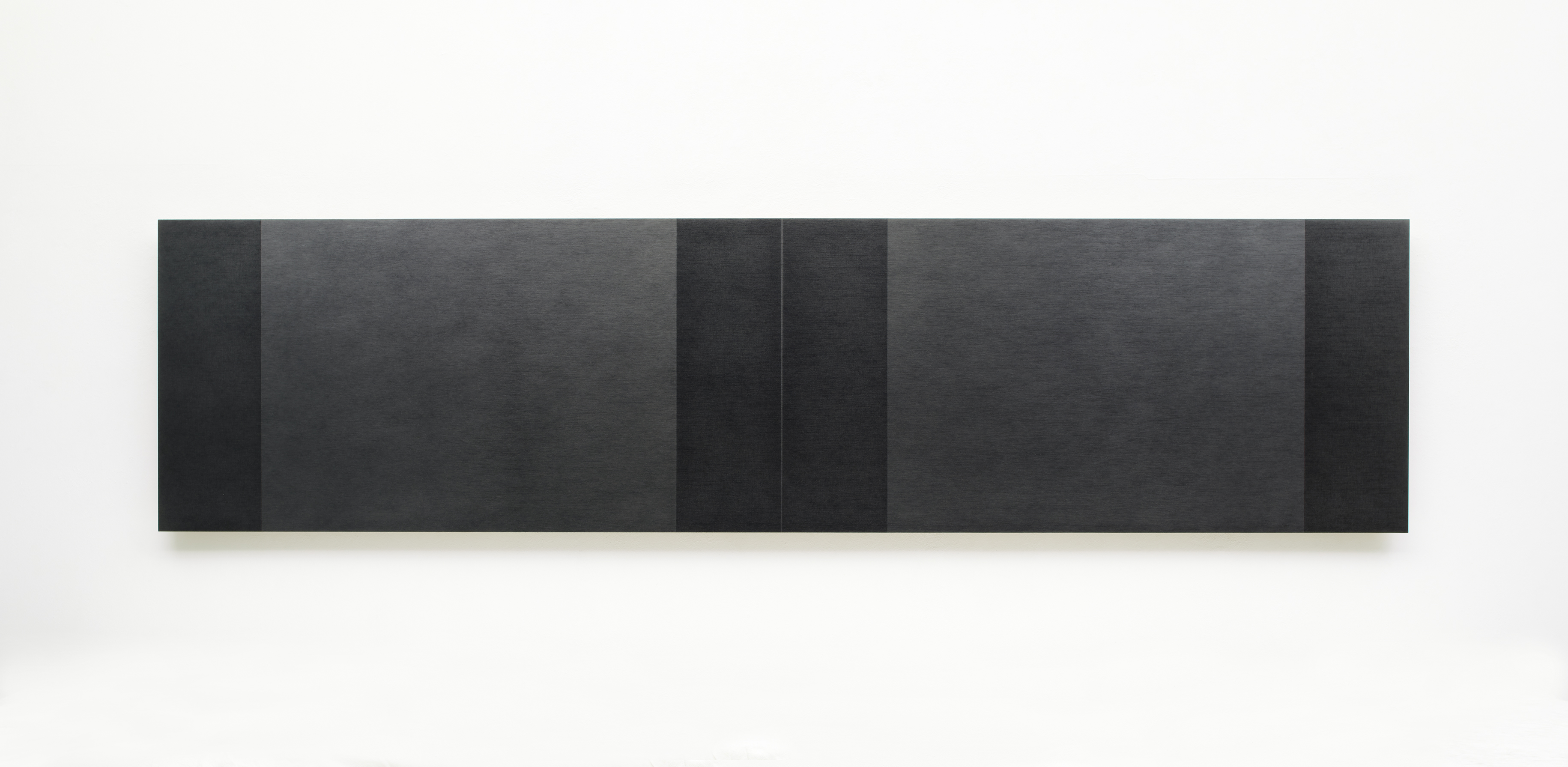
I use the pencil, by adding one layer over another, the surfaces tend to get shinier the more layers I add. This is the result of all the oil that is compressed inside the pencil’s graphite. In turn, the surface of these pieces become almost like mirrors, reflecting the surrounding outside world inside the surfaces of my works. This means, each piece performs like a projecting screen as they reflect colours and forms into the surfaces of the works .... a projecting screen to reflect the world!
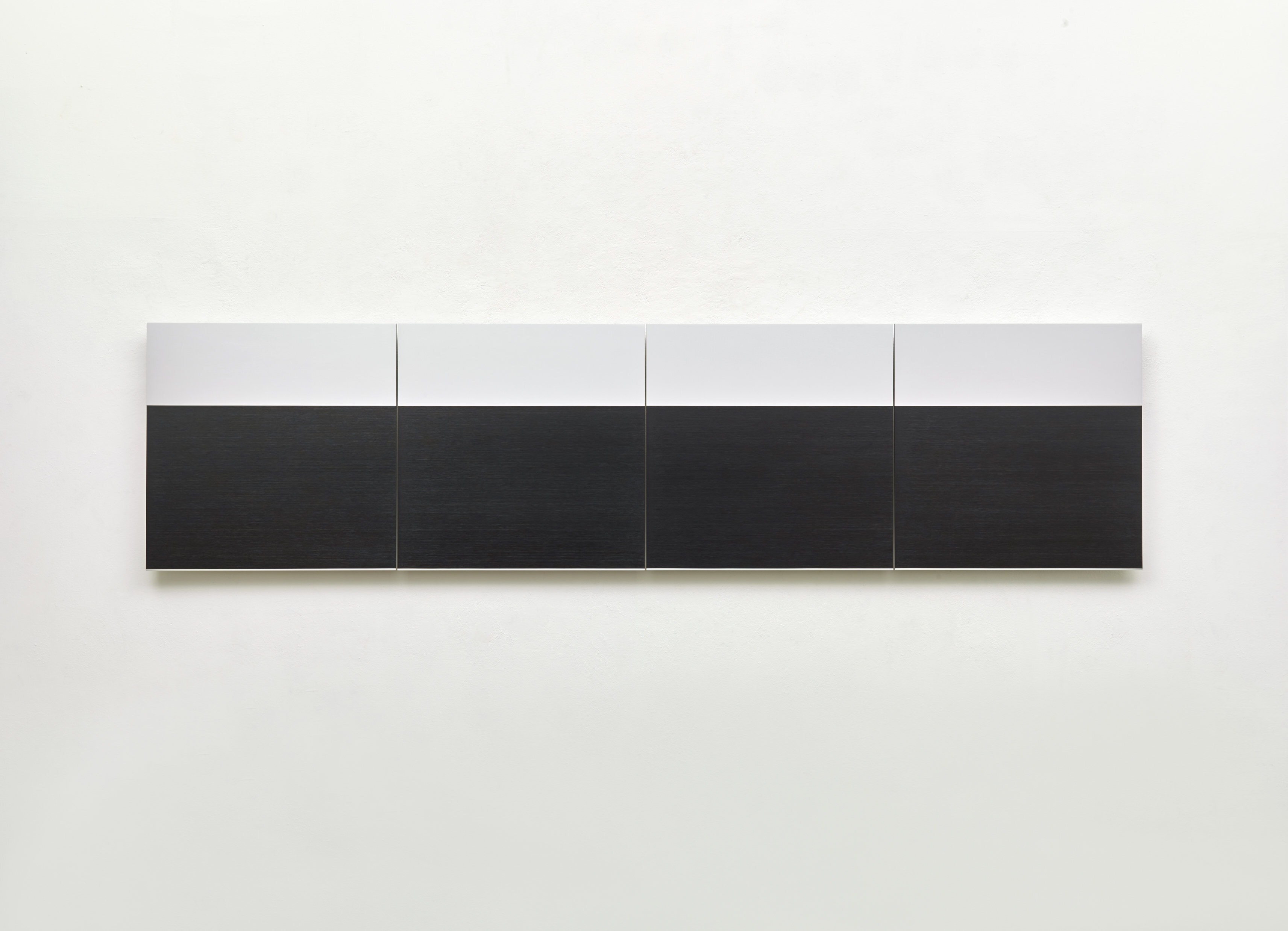
Temporary Ground. Territory. (The Sleeper), 2015, a four part aluminium work, is site-specific in the sense that it was created and done for this exhibition, it is installed at the Sleeper Art Space, located in the centre of Edinburgh. It is a highly artificial space, built and designed by Neil Gillespie in 2000, a partner of Reiach and Hall Architects. ‘Sleeper’ is located within the architect’s studio building.
Since its inception in 2000, ‘Sleeper’ has been run in close collaboration with Alan Johnston. The programme predominantly features international artists, who have shown a wide variety of projects at the space. I was inspired by the works of the artists that exhibited there before me.
The work which I created for this exhibition is drawn with paint-stick directly onto four anodised aluminium panels. The upper third of each panel reveal’s the pure silver, anodised section of the support, while the bottom two-thirds are overlaid with black paint-stick (oil & wax based). The black part doesn’t run all the way down to the lower edge of the panel. It stops short exactly 4 mm above the bottom edge.
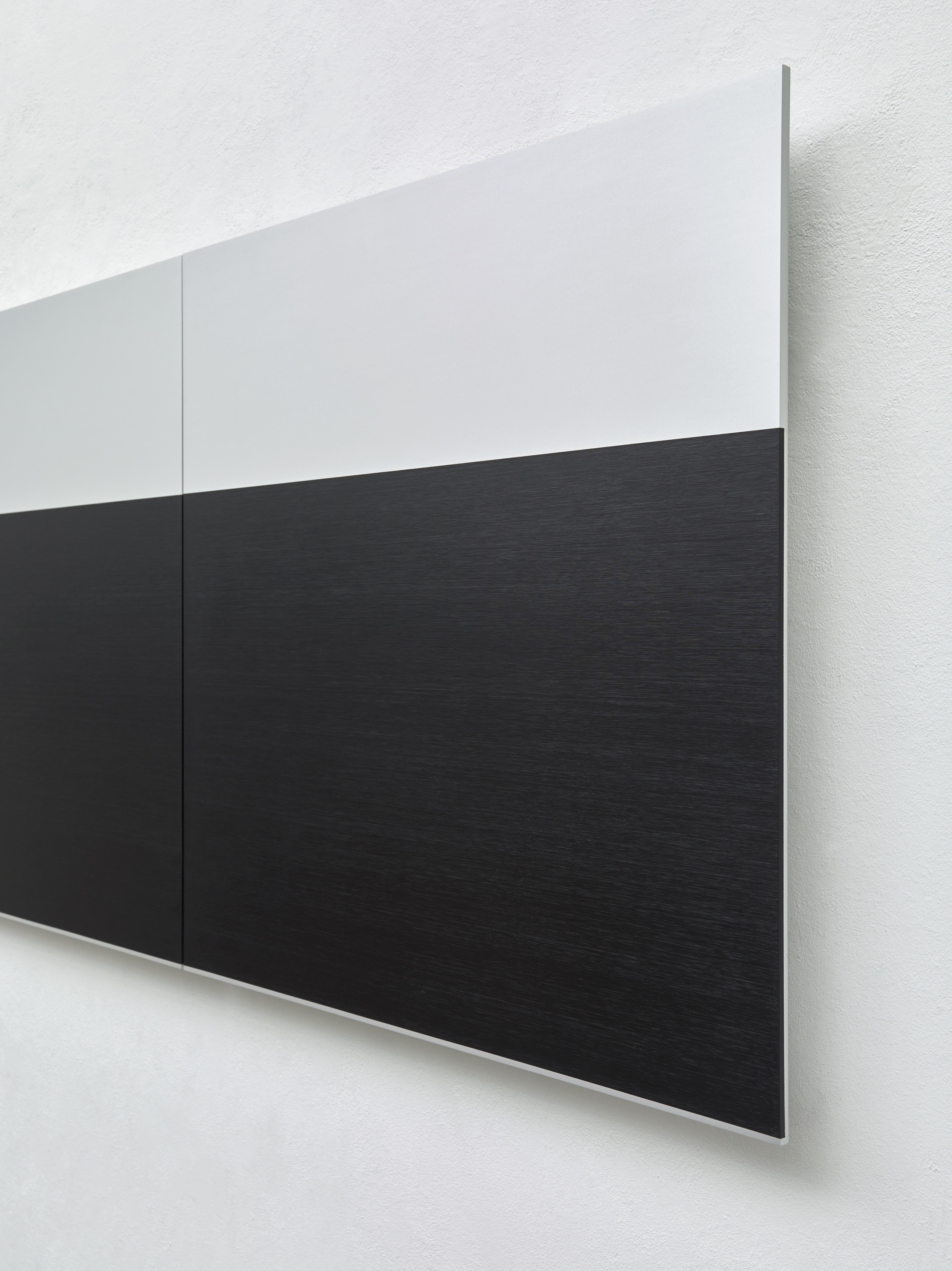
Furthermore, the black paint-stick is drawn half way around the edges of the 8mm thick panels, leaving the 4mm line of anodised aluminium exposed, allowing you to see the silver of the panels sides, too. The silver line is connected both with the 4 mm line along the bottom and the field that makes up the top section.
The distance between the panels themselves is precisely 4 mm, as you approach the work your eyes are drawn across all four panels, to back and sides and up towards the lighter top section. Then around the panels, jumping over the 4 mm gap to the next panel, to the next and so on. I hope the experience is a real tour de force, at first, the work appears simple but as you approach it, it reveals all its intricacies.
Of course, these details and the way I articulate the composition of the work also shows my continued interest in the 3rd dimension.
For a museum survey at the Weserburg in 2008, you also created a new wall drawing especially for that exhibition. That wall drawing referenced an experience you had in your youth when you played in a Punk band in Hamburg. Can you tell me about this work?
The wall drawing conceived for my show at the Museum in Bremen is entitled Lowdown. The title refers to one of my all-time favourite songs by the band ‘Wire’. I first heard it on a live recording made at the Roxy in London during the spring of 1977 and later the studio version, which appeared on their first album Pink Flag.
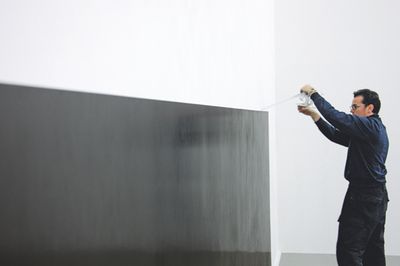
Lowdown was installed in the first space leading into my mid-career retrospective, on the wall opposite to the entrance. The work is the largest wall drawing I have ever made, executed with pencils directly onto the museum wall. The piece is still on the wall to this day. The dimensions of the drawing itself are 160 x 900 cm, positioned on a 600 x 1200 cm wall. The work reacts like an enormous projecting screen. You can see the entire room and all the visitors surrounding you in it. Like its origin, the work can be read as a stage. —[O]
A respected voice in contemporary art discourse.
Focusing on ambitious storytelling and insightful art-world commentary. Ocula Magazine publishes in-depth interviews, critical essays and timely analysis on the artists, exhibitions and ideas driving the global art world.
Learn more about Ocula Magazine
Showcasing the best of the art world.
Ocula partners with galleries from around the world to highlight their artists, artworks and exhibitions. Gallery membership is by application and invitation, with each member vetted by an independent panel.
Learn more about Ocula Membership
Specialises in the sale of major artworks.
Led by a team with deep ties to the world’s leading auction houses, galleries and collectors. Ocula’s advisory team offers bespoke services to high-net-worth clients from around the world who are looking to acquire the best of contemporary and modern art.
Learn more about our team and services