





DAVID SALLE
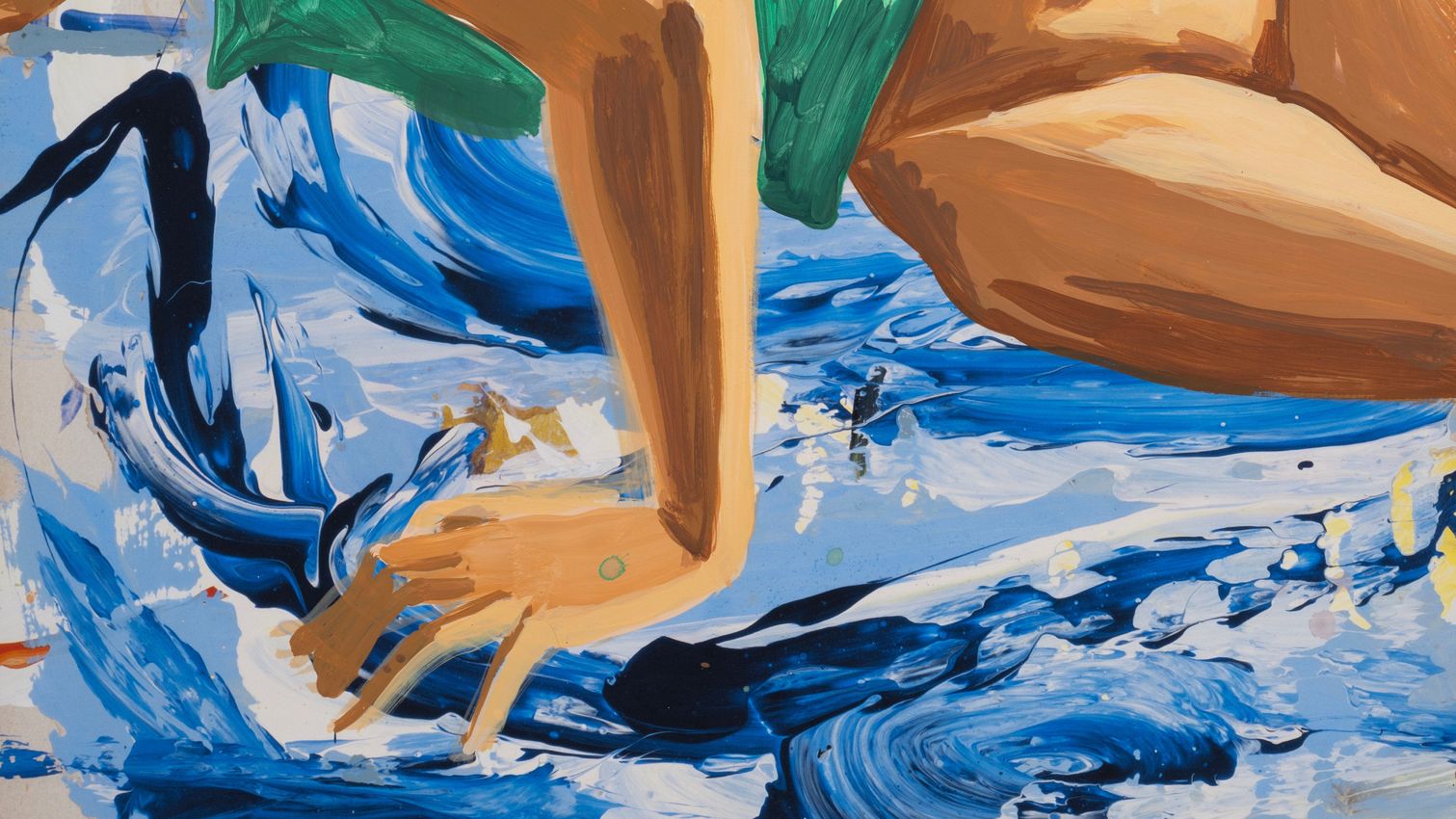
b. 1952, United StatesBlending painterly virtuosity with postmodern wit, David Salle is a pioneering American artist known for juxtaposing eclectic imagery in layered compositions that interrogate the language of painting itself.
Early Years
David Salle was born in 1952 in Norman, Oklahoma, and raised in Wichita, Kansas. He studied at the California Institute of the Arts (CalArts) in the early 1970s under conceptualist John Baldessari, graduating with a BFA and MFA. This formative period immersed him in performance, structuralist film, and post-conceptual theory—disciplines that continue to inform his multifaceted approach to contemporary art.
Salle moved to New York City in 1976, where he quickly became a central figure in the city’s downtown art scene. His early exhibitions at Mary Boone Gallery positioned him at the forefront of the Pictures Generation, alongside artists such as Cindy Sherman and Richard Prince. He currently lives and works in Brooklyn, New York.
David Salle Artworks
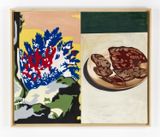
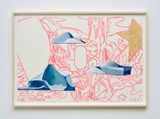
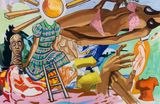
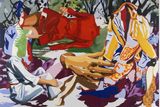
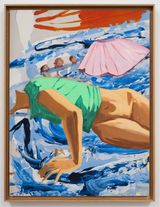
David Salle’s artworks are defined by their densely layered compositions, which fuse figurative painting with collage-like methods of visual sampling. He recontextualises fragments of art history, mass media, and advertising, often overlaying unrelated images to create an intentionally dissonant aesthetic.
Early Collage Paintings
David Salle’s early paintings from the late 1970s and early 1980s were groundbreaking in their fusion of eclectic references and layered compositions. Often working on large canvases, he juxtaposed photorealistic female nudes with fragments of text, furniture silhouettes, or elements drawn from advertising and classical art. These works—such as Gericault’s Arm (1980) and Sextant in Dogtown (1987)—epitomise his strategy of combining the sensual with the cerebral, inviting both attraction and alienation. The visual disjunctions recall collage, but painted with a refined, often muted palette. Salle’s practice from this period helped shape the postmodern discourse around image-making and authorship in art.
Interplay of Image and Style
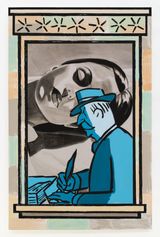
In the 1990s and 2000s, Salle developed an increasingly expansive and colourful visual language. His paintings began to feature more rhythmic arrangements of images, formal balance, and calligraphic linework, echoing both Art Nouveau and comic book aesthetics. He experimented with a broader range of colour and tone, using blocks of vivid pigment alongside monochrome passages. Series like The Tapestries saw him reworking previous motifs, creating visual echoes and recursive structures within his practice. Though still concerned with juxtaposition and interruption, these later paintings feel more orchestrated than chaotic—reflecting a mature artist in full command of his stylistic range and visual archive.
Recent Developments
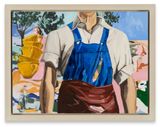
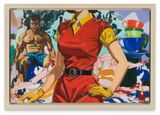
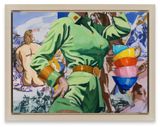
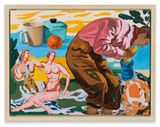
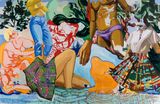
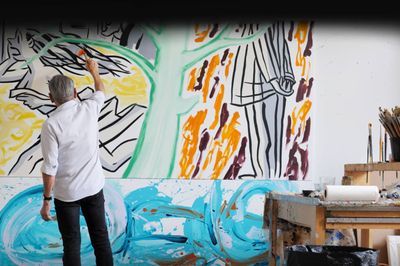
Salle’s recent paintings revisit the strategies of fragmentation and image layering with renewed complexity and fluency. In works from his “Tree of Life” series, exhibited at Thaddaeus Ropac and Skarstedt, the artist arranges figures and motifs into loosely gridded compositions that suggest theatrical sets or narrative frames. Female figures, taken from 1950s pulp illustration and pin-up culture, frequently appear, painted with loose, gestural brushstrokes. These are juxtaposed with areas of hard-edge abstraction, gestural splashes, and graphic overlays. The paintings hum with tension between seduction and critique, visual pleasure and historical weight. Salle’s art continues to probe how meaning is constructed—and disrupted—through painting.
David Salle Exhibitions
David Salle has been the subject of both solo exhibitions and group exhibitions at important institutions. A selection of important exhibitions are provided below. In 2026, Spruth Magers will present a solo exhibition of David Salle’s paintings.
Solo Exhibitions
- A Well-leafed Tree Remixed, Times Square Arts, New York (2024)
- DAVID SALLE: NEW WORKS ON PAPER, Edward Hopper House Museum & Study Center, Nyack (2024)
- David Salle, Brant Foundation, Greenwich (2021)
- Inspired by True-Life Events, Centro de Arte Contemporáneo de Málaga (CAC Malaga), Málaga (2016)
- America Is Hard to See, Whitney Museum of American Art, New York (2015)
- Debris, Dallas Contemporary, Dallas (2015)
- Retrospective, Stedelijk Museum, Amsterdam, Netherlands. Travelled to Museum Moderner Kunst Stiftung Ludwig, Vienna, Austria; Museo d’Arte Contemporanea Castello di Rivoli, Turin, Italy; Guggenheim Museum, Bilbao, Spain (1999)
Group Exhibitions
- Infinite Scroll, The Ranch, Montauk (2022)
- Every Picture Tells a Story, Parrish Art Museum, Water Mill (2018)
- Before/On/After: William Wegman and California Conceptualism, Metropolitan Museum of Art, New York (2018)
- America! America! How Real is Real?, Museum Frieder Burda, Baden-Baden, Germany (2017)
- Zeitgeist, Museum of Modern and Contemporary Art Geneva, Geneva (2017)
- Fast Forward: Paintings from the 1980s, Whitney Museum of American Art, New York (2017)
- The Pictures Generation, 1974 - 1984, Metropolitan Museum of Art, New York (2009)
- Not for Sale, MoMA PS1, New York (2007)
David Salle Website and Instagram
David Salle’s website can be found here, and his Instagram here.
Critical Reception
David Salle’s art has been the subject of numerous critical essays and reviews in leading art publications, including Artnet News, Interview Magazine, and The Guardian.
David Salle FAQs
Who is David Salle?
David Salle is a leading American postmodern painter known for layered, collage-like canvases that combine disparate images, styles, and references from art history and mass media.
What is David Salle’s process?
David Salle’s process often begins with collecting photographs, magazine images, drawings, and art-historical references, which David Salle arranges into layered compositions that function like visual montage. David Salle then combines different painting techniques—such as contour drawing, grisaille, flat colour, and more polished passages—so that styles and images collide rather than resolve into a single narrative.
Where can I see David Salle’s art?
David Salle’s art can be seen in major museum collections including The Museum of Modern Art, the Metropolitan Museum of Art, the Whitney Museum of American Art, and the Solomon R. Guggenheim Museum in New York. David Salle is also represented in international institutions such as Tate Modern in London, Centre Pompidou in Paris, the Stedelijk Museum in Amsterdam, and the National Gallery of Art in Washington, D.C. You can follow the artist on Ocula to find out about future exhibitions and about art for sale.
What is David Salle known for?
David Salle is best known for his visually complex paintings that layer disparate images, styles, and references within a single composition. He rose to prominence in the 1980s as a leading figure of postmodernism and the Pictures Generation. His works often juxtapose photorealistic nudes, cartoonish line drawings, and abstract motifs, creating a visual language of contradiction and ambiguity. Salle’s art challenges traditional notions of authorship, meaning, and coherence, making him a key voice in contemporary American painting.
How does David Salle relate to the Pictures Generation?
David Salle is closely associated with the Pictures Generation—a group of artists who emerged in the late 1970s and 1980s exploring appropriation and the influence of mass media. While many of his peers, like Cindy Sherman and Richard Prince, worked primarily with photography, Salle translated similar concerns into the medium of painting. His use of found imagery, fragmentation, and repetition links him to this conceptual lineage, though his painterly sensibility and classical training give his work a distinctive formal richness.
Is David Salle also a writer?
Yes, David Salle is a respected writer and critic as well as an artist. His 2016 book How to See: Looking, Talking, and Thinking About Art compiles essays on artists including John Baldessari, Jeff Koons, and Dana Schutz. Known for his sharp yet accessible prose, Salle offers valuable insight into contemporary art and the viewing experience. His writings regularly appear in The New York Review of Books and other publications, establishing him as a rare artist equally adept in both visual and verbal critique.
Ocula | 2026


View David Salle's Artworks

























Explore and Follow Artists Shaping Contemporary Art
A respected voice in contemporary art discourse.
Focusing on ambitious storytelling and insightful art-world commentary. Ocula Magazine publishes in-depth interviews, critical essays and timely analysis on the artists, exhibitions and ideas driving the global art world.
Learn more about Ocula Magazine
Showcasing the best of the art world.
Ocula partners with galleries from around the world to highlight their artists, artworks and exhibitions. Gallery membership is by application and invitation, with each member vetted by an independent panel.
Learn more about Ocula Membership
Specialises in the sale of major artworks.
Led by a team with deep ties to the world’s leading auction houses, galleries and collectors. Ocula’s advisory team offers bespoke services to high-net-worth clients from around the world who are looking to acquire the best of contemporary and modern art.
Learn more about our team and services