




JOAN MIRÓ
1893-1983, SpainJoan Miró i Ferrà—better known as Joan Miró—was a Catalan painter, sculptor and ceramicist whose inventive style was extremely influential in the development of avantgarde art. He remains one of the best-known artists of the 20th century.
Early Years
Born in Barcelona in 1893, Miró initially attended both business school and the Escola Superior d’Arts Industrials i Belles Arts in Barcelona. However, after his studies and while working as a clerk, he contracted typhoid fever, and after a period of convalescence, decided to focus on art-making.
From 1915 to 1919 Miró painted landscapes, portraits and nudes, largely at his family’s home on Majorca. During this period, he experimented with a range of influences including fauvism and cubism, and the works of Vincent van Gogh and Cézanne. While sampling from various sources, these paintings remain something uniquely Miró’s own, though with only a hint of the artist’s distinct visual style to come.
During the early stages of his career, Miró was attracted to the inclinations of subterfuge found in the Dada movement. In 1923, he began to transition to a visual language more explicitly composed of signs and increasingly separated from representation or reality. He joined the Surrealists in 1924 and would later be described by lead surrealist André Breton as ‘the most surrealist of us all’.
Joan Miró Artworks
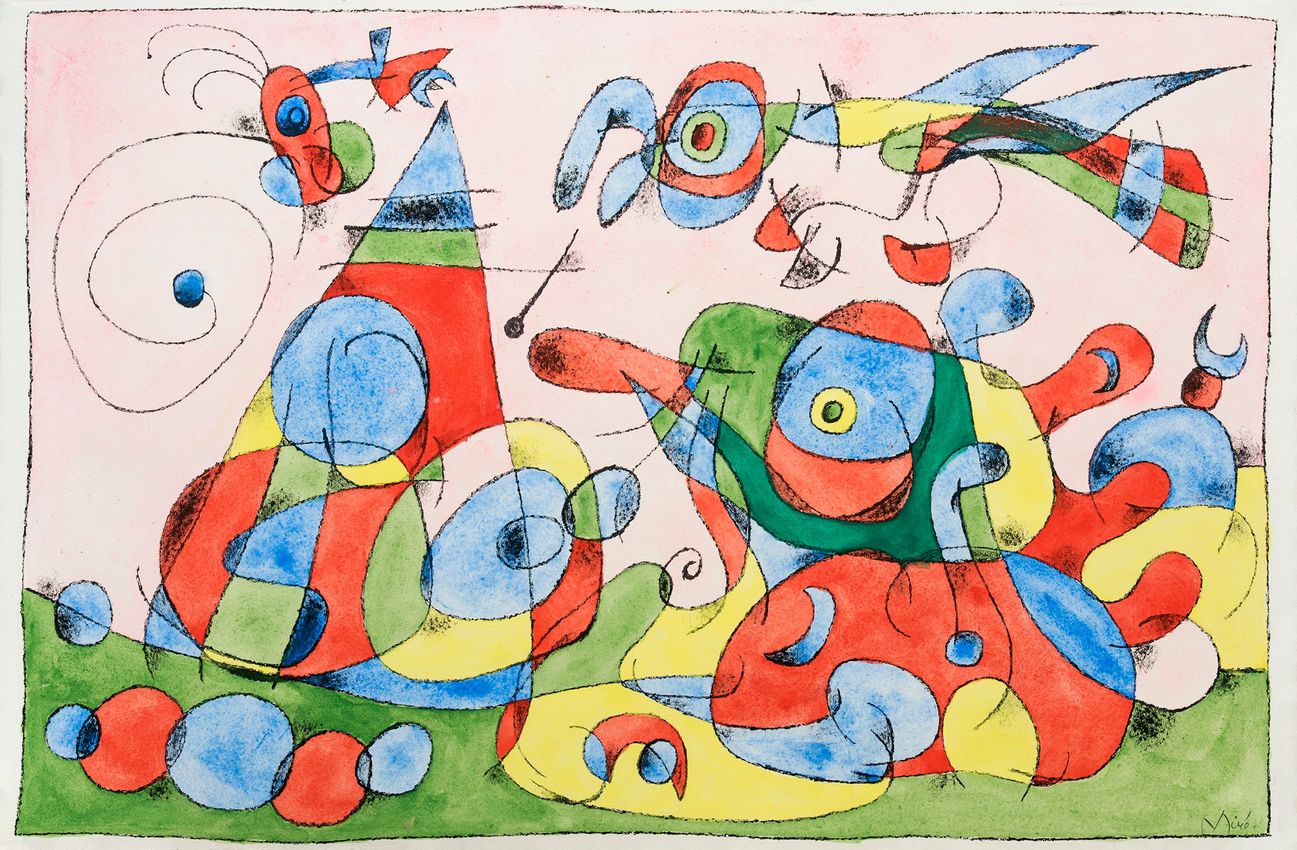
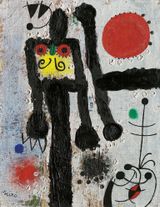
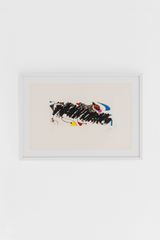
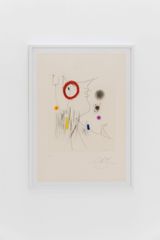
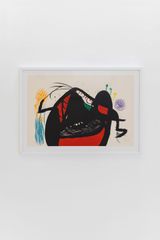
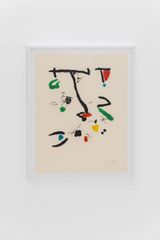
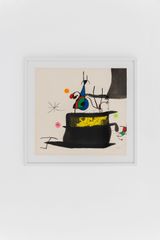
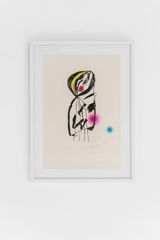
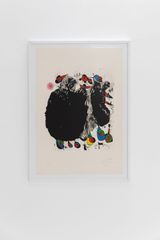
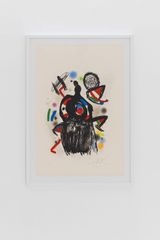
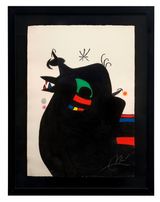
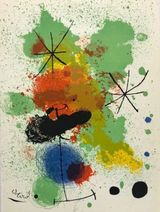
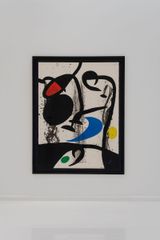
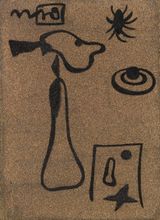
In Joan Miró’s art, the Catalan native, uses simple shapes and symbols to form a complex and novel visual grammar. This surreal, formally driven style features across paintings, drawings, etchings, ceramics and sculpture.
Escaping Convention
As well as a Surrealist, Miró was also a leader among the associated artists in explorations of the subconscious, particularly with automatic drawing. Most of his paintings began as automatic drawings in an attempt to escape the conventions of representation and the painting medium itself. Describing his 1925 painting The Birth of the World, Miró said ‘Rather than setting out to paint something I began painting and as I paint the picture begins to assert itself, or suggest itself under my brush ... The first stage is free, unconscious.’
In each of his works, Miró is highly selective of which formal features of the landscape to accentuate, and which to discard. A prime example of Miró’s poetic rendering of everyday scenes, The Hunter (Catalan Landscape) (1923–4) shows the Catalan landscape reduced into flattened planes. Minimal symbols represent the animals and vegetation; the titular hunter is a bare few set of lines against a flat pink representing the ground and a flat yellow sky.
The Dutch Interiors
In 1928, Miró visited the Netherlands and became interested in the Dutch masters. Bringing home a set of postcards from the Rijksmuseum in Amsterdam, he began a series of three paintings combining the Dutch regional style with his own unique visual vocabulary.
In Dutch Interior (I), a painting by Hendrick Martensz Sorgh is transitioned from an atmospheric image of a lute player performing for a woman to an energetic gathering of symbols across a flattened picture plane. Some aspects—such as the man’s collar—have been accentuated, while others—such as the woman at the table—have been diminished or replaced. In this series, Miró’s direct references to other images allow the audience to follow his path of inventive abstraction.
The Assassination of Painting
In the late 1920s, Miró became interested in the idea of the ‘assassination of painting’, within which he sought to escape or even destroy the traditions of bourgeois art and instead pursue more experimental forms. A work exemplary of this period, Painting (1936) was made with a mixture of gravel, sand and oil paint. The artist assured his dealer that rather than the work being ruined if some of the materials came loose when it was sent to an exhibition, the loss would ‘make the surface . . . look like an old crumbling wall, which will give great force to the formal expression.’
In this period, he also experimented in collage and sculptural assemblage, as well as making costumes for ballet.
Spanish Paintings
Throughout his entire career, Miró’s Spanish and Catalan nationalism remained a key influence on his work.
Ernest Hemingway, spoke highly of Miró’s Spanish pastoral painting The Farm (1921), which he purchased: ‘It has in it all that you feel about Spain when you are there and all that you feel when you are away and cannot go there. No one else has been able to paint these two very opposing things.’
During the Spanish Civil War, Miró was living in Paris. Deeply affected by the tragedy and tumult consuming his homeland, he was inspired to employ social criticism in his art. Works of this period also became more representational, such as in The Reaper—a mural for the Spanish Republic’s pavilion at the Paris World Exhibition of 1937 that showed a peasant revolt.
Sculpture
Miró was also known for his Surrealist sculptures.
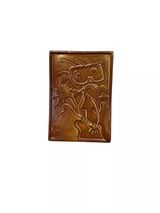
His earliest pieces were formed out of collections of found objects, such as Object (1936), whose media list is lengthy: ‘stuffed parrot on wood perch, stuffed silk stocking with velvet garter and doll’s paper shoe suspended in hollow wood frame, derby hat, hanging cork ball, celluloid fish and engraved map.’ In the mid-1940s he turned towards ceramics, for which he embraced the full materiality of clay, often making intentionally imperfect pieces.
Public Commissions
Throughout his life Miró produced many large-scale public sculptures throughout the world, in cities such as Paris, Chicago, Madrid and Barcelona (where the Fundació Joan Miró is also located). In 1958 Miró produced two murals for Paris’ UNESCO building, Wall of the Moon and Wall of the Sun (1958), Composed of brick-like tiles that together bring shape to a colourful set of symbols, including the titular moon, the murals received a Guggenheim International Award.
Exhibitions
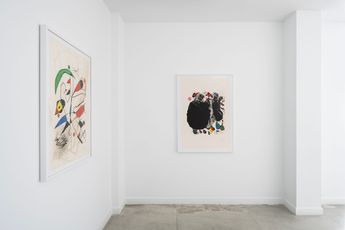
Joan Miró’s art has been exhibited widely around the world, in gallery and institutional group exhibtions and solo shows. The Fundació Joan Miró continues to promote the artist’s work in Spain and internationally.
Solo exhibitions include:
- Joan Miró. Poetry into Painting, Tokyo Metropolitan Art Museum, Tokyo (2025)
- Miró. La couleur de mes rêves, Grand Palais, Paris (2019)
- Joan Miró, 1917–1934: La Naissance du Monde, Centre Georges Pompidou, Paris (2004)
- Joan Miró: A Retrospective, Guggenheim, New York (1987)
- Joan Miró: Anys 20. Mutació de la Realitat, Fundació Joan Miró, Barcelona (1983), Joan Miró, Grand Palais, Paris (1974)
- Joan Miró, Tate Gallery, London (1964)
- Joan Miro, Musee National d’Art Moderne, Paris (1962)
- Joan Miró, Museum of Modern Art, New York (1941)
Group exhibitions include
- The Galerie Maeght and 20th Century Painters, The National Museum of Western Art, Tokyo (2018)
- Soldier, Spectre, Shaman, Museum of Modern Art, New York (2016)
- La Subversion des Images. Surrealism, Photographie, Film, Centre Georges Pompidou, Paris (2009)
- The Dada and Surrealist Word-Image, Los Angeles County Museum of Art (1989)
- Dada and Surrealism Reviewed, Hayward Gallery, London (1978)
- Le Surréalisme, 1922–1942, Musée des Arts Décoratifs, Paris (1972)
- Cubism and Abstract Art and Fantastic Art, Dada, Surrealism, Museum of Modern Art, New York (1936)
- L’exposition Surréaliste, Galerie Pierre Colle, Paris (1925)
Art Market
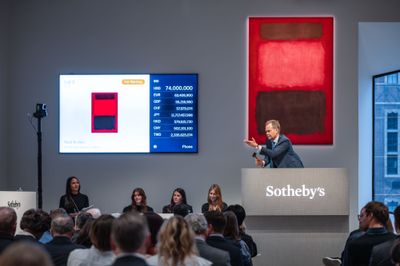
Joan Miró’s auction sales have fetched high prices. In 2012 Peinture (Étoile Bleue) (1927) exceeded the high estimate at Southeby’s, selling for over £23 million (US $31 million).
In 2018 Femme entendant de la musique (1945) greatly exceeded a high estimate of US $15 million, fetching well over US $21 million at Christie’s. One of Miró’s highest grossing works Femme et oiseaux (1940) sold for £24,571,250 (US $33 million) at Southeby’s in 2017.
Website
The Fundació Joan Miró website can be found here.
Joan Miró FAQs
Where can I see Joan Miró’s artworks?
Miró’s works are held in major public and private collections globally. In Spain, the Fundació Joan Miró in Barcelona and the Fundació Pilar i Joan Miró in Palma de Mallorca offer deep insights into his oeuvre. In Paris, visit the Centre Pompidou, holds key works from his Surrealist period, and in the United States, the Museum of Modern Art in New York and the Art Institute of Chicago regularly exhibit his paintings and prints.
What is distinctive about Joan Miró’s artistic style?
Miró developed a symbolic visual language combining abstraction, Surrealist automatism, and vivid colour. Over the decades, his use of simplified shapes, biomorphic forms, and playful line transformed into a style that resisted categorisation—moving fluidly between painting, sculpture, ceramics, and printmaking.
Did Joan Miró ever work on public art projects?
Yes. Miró completed several major public commissions. These include the ceramic mural for the UNESCO building in Paris (1958), the Dona i Ocell sculpture (1983) in Barcelona’s Parc Joan Miró, and a monumental tapestry for the World Trade Center in New York (1974–77), which was tragically destroyed on 11 September 2001.
Was Joan Miró politically active through his art?
While not overtly political in public statements, Miró’s work often carried symbolic resistance. During the Spanish Civil War and under Franco’s dictatorship, his artistic language became a form of coded dissent. His 1937 work Aidez l’Espagne was explicitly created as an anti-fascist poster to support the Spanish Republic.
What happened to Miró’s studio after his death?
Miró’s studio in Mallorca, preserved exactly as he left it, now forms part of the Fundació Pilar i Joan Miró a Mallorca, opened in 1992. Visitors can see his tools, sketches, and unfinished works, offering a rare glimpse into the working process of one of the 20th century’s most influential artists.
Ocula | 2025

View Joan Miró's Artworks




















Explore Joan Miró's Exhibitions








Joan Miró in Ocula Magazine









Explore and Follow Artists Shaping Contemporary Art
A respected voice in contemporary art discourse.
Focusing on ambitious storytelling and insightful art-world commentary. Ocula Magazine publishes in-depth interviews, critical essays and timely analysis on the artists, exhibitions and ideas driving the global art world.
Learn more about Ocula Magazine
Showcasing the best of the art world.
Ocula partners with galleries from around the world to highlight their artists, artworks and exhibitions. Gallery membership is by application and invitation, with each member vetted by an independent panel.
Learn more about Ocula Membership
Specialises in the sale of major artworks.
Led by a team with deep ties to the world’s leading auction houses, galleries and collectors. Ocula’s advisory team offers bespoke services to high-net-worth clients from around the world who are looking to acquire the best of contemporary and modern art.
Learn more about our team and services