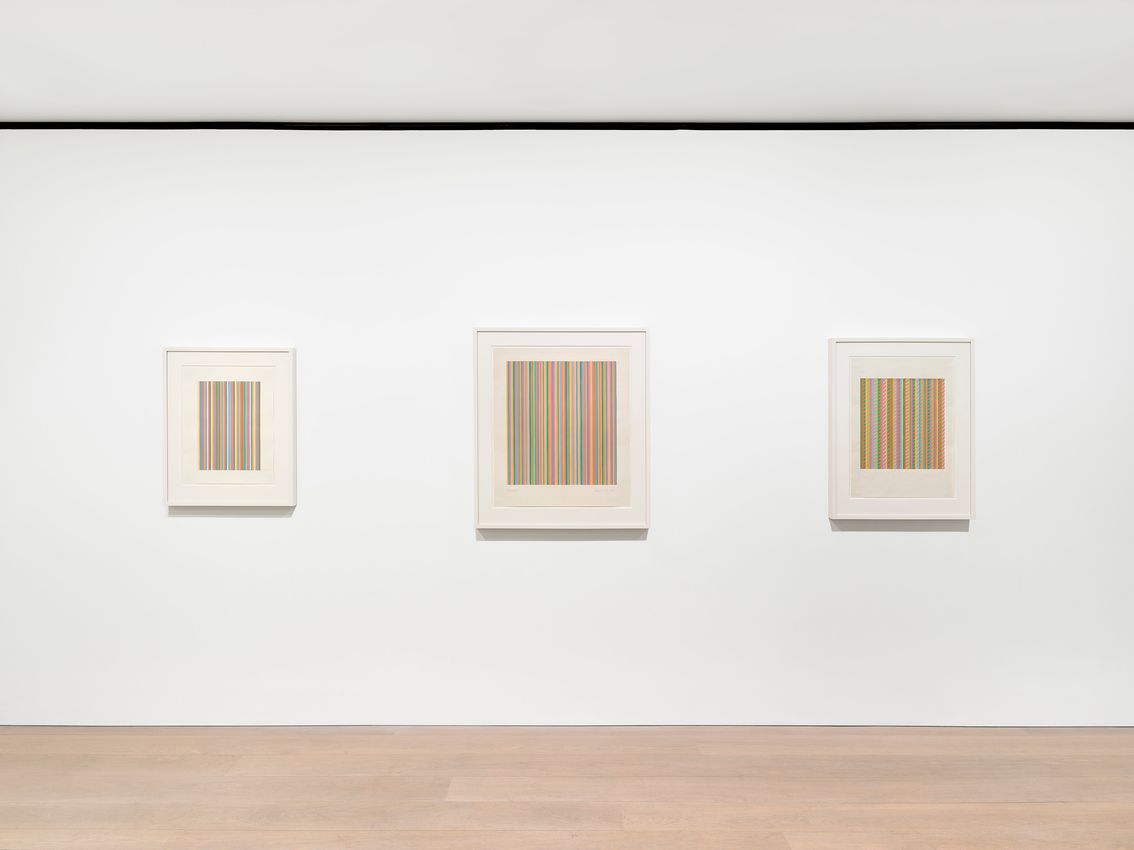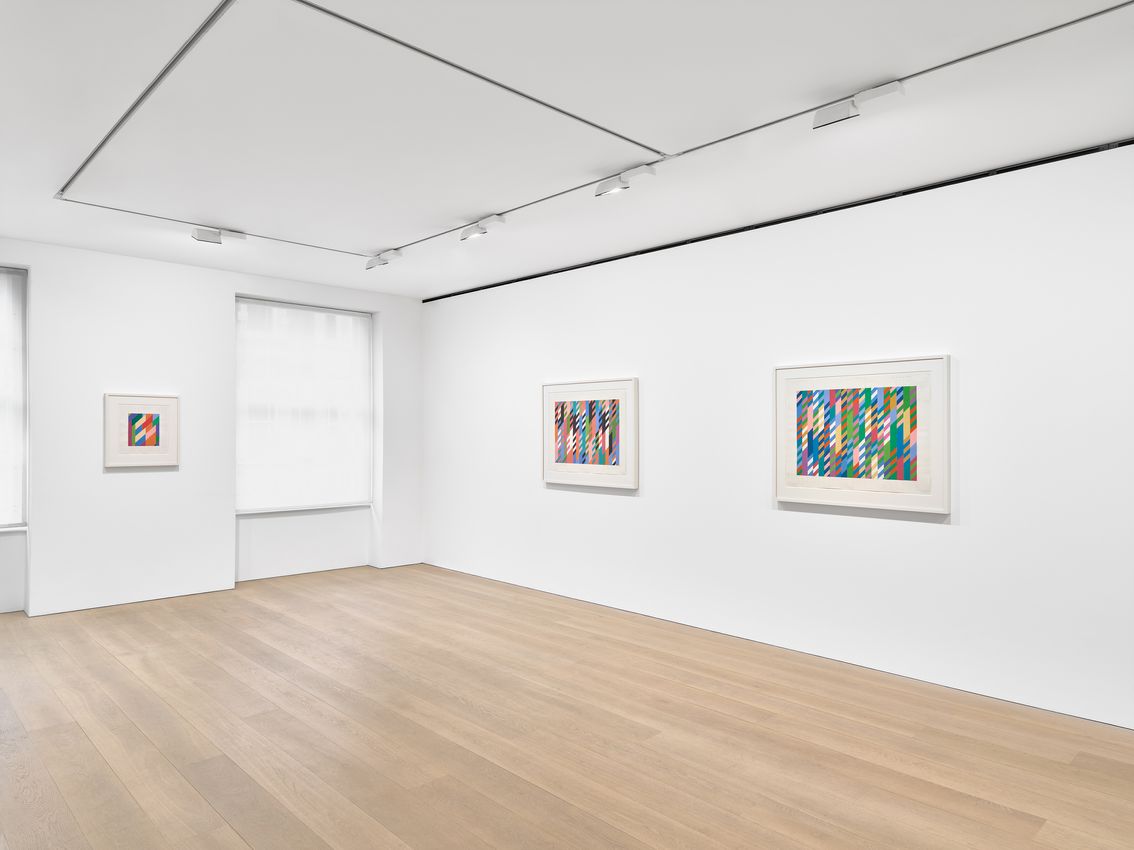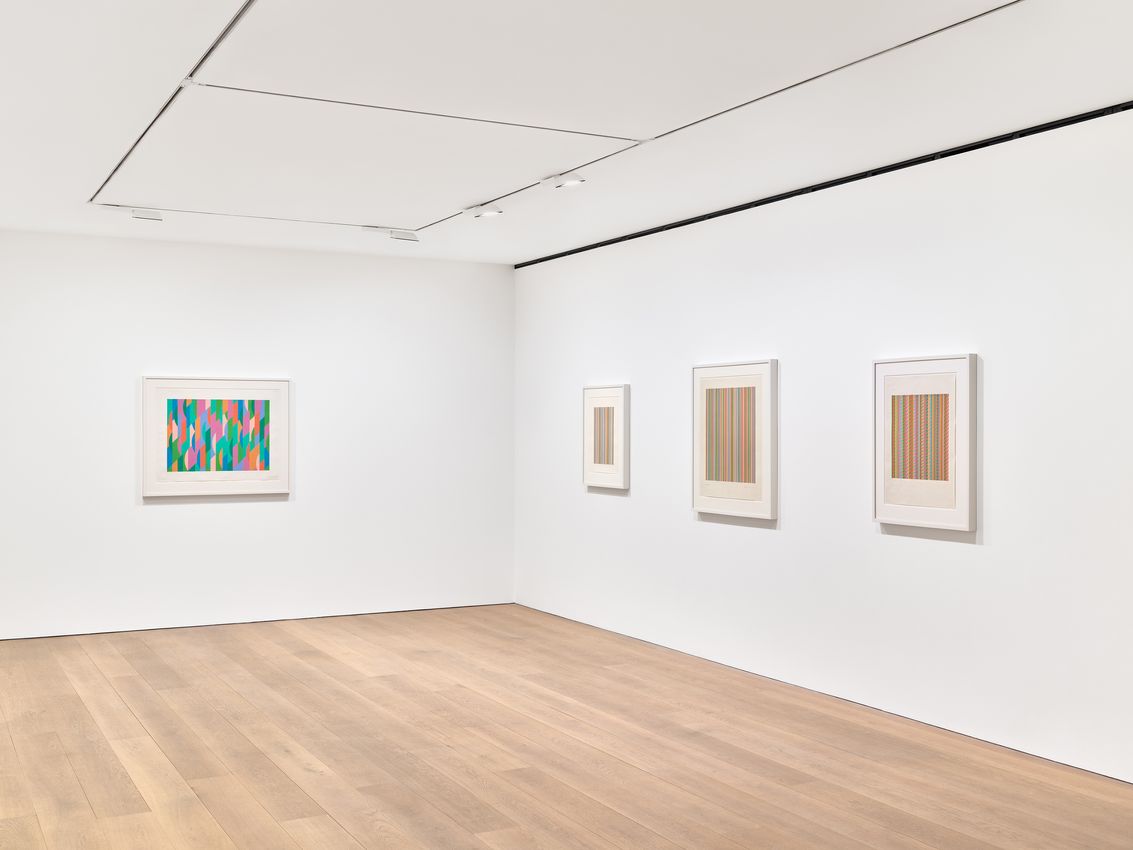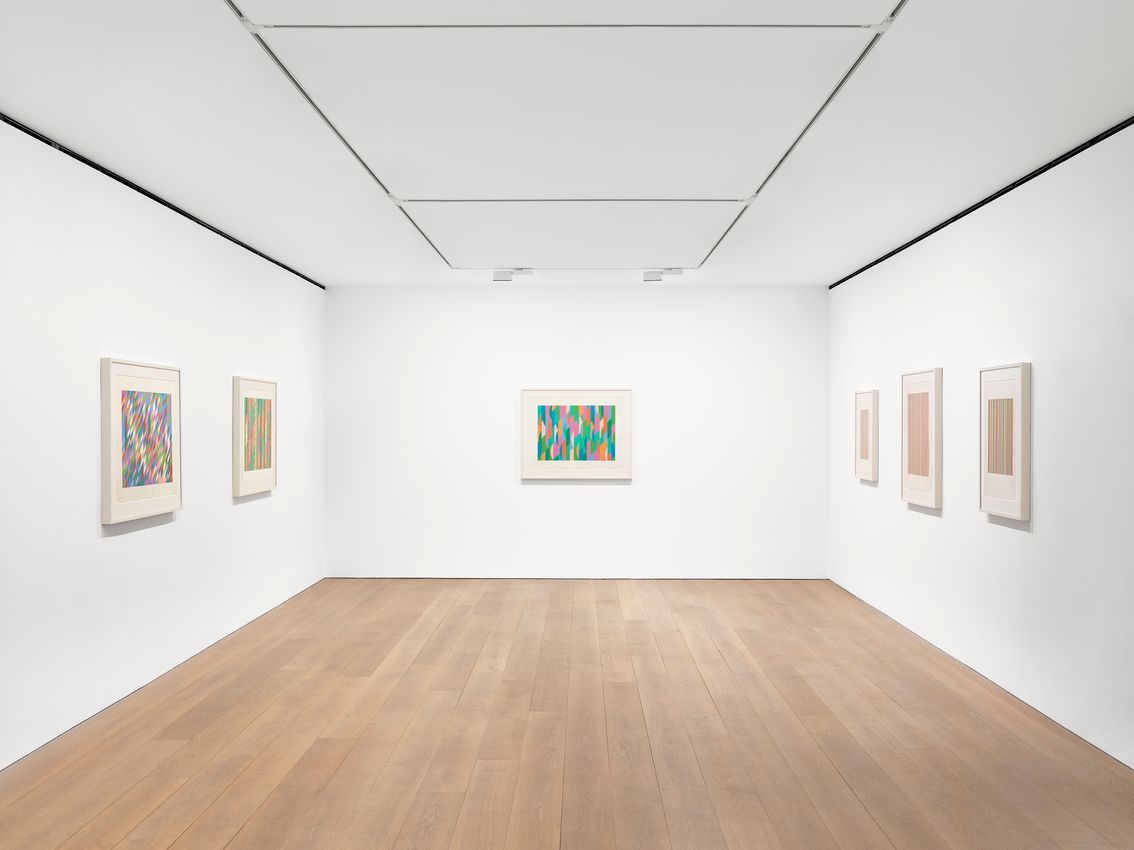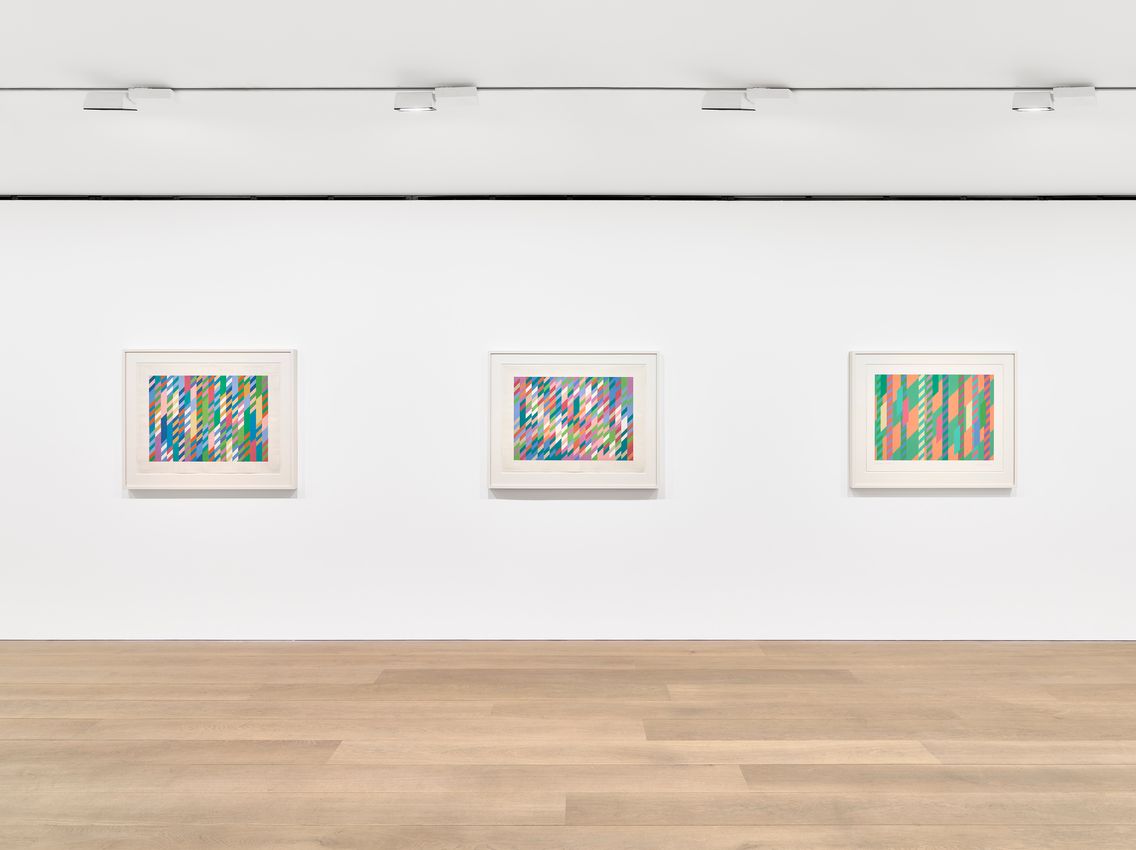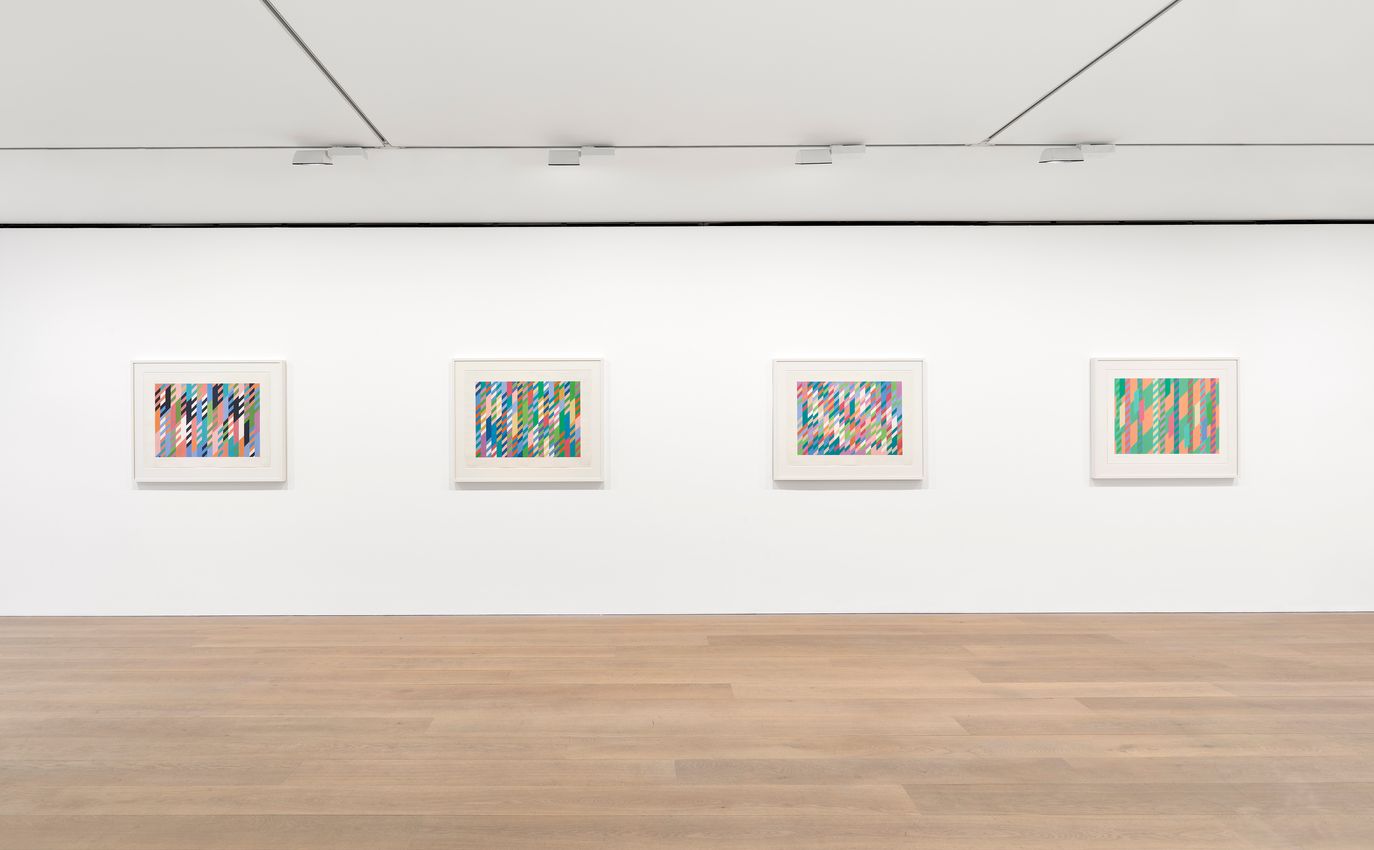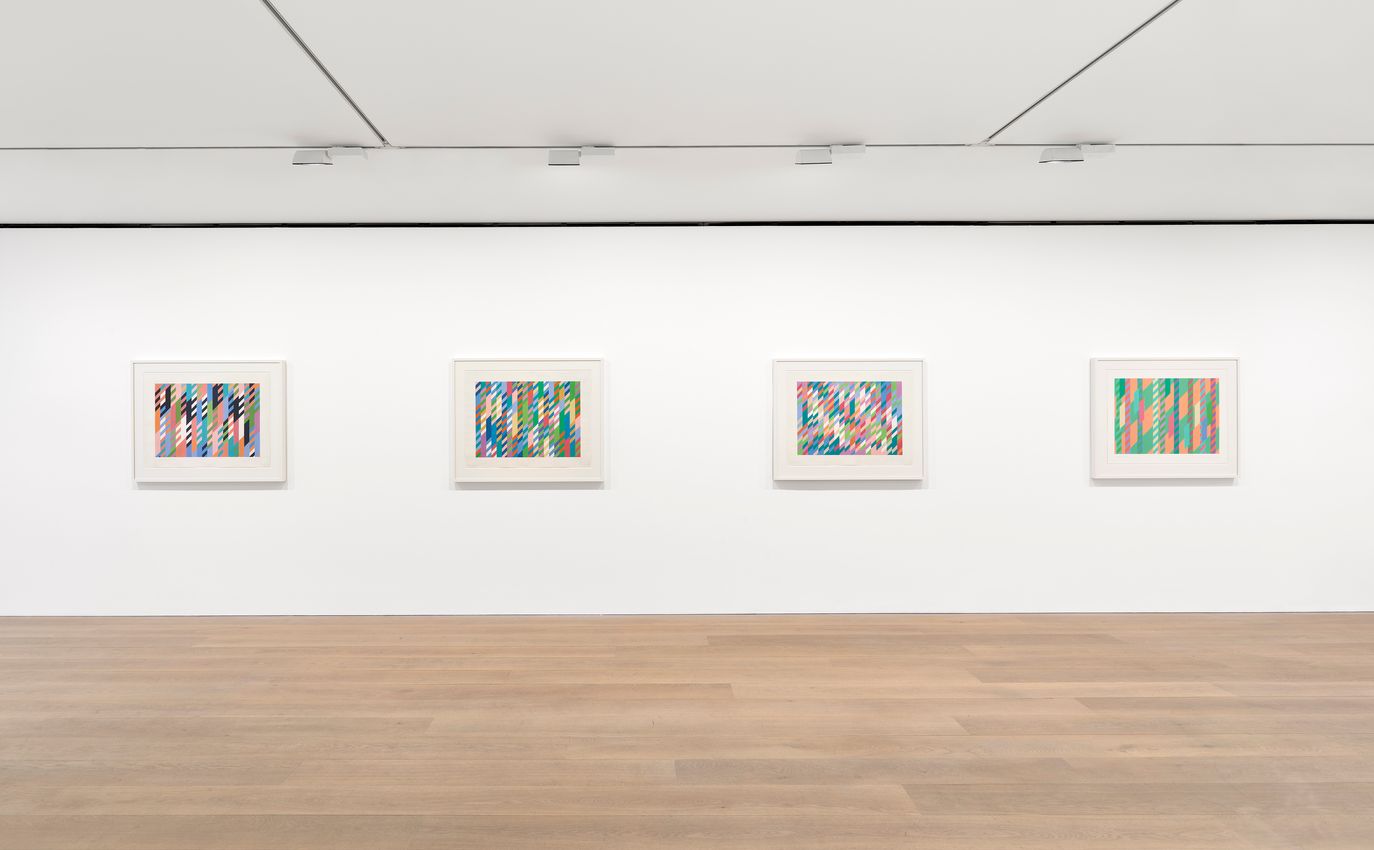
David Zwirner is pleased to present an exhibition of studies by Bridget Riley in The Upper Room in the London gallery. The artist has selected a group of works from the 1980s and 1990s that reflect the connection between the writings of Paul Klee (1879-1940) and her own understanding of abstract painting. As Riley has noted, ‘Paul Klee was of seminal importance to me because he showed me what abstraction meant.’1 Late works by the Bauhaus master will be on display concurrently on the ground and first floors.
On view in the exhibition will be working studies that show the movement from ‘stripes’ to ‘rhomboids.’ In the earliest of these works, Riley begins to cross her stripes with short diagonal elements, to move the eye around, across, and through the pictorial space, leading to the development of a new visual form, her ‘rhomboid’ paintings.
In 2002, Bridget Riley co-curated Paul Klee: The Nature of Creation at the Hayward Gallery, London, with Robert Kudielka. As Riley wrote in the catalogue published on the occasion of the exhibition, ‘Klee is unique in that he demonstrated more fully [than his contemporaries] that the elements of painting are not just a means to an end, but have distinct characteristics of their own...A colour in a painting is no longer the colour of something but a hue and a tone either contrasting with other hues and tones or related in shade and gradations. And, very importantly, forms do not act as substitutes for bodies in physical space but are spatial agents in the picture plane.’2
The rhomboid paintings, for which these studies were prepared, constituted a new learning phase for Riley. When they were first exhibited, some thought that the rhomboids were painterly strokes, enlarged and formalised, deriving once again from Georges Seurat, and there was a certain truth in this observation. The integration of these forms was a very conscious effort by the artist to rediscover pictorial craftsmanship and to increase the means at her disposal. Seen together, these works embody Riley’s powers of invention-and even reinvention-and her ongoing engagement with the understanding of abstract painting.
Bridget Riley was born in 1931 in London, where she attended Goldsmiths College from 1949 to 1952 and the Royal College of Art from 1952 to 1955.
Riley’s first solo exhibitions were held at Gallery One, London, in 1962 and 1963, followed by two exhibitions at Robert Fraser Gallery, London, in 1966 and 1967. In 1968, she represented Great Britain at the 34th Venice Biennale (along with Phillip King), where she was the first living British painter to win the prestigious International Prize for Painting. Her first retrospective, covering the period from 1961 to 1970, opened at the Kunstverein Hannover in 1971 and subsequently travelled to Kunsthalle Bern; Kunsthalle Düsseldorf; Galleria Civica d’Arte Moderna, Turin; and the Hayward Gallery, London.
More recent significant solo presentations include those at Dia Center for the Arts, New York (2000-2001); Museum of Contemporary Art Australia, Sydney (2004-2005); Musée d’Art Moderne de la Ville de Paris (2008); Walker Art Gallery, Liverpool (travelled to Birmingham Museums and Art Gallery; Norwich Castle Museum and Art Gallery; Southampton City Art Gallery; 2009-2010); The National Gallery, London (2010-2011); Art Institute of Chicago (2014-2015); The Courtauld Gallery, London (2015); De La Warr Pavilion, Bexhill on Sea, England; Christchurch Art Gallery, New Zealand (2017); the Kawamura Memorial DIC Museum of Art, Sakura, Japan (2018); and the National Galleries of Scotland, Edinburgh (travelled to the Hayward Gallery, London, 2019-2020). David Zwirner has worked with Riley since 2014.
1 Bridget Riley, ‘Making Visible,’ in Riley and Robert Kudielka, Paul Klee: The Nature of Creation. Exh. cat. (London: Hayward Gallery, 2002), p. 15.
2 Riley, ‘Making Visible,’ p. 16.
One of the most significant artists working today, Bridget Riley’s dedication to the interaction of form and color has led to a continued exploration of perception. From the early 1960s, she has used elementary shapes such as lines, circles, curves, and squares to create visual experiences that actively engage the viewer, at times triggering optical sensations of vibration and movement. Her earliest black-and-white compositions offer impressions of several other pigments, while ensuing, multi-chromatic works present color as an active component. Although abstract, her practice is closely linked with nature, which she understands to be “the dynamism of visual forces—an event rather than an appearance.”


A respected voice in contemporary art discourse.
Focusing on ambitious storytelling and insightful art-world commentary. Ocula Magazine publishes in-depth interviews, critical essays and timely analysis on the artists, exhibitions and ideas driving the global art world.
Learn more about Ocula Magazine
Showcasing the best of the art world.
Ocula partners with galleries from around the world to highlight their artists, artworks and exhibitions. Gallery membership is by application and invitation, with each member vetted by an independent panel.
Learn more about Ocula Membership

Specialises in the sale of major artworks.
Led by a team with deep ties to the world’s leading auction houses, galleries and collectors. Ocula’s advisory team offers bespoke services to high-net-worth clients from around the world who are looking to acquire the best of contemporary and modern art.
Learn more about our team and services